AI Overview Optimization: What Actually Changes
Google ranks first for "AI Overview optimization" and says no special optimization exists. What the docs state, what the studies measured, what nobody tested.
Citon42 min read
Short answer
Is there a separate way to optimize for Google AI Overviews?
Not according to Google. Its own guidance states that there are no additional requirements to appear in AI Overviews or AI Mode and no other special optimizations necessary, and that optimizing for generative AI search is still SEO, because the features run on core Search ranking and quality systems. One real eligibility requirement does exist and it is administrative rather than editorial: since 2026-08-31 a Search Console control decides whether a site is included in Search generative AI features at all. Beyond that, the strongest tested correlate of being cited is organic rank position, and the only controlled experiment on structured data returns a null result.
The page ranking first in the United States for the phrase ai overview optimization is published by Google, and it tells you that AI Overview optimization is not a thing.
We read the live top ten for that term on 2026-09-10, along with the top ten for google ai overview seo, how to optimize for ai overviews and ai overview citations. That is 40 organic results. Google's own documentation holds position 1 on three of those four queries. A practitioner thread asking the question holds position 2 on the same three. Everything from position 3 down is a strategy listicle, and five of the eight are numbered: seven strategies, seven top strategies, ten tips.
Not one of the 40 reports a measured before-and-after against a control.
There is one more detail in that SERP worth pausing on. The result at position 2, on three of the four queries, is a practitioner thread asking how to optimize for AI Overviews. Google is ranking the question above nine pages that answer it.
That is the gap this post fills, and filling it turns out to be less about finding a better technique than about reading two things carefully: what Google actually writes down, and what the studies everybody quotes actually counted.
The 30-second answer
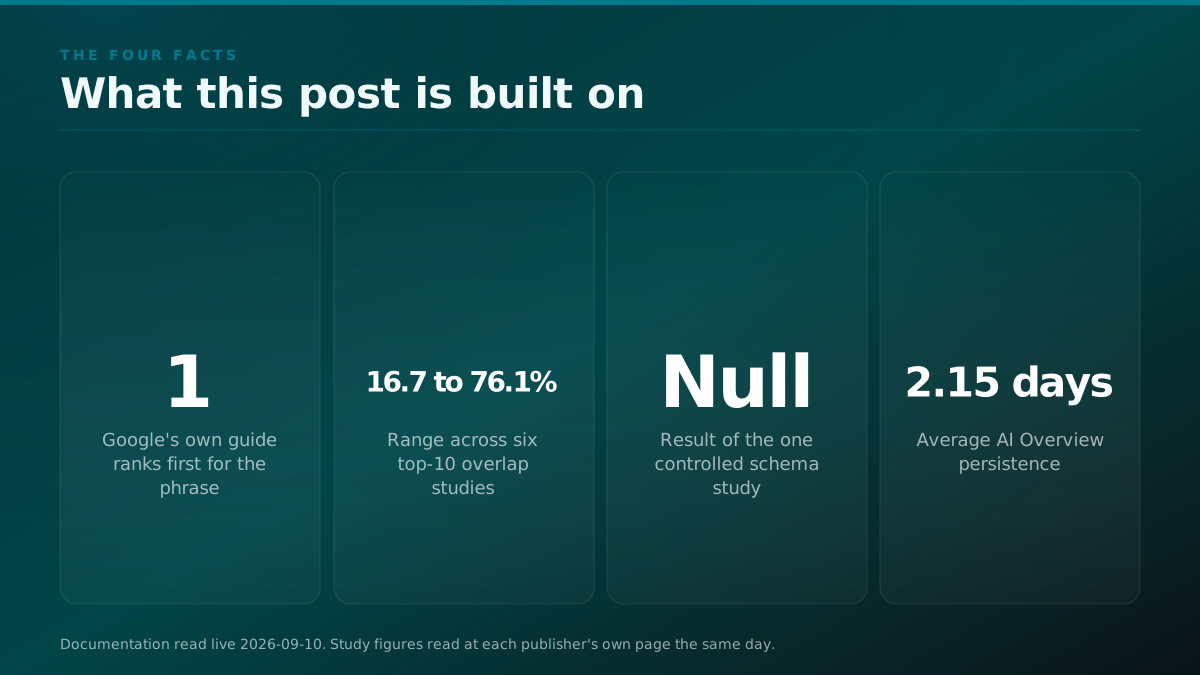
Google publishes a document telling you there is no such thing as AI Overview optimization, and that document ranks first for the phrase. It states there are no additional requirements and no special optimizations, no special schema, no ideal page length, and no need to write differently. One genuine eligibility requirement exists and it is a Search Console toggle, live for all sites since 2026-08-31, not an editorial technique. Everything else on offer is correlation, the published correlations disagree with each other by a factor of 3.6, and the single best-designed experiment on structured data comes back null.
Is there a separate way to optimize for Google AI Overviews?
No, according to the only party with access to the systems. Google states that there are no additional requirements to appear in AI Overviews or AI Mode and no other special optimizations necessary, because the features run on the same core Search ranking and quality systems that decide ordinary results. Ordinary Search eligibility is the bar.
There are no additional requirements to appear in AI Overviews or AI Mode, nor other special optimizations necessary.
That is from Google's AI features and your website page, which carries a last-updated stamp of 2025-12-10. The dedicated AI optimization guide published later puts it more bluntly, and this is the sentence the entire industry has been arguing around.
From Google Search's perspective, optimizing for generative AI search is optimizing for the search experience, and thus still SEO.
Both quotations were matched against the text of the live pages fetched on 2026-09-10, not lifted from somebody else's summary of them. The same pass checked an invented control string against the same pages, which did not match, so we know the matcher was not simply returning true for everything put to it. Fourteen quoted statements matched; the control did not.
The mechanism behind the claim is stated too, and it is the part worth internalising.
No third-party tool has access to our internal ranking or AI systems.
Read the guide's own explanation and the reason for the "still SEO" position becomes structural rather than rhetorical. Google says its generative AI features are rooted in its core Search ranking and quality systems, and that they rely on retrieval-augmented generation against the Search index plus a technique it calls query fan-out, defined as a set of concurrent related queries the model generates to fetch additional relevant results. There is no second index. There is no separate ranking stack. The retrieval layer is the Search index, and the thing selecting from it is the Search ranking system.
If that is true, a separate optimization discipline could only exist in the gap between "ranked well" and "got cited". That gap is real, it is where all the interesting work is, and it is not where the listicles are pointing.
What Google states, quoted from the live pages with their own update stamps
| Statement | Source page | Page last updated | Source |
|---|---|---|---|
| There are no additional requirements to appear in AI Overviews or AI Mode, nor other special optimizations necessary | AI features and your website | 2025-12-10 | published |
| From Google Search's perspective, optimizing for generative AI search is optimizing for the search experience, and thus still SEO | AI optimization guide | 2026-07-10 | published |
| Our generative AI features on Google Search are rooted in our core Search ranking and quality systems | AI optimization guide | 2026-07-10 | published |
| A site must be included in Search generative AI features in Search Console to be eligible for display | AI optimization guide | 2026-07-10 | published |
| Structured data isn't required for generative AI search, and there's no special schema.org markup you need to add | AI optimization guide | 2026-07-10 | published |
| An AI Overview occupies a single position in search results, and all links in the AI Overview are assigned that same position | Performance report metrics | Read 2026-09-10 | published |
| Google-Extended does not impact a site's inclusion in Google Search nor is it used as a ranking signal | Google common crawlers | 2026-07-14 | published |
| This control isn't used as a ranking or inclusion signal affecting other parts of Search | Search generative AI control | Read 2026-09-10 | published |
as of 2026-09-10
Method: Six Google properties were fetched directly over HTTP with a browser user agent, stripped of script and style, and searched for each quoted string case-insensitively with surrounding context printed so the sentence could be read in place. Fourteen positive checks matched and one negative control did not.
It is worth being precise about what that table is and is not. Every string in it was matched against the text of a page fetched over HTTP on 2026-09-10, stripped of script and style, and printed with the surrounding sentence so it could be read in context rather than as a fragment. That matters because quotations in this subject get passed hand to hand until they drift, and the most commonly circulated version of Google's position is a paraphrase of a paraphrase. Where Google's page exposes a last-updated stamp, it is reproduced, because two of these statements are in tension with each other and the only way to see which is current is to look at the dates.
What is query fan-out, and can you optimize for it?
This is the one genuinely novel mechanism in the stack, and it is the one most often turned into a product.
Google defines it plainly. Query fan-out is a set of concurrent, related queries generated by the model to request more information and fetch additional relevant search results to address the user's query. So a single question from a user becomes several retrievals behind the scenes, and the answer is assembled from what comes back across all of them. Google states that both AI Overviews and AI Mode may use the technique.
The obvious commercial move is to guess the fan-out queries and build a page for each. Two things stand in the way, and the first is simply that Google does not tell you what they were. There is no report, no export, and no field in Search Console that names the sub-queries run against your page. You would be optimizing against inference.
The second is that Google has named the tactic as a policy violation. Generating pages to cover anticipated fan-out queries, done primarily to manipulate rankings or generative AI responses, falls under the scaled content abuse spam policy by Google's own statement. It adds that this is an ineffective long-term strategy anyway, on the grounds that a high quantity of pages does not make a site higher quality or more relevant.
There is a legitimate version of the same instinct, and it predates all of this. If a subject genuinely has eight distinct questions underneath it, covering them properly is good work whether or not a model fans out. The difference between that and the spam version is whether the pages would exist if the fan-out mechanism did not, and that is a question you can answer honestly about your own site in about a minute.
Does E-E-A-T apply here, and is it a ranking factor?
Both AI pages route back to Google's general helpful-content guidance, which is the closest thing to an answer about content quality in this context.
That guidance is worth reading precisely because of what it does not say. Measured directly, the helpful-content page contains no mention of AI Overviews, AI Mode, or generative features at all, against a control count of nineteen occurrences of experience and E-E-A-T terminology in the same file. It is the general quality document, and both AI pages point at it rather than at anything AI-specific.
Its load-bearing sentence on E-E-A-T is more careful than the way the acronym usually gets used: while E-E-A-T itself is not a specific ranking factor, using a mix of factors that can identify content with good E-E-A-T is useful. That is a statement about proxies, not about a score, and anybody selling you an E-E-A-T optimization for AI Overviews is selling a metric Google says is not a metric.
What does Google explicitly tell you not to bother with?
The optimization guide contains a section that reads as a list of things people are currently wasting money on. Set against the advice on the pages ranking below it, the overlap is close to total.
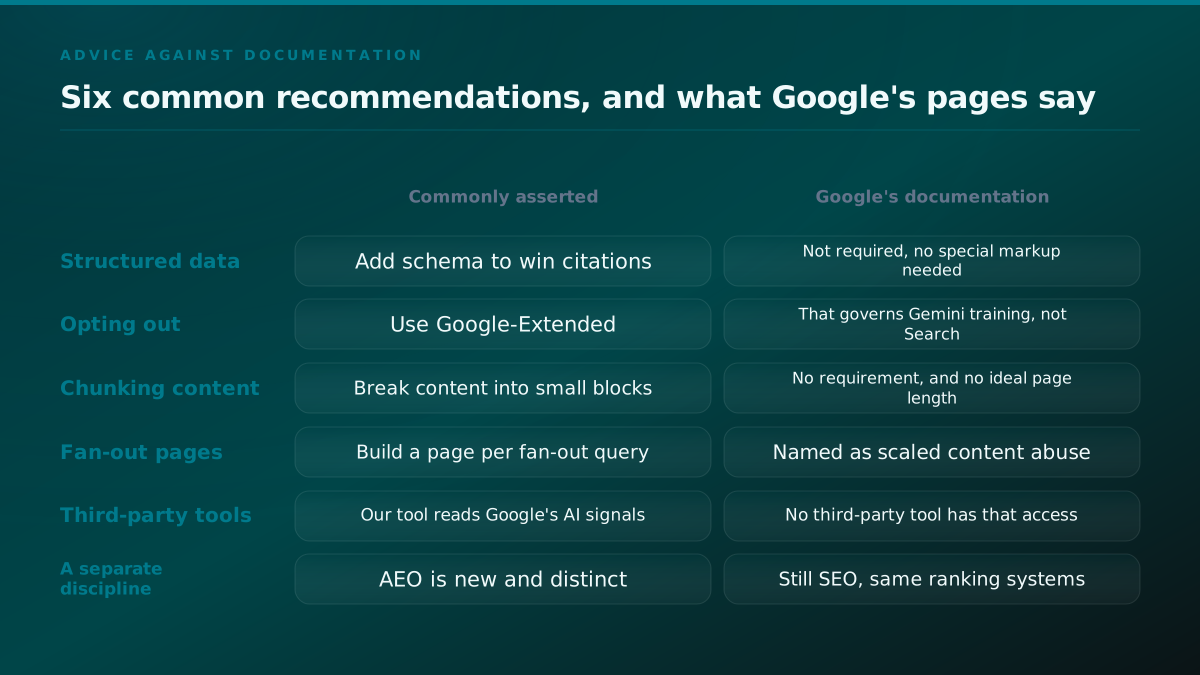
Structured data. The guide is unambiguous.
Structured data isn't required for generative AI search, and there's no special schema.org markup you need to add.
It goes on to say structured data is still worth using as part of overall SEO because it helps with eligibility for rich results, which is a different benefit from the one being sold. The single structured-data instruction Google gives for AI features is that your markup should match the visible text on the page. That is an honesty requirement, not an optimization technique.
Chunking and answer-first rewriting. Google states there is no requirement to break content into tiny pieces for AI to better understand it, that there is no ideal page length, and that you do not need to write in a specific way just for generative AI search. Every one of those is contradicted by advice on the current SERP.
A page per fan-out query. This one carries a warning rather than a shrug. Generating pages to cover anticipated fan-out queries, done primarily to manipulate rankings or generative AI responses, violates Google's scaled content abuse spam policy by Google's own statement.
Inauthentic brand mentions. The guide says seeking inauthentic mentions across the web is not as helpful as it might seem.
None of this means the underlying activities are worthless. Clear writing, sensible structure and genuine mentions are all good for reasons that predate AI Overviews by two decades. What it means is that the AI Overview justification for them is invented, and a strategy sold on an invented mechanism cannot be evaluated, because there is no stated way for it to fail.
The register this produces is consistent and easy to recognise once you are looking for it.
At a glance
What Google's own documentation says about the popular AI Overview advice
| The advice | What Google's documentation actually says | Where it says it |
|---|---|---|
| Add more schema to win AI Overviews | Structured data is not required and there is no special schema.org markup to add. The one instruction given is that markup should match the visible text on the page | AI optimization guide, updated 2026-07-10 |
| Use Google-Extended to opt out of AI Overviews | Google-Extended governs training of Gemini models and does not impact a site's inclusion in Google Search nor act as a ranking signal. It is not an AI Overviews control | Google common crawlers, updated 2026-07-14 |
| You cannot leave AI Overviews without leaving Search | A dedicated Search Console control excludes a site from generative AI features and is explicitly not used as a ranking or inclusion signal affecting other parts of Search | Search generative AI control, rolled out to all sites 2026-08-31 |
| Chunk content into AI-digestible blocks and write answer-first | There is no requirement to break content into tiny pieces, no ideal page length, and no need to write in a specific way just for generative AI search | AI optimization guide, updated 2026-07-10 |
| Build a page for every fan-out query | Doing so primarily to manipulate rankings or generative AI responses violates the scaled content abuse spam policy | AI optimization guide, updated 2026-07-10 |
| Our tool reads Google's AI ranking signals | No third-party tool has access to Google's internal ranking or AI systems | AI optimization guide, updated 2026-07-10 |
So is there any requirement that is genuinely specific to AI Overviews?
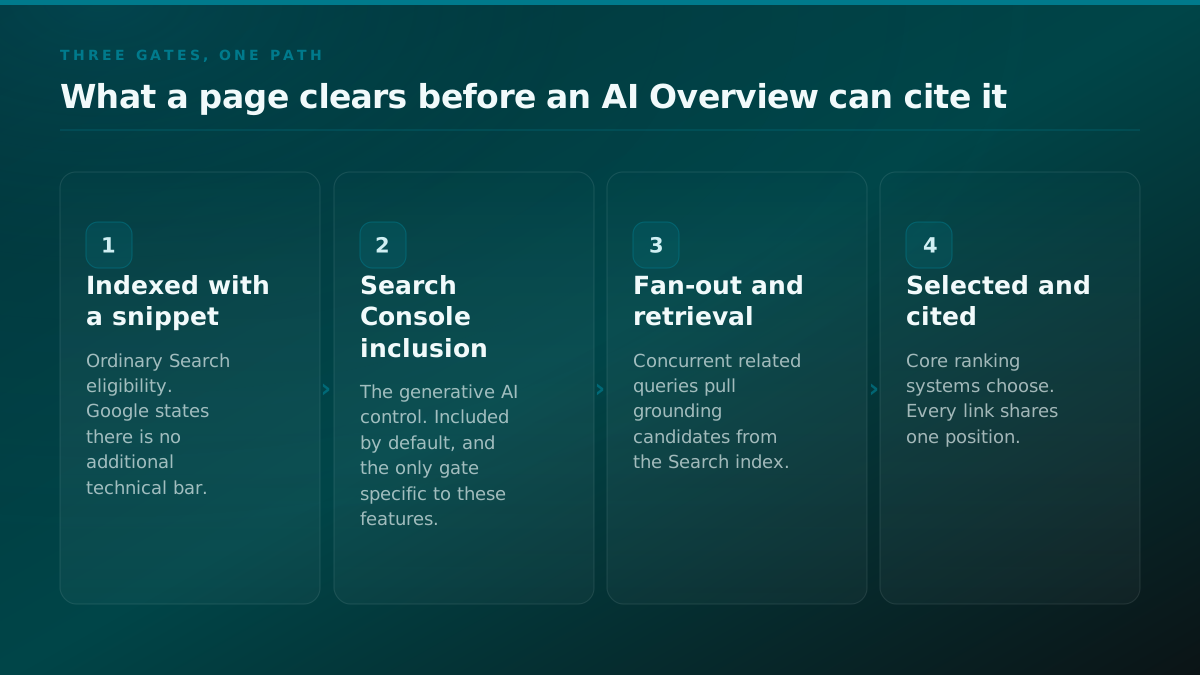
Yes, exactly one, and it is administrative rather than editorial. A site must be included in Search generative AI features in Search Console to be eligible for display at all, which is the only documented gate in the whole chain that exists solely for these features and the only one no advice page on this SERP mentions.
A site must be included in Search generative AI features in Search Console to be eligible for display in generative AI features on Google Search.
That is from the guide stamped 2026-07-10. It is the only documented gate in the entire chain that exists solely for generative AI features, and it is absent from every advice page on the SERP.
The control it refers to lives in Search Console under property settings, named the Search generative AI control. Its help page carries a note that as of 2026-08-31 it was rolled out to all websites worldwide. It offers two options. The default includes your site's links and content in Search generative AI features. The other option is worded plainly: exclude my site's links and content from Search generative AI features.
Three things about it matter more than the toggle itself.
First, the scope is bounded and Google says so.
This control isn't used as a ranking or inclusion signal affecting other parts of Search.
Second, the cost of excluding is stated without softening: you will not receive any traffic or impressions from these features. There is no partial mode where you keep the traffic and lose the summarisation.
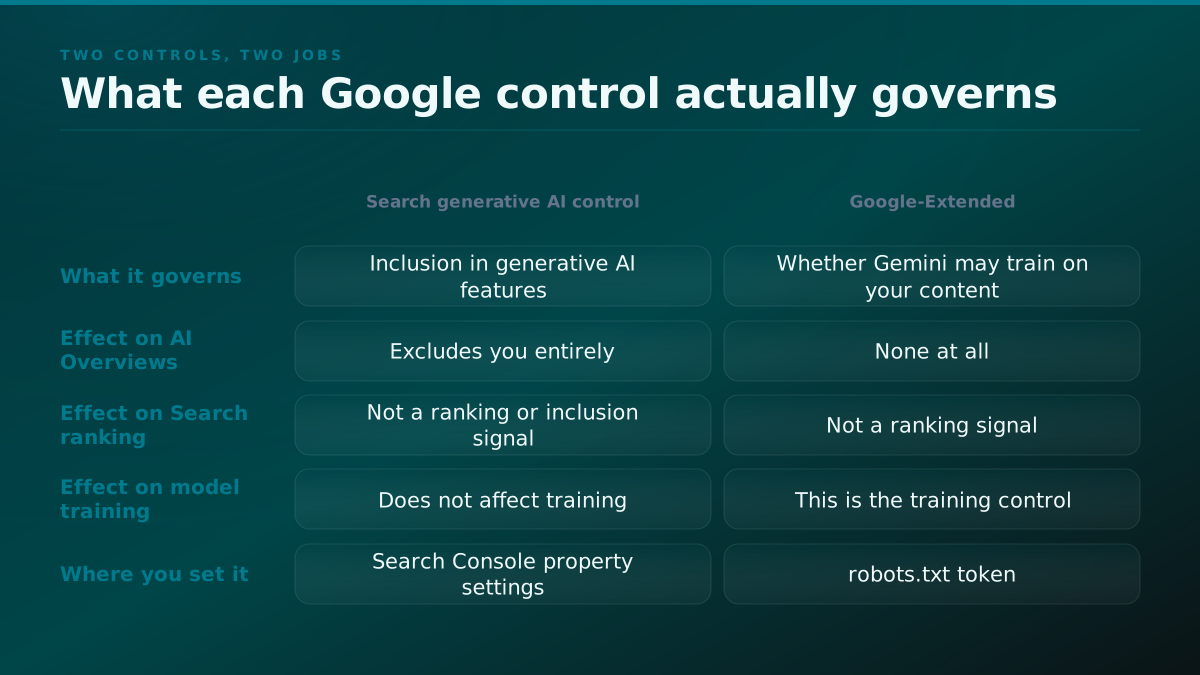
Third, it is not a training control. Google's help page says so directly and points to Google-Extended for that purpose instead, which brings us to the most durable piece of wrong advice in this entire subject.
The week the control shipped, publishers started working out whether to use it, and the numbers they brought are the interesting part. One operator reported generative AI impressions tripling from around 5,000 to 15,000 daily with no traffic increase at all, which is exactly the shape that makes the toggle tempting and exactly the shape that makes it hard to evaluate.
The consensus in that thread ran against opting out, and the sharpest objection was a historical one: the same argument was had when featured snippets arrived, and hiding from the feature was not what worked then. The most useful suggestion was narrower, which is to exclude one informational cluster for thirty days and watch branded and direct traffic rather than organic click-through, since those are the channels an answer-without-a-click would show up in.
One path, three gates
What a page has to clear before an AI Overview can cite it
- Your pageServed to Google's ordinary crawlers
- Indexed with a snippetOrdinary Search eligibility, no extra bar
- Console inclusionThe generative AI control, on by default
- Query fan-outRelated queries the model generates itself
- Retrieved candidatePulled from the Search index for grounding
- Cited in the answerOne shared position, link included
- ExcludedNo impressions, no traffic from these features
- Your pageIndexed with a snippetordinary indexing
- Indexed with a snippetConsole inclusioneligibility check
- Console inclusionQuery fan-outincluded, the default
- Console inclusionExcludedexcluded by the control
- Query fan-outRetrieved candidategrounding retrieval
- Retrieved candidateCited in the answerselected by ranking systems
Is Google-Extended how you opt out of AI Overviews?
No, and this one has been wrong for a long time while being repeated constantly. Google-Extended is a training control governing whether crawled content may be used to train future Gemini models, and Google states plainly that it does not impact a site's inclusion in Google Search nor act as a ranking signal.
Google-Extended does not impact a site's inclusion in Google Search nor is it used as a ranking signal.
Google-Extended manages whether content Google crawls may be used for training future generations of Gemini models. The named products are Gemini Apps, the Vertex AI API for Gemini, and grounding with Google Search on Vertex AI. It is also not a crawler in the ordinary sense: it has no separate user-agent string, crawling is performed by existing Google agents, and the robots.txt token acts purely as a control.
So a site that added Google-Extended to robots.txt believing it had opted out of AI Overviews did not opt out of anything relevant. Its pages remained fully eligible for AI Overviews and AI Mode the entire time. Until 2026-08-31 there was no site-wide way to do what those teams thought they were doing, and now there is, in a completely different place.
This is the same shape of error we have written about before across our work on AI citations, where a control that governs training gets mistaken for a control that governs retrieval, because both are described as "AI" and the distinction is invisible unless you read the specification. The specifics differ across vendors. The confusion is identical, and it is worth reading our post on which OpenAI crawler actually decides citation eligibility alongside this one, because the two mistakes are structurally the same mistake.
What do the snippet controls actually do, and where do they leak?
If you want less of your content used, and you do not want the all-or-nothing exclusion, the robots meta tags are the documented lever. Google's robots meta tag specification, stamped 2026-03-24, states that nosnippet will also prevent the content from being used as a direct input for AI Overviews and AI Mode, and that max-snippet will also limit how much of the content may be used as a direct input.
That is genuinely useful and it is more granular than the Console toggle. It also has two holes that the same specification documents, and anyone relying on these controls should know about both.
The first: the max-snippet limit does not apply in cases where a publisher has separately granted permission for use of content. So the cap is a default rather than a hard ceiling, and a separate agreement overrides it.
The second is the more interesting one. Structured data remains usable for search results when declared within a data-nosnippet element. Google states that robots meta tag limitations do not affect the use of structured data, with the exception of article.description.
Put those together and you get a specific, avoidable failure. A publisher who wraps a passage in data-nosnippet to keep it out of AI features, while shipping that same passage as structured data in a JSON-LD block, has not withheld the content. They have withheld one copy of it and volunteered another. This is where Google's instruction that structured data should match the visible text stops being a style note and becomes load-bearing, because the two rules interact: markup that mirrors your page is exactly the markup that survives your snippet controls.
If there is no separate lever, what does correlate with being cited?
Rank. Consistently, across every published study, and with the strength of the relationship being the only thing in dispute.
This is where the field's evidence base lives, and it is also where it falls apart under inspection, because the numbers everybody quotes disagree with each other far more than anyone quoting them admits.
Six studies, one question, a 3.6x spread in the answer
| Publisher and date | Sample and method | Reported top-10 overlap | What it actually counted | Source |
|---|---|---|---|---|
| BrightEdge, 2025-09-18 | 9 industries over 16 months, via the publisher's own parser. No query count, no citation count and no market stated | 16.7 percent | Unauditable as published, because the denominator is never given | published |
| seoClarity, collected 2025-10-12 | 362,000 US desktop queries, 5.1 million citations, top 20 organic extracted per keyword | 32 percent | Citations against the top 10 organic results, single-day collection | published |
| Ahrefs, 2026-03-02 | 863,000 keyword SERPs, 4 million AI Overview URLs, data as of January 2026 | 37.9 percent | URLs against the first 10 SERP blocks, where ads, featured snippets, PAA boxes and video packs each count as a block | published |
| Originality.ai, 2025-11-18 | No sample size stated on the page, referring to an earlier study's dataset | 52 percent | Organic citations only, after excluding the 52 percent of all citations that fell outside the top 100 | published |
| Authoritas, 2025-02-19 | 11,203 keywords, US desktop only, three collections across roughly 21 weeks | About 60 percent | Expressed inversely, as about 40 percent of top-10 organic pages not being cited | published |
| Ahrefs, 2025-07-21 | 1.9 million citations from 1 million AI Overviews | 76.1 percent | Only the three most visible citations per AI Overview, which is why it is not comparable with the same publisher's later figure | published |
as of 2026-09-10
Method: Each publisher's own page was fetched and the headline figure, sample size, window and comparison set read from the body text. Where a page's summary and body disagreed, the body was taken and the disagreement recorded. No figure here is derived, averaged or reconciled, because averaging measurements of different quantities would manufacture a number none of them reports.
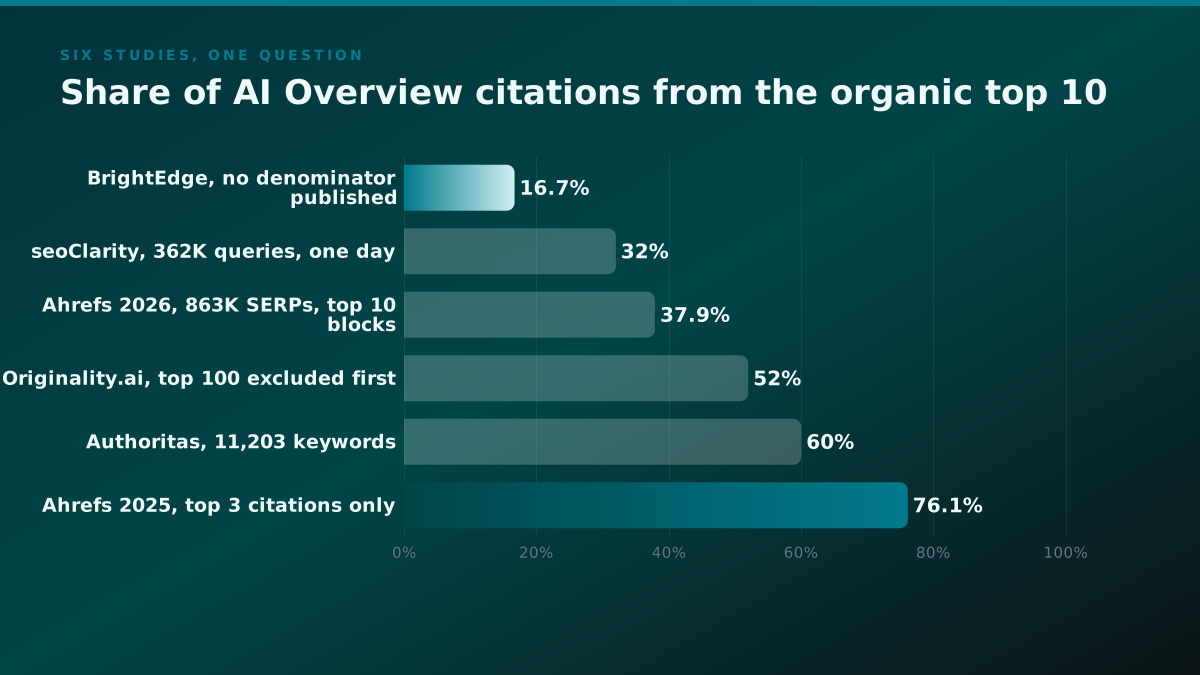
Six studies. One apparently simple question: what share of AI Overview citations come from pages ranking in the organic top 10. Reported answers of 16.7, 32, 37.9, 52, about 60, and 76.1 percent.
That is a 3.6x spread, and it is not because Google changed by 3.6x. It is because those six studies are not measuring the same quantity.
Worth knowing
Every citation-overlap number you have seen is an instrument reading, not a fact about Google
Six published studies ask what share of AI Overview citations come from the organic top 10. They report 16.7, 32, 37.9, 52, about 60, and 76.1 percent. That is a 3.6x spread on what sounds like one question. It is not a mystery and it is not contradiction: they counted different units against different denominators on different dates. One measured URLs against SERP blocks, so ads and People Also Ask boxes consumed slots. One measured only the three most visible citations per answer. One excluded the 52 percent of citations that fell outside the top 100 before computing its headline. One published no denominator at all. Quoting any single figure as the overlap is quoting a measurement apparatus, and the useful reading is the direction they agree on, which is that ranking well helps and is nowhere near sufficient.
Six publisher pages, each read live on 2026-09-10
Work through the differences and each number becomes legible.
The Ahrefs March 2026 figure of 37.9 percent counts URLs appearing within the first ten blocks, and the study says explicitly that ads, featured snippets, People Also Ask boxes and video packs were each tracked as separate blocks. On a feature-heavy SERP, ten blocks may contain four organic results. Their blue-links-only control returns 37.10 percent, so the block definition is not the whole explanation, but it means the number is not answering the question most readers think it is answering.
The Originality.ai figure of 52 percent is computed after excluding citations outside the top 100, and the study states that 52 percent of all citations fell outside the top 100. So the headline describes a share of the remaining subset, not a share of all citations.
The seoClarity figure of 32 percent comes from a single day of collection, 2025-10-12, across 362,000 US desktop queries and 5.1 million citations. That is a large sample of a narrow moment.
The BrightEdge figure of 16.7 percent is the outlier at the bottom and the least auditable: a 16-month, nine-industry claim published with no query count, no citation count and no market stated.
And the Authoritas figure of about 60 percent is expressed inversely, as roughly 40 percent of top-10 organic pages not being cited, which is a different question again.
There is a further wrinkle worth knowing about if you go and read these sources yourself, because we hit it and it cost us a correction. The seoClarity page's own summary at the top advertises different figures than its body carries. The summary says roughly 50 percent top-10 overlap and roughly 49 percent of citations from the top 20. The body says 32 percent and 56 percent. The most likely explanation is a summary left over from an earlier revision that was never re-cut when the study was updated, which is an ordinary publishing accident rather than anything sinister.
It has a consequence, though. Two figures widely attributed to that publisher in 2026 write-ups, that 97 percent of AI Overview citations come from the top 20 and that position 1 appears in AI Overviews more than half the time, are not on the current page at all. The live page says 56 percent and 43 percent. Those look like earlier numbers still circulating as though they were current, which is the same failure mode as the click-through figure discussed below and the same fix applies: open the page, read the body, note the date.
What the one academic source says
There is one source in this area with no product attached to it and a released dataset, which makes it worth separating from the rest.
An April 2026 benchmark built on 11,500 real user queries, published as a public dataset, compared Google organic results, AI Overviews, and a generative model directly on the same queries. Three of its findings bear on this post.
It puts AI Overview prevalence at 51.5 percent of those queries, far above the keyword-database estimates, for the sampling-frame reason discussed above.
It reports that the sources consulted across different engines have very little overlap, at under 0.2 average Jaccard similarity. That is a formal statement of something practitioners describe anecdotally all the time, which is that being cited by one assistant tells you almost nothing about whether another will cite you.
And it reports that sites blocking Google's AI crawler are significantly less likely to be retrieved by AI Overviews despite the content being accessible. That is the one finding in this post that points at a concrete technical action with evidence behind it, and it lines up with the documented behaviour of the snippet controls rather than contradicting it.
We should be clear about our own limits here: we read the abstract and the reported findings, not the full paper, so the internals are unexamined by us and should be treated that way.
Did AI Overview citations really collapse from 76 percent to 38 percent?
This deserves its own answer because it is the most repeated trend line in the subject and it is not a trend line.
Both figures are real and both come from the same publisher. The 76.1 percent is from July 2025. The 37.9 percent is from March 2026. Set side by side they look like a dramatic decline in how much ranking matters, and that framing has been reproduced widely.
Three things changed between the two studies.
The July 2025 study analysed only the three most visible citations in each AI Overview. The March 2026 study analysed all citations, 4 million URLs across 863,000 keyword SERPs, which works out to roughly 4.6 per SERP. Sampling only the most prominent citations biases toward the strongest-ranking sources, so the earlier figure was always going to be higher.
The publisher also states it improved its parsing methodology so it could see more of the citations. A better parser finding more citations will find more of the marginal ones, which again pushes the number down without anything at Google changing.
And the comparison set changed from ranking positions to SERP blocks.
Two instruments, one trend line. The honest summary is that we do not have a clean time series on this quantity at all, from anyone. What we have is two snapshots taken with different equipment.
Three registers, one question
What is asserted, what is documented, and what has actually been tested
| Commonly asserted | Documented by Google | Tested with a control | |
|---|---|---|---|
| Structured data | Add schema to win AI Overview citations | Not required, no special markup, and it should match visible text | One study, null for schema presence once a ranking artifact is corrected |
| The dominant lever | A distinct list of AI Overview ranking factors | The features run on core Search ranking and quality systems | Organic rank position dominates, with citation odds falling sharply per position |
| Opting out | Use Google-Extended | Google-Extended governs Gemini training and does not affect Search inclusion | Not applicable, this is a documentation question rather than an empirical one |
| Position within the answer | Track your rank inside the AI Overview | The whole AI Overview holds one position and every link shares it | Not applicable, the quantity does not exist |
| Stability of a citation | Win a citation and hold it | Silent on stability | About 70 percent change between consecutive observations, roughly 2.15 days persistence |
What about the 61 percent CTR collapse?
Also stale, also superseded, and superseded by the very publisher that produced it.
Worth knowing
The 61 percent CTR collapse is stale, and its own publisher has moved
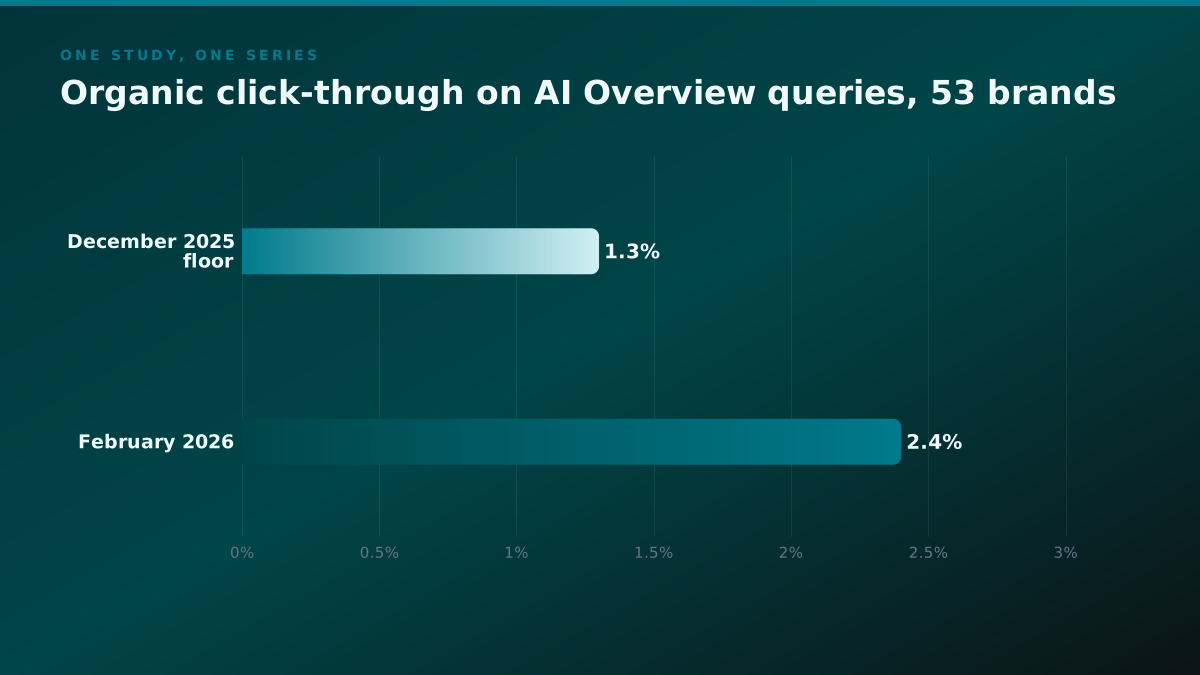
The figure repeated everywhere is that AI Overviews cut organic click-through by 61 percent. It comes from a real study of 3,119 informational terms across 42 organisations, published in November 2025, and it has two problems. First it does not reconcile with the numbers printed beside it: the same paragraph gives a fall from 1.76 percent to 0.61 percent, which is a 65 percent decline, and the publisher's own year-on-year table gives 65.2 percent. Second and more importantly, the same publisher released a far larger study in April 2026, covering 53 brands and 5.47 million queries, which shows click-through on AI Overview queries recovering from a floor of 1.3 percent in December 2025 to 2.4 percent in February 2026. The narrative reversed and the citation did not. If a page is still quoting 61 percent in 2026 without the update, it has not reread its own source.
Two studies from the same publisher, November 2025 and April 2026, both read live 2026-09-10
There is a better source for the underlying question, and it is the one least likely to be selling you something. Pew Research Center ran a browsing-behaviour study on 900 United States adults who agreed to share their activity, covering 68,879 unique Google searches in March 2025, of which 12,593 produced an AI summary. It found that users who encountered an AI summary clicked a traditional search result on 8 percent of visits, against 15 percent for visits with no summary. It found that a link inside the summary itself was clicked on just 1 percent of visits to pages carrying one. And it found sessions ending on 26 percent of pages with a summary against 16 percent without.
That study has no product attached to it, measures humans rather than aggregated console data, and states its own limitation plainly: technical constraints meant only Google searches could be analysed, and it covers a single month.
It is also not comparable with the agency CTR studies, and the two are routinely stacked as though they corroborate each other. Pew measures per-visit click behaviour across all query types on a probability panel. The agency studies measure impression-weighted click-through on informational client keywords pulled from Search Console. Different populations, different denominators, different query mixes. Both can be true and neither confirms the other.
How often do AI Overviews even appear?
There is no single answer to this, and the range is wide enough that quoting one number is close to meaningless.
How often AI Overviews appear, by what was sampled
| Source | What was sampled | Reported prevalence | Source |
|---|---|---|---|
| Authoritas, collected Aug 2024 to Jan 2025 | 11,203 keywords, US desktop | 18.8 percent of the SERPs in that set | published |
| Semrush, November 2025 reading | More than 10 million keywords from a keyword database | 15.69 percent, down from a 24.61 percent peak in July 2025 | published |
| Academic benchmark, April 2026 | 11,500 real user queries released as a public dataset | 51.5 percent of queries | published |
as of 2026-09-10
Method: Figures read from each publisher's live page or abstract on 2026-09-10, with the sampling frame recorded alongside each number because the frame is what explains the spread.
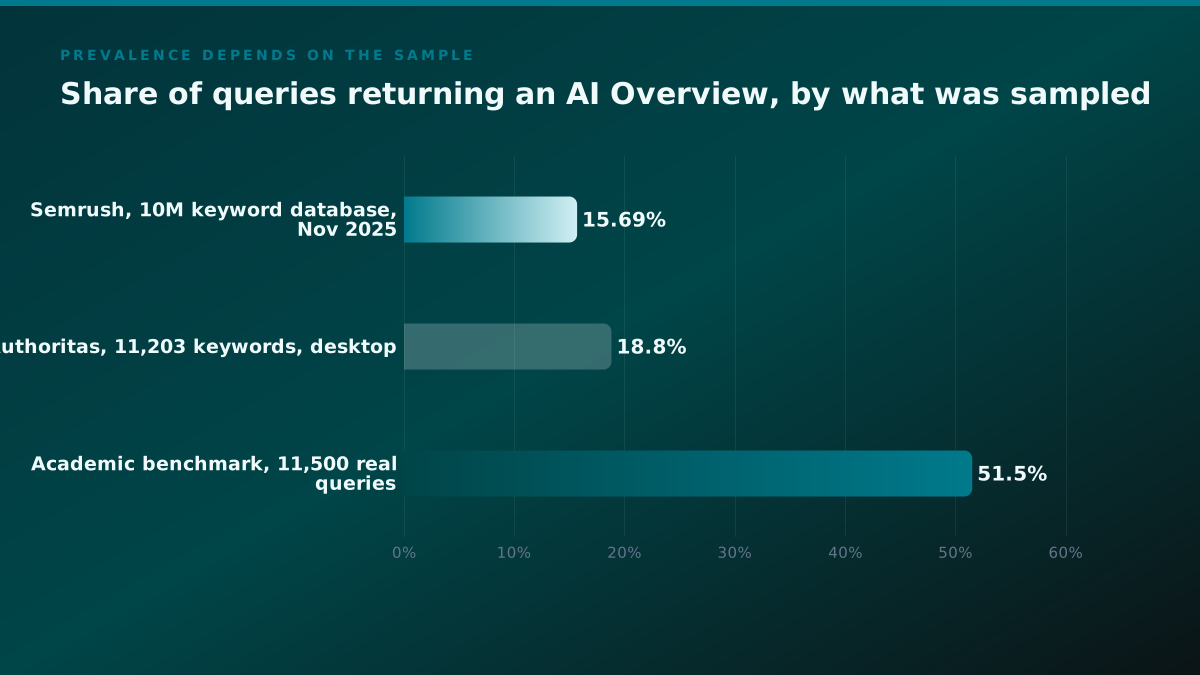
A keyword-database study covering more than 10 million keywords put prevalence at 15.69 percent in November 2025. An academic benchmark of 11,500 real user queries, released as a public dataset, put it at 51.5 percent in April 2026.
The gap is a sampling-frame artifact, not a discovery. Keyword-tool databases are built around commercial head terms, which trigger AI Overviews far less often. A representative sample of what people actually type skews toward questions, and questions trigger the feature heavily.
The Semrush series carries one further detail that most 2026 write-ups drop: the direction is not monotonic. Prevalence rose from 6.49 percent in January 2025 to a peak of 24.61 percent in July 2025, then fell back to 15.69 percent by November. Anyone describing a smooth upward march is describing a curve they truncated.
Google's own framing is consistent with a variable rate. Its documentation states AI Overviews are only shown when its systems determine the feature is additive to classic Search, and adds that they often do not trigger. That sentence is the answer to one of the most common searches in this cluster, which is some version of "why is my AI Overview not showing". It is not a bug and it is not something you failed to optimize for.
Does structured data actually move citations?
Google says it is not required. The interesting question is whether it helps anyway, and here there is exactly one study designed to answer it rather than assert it.
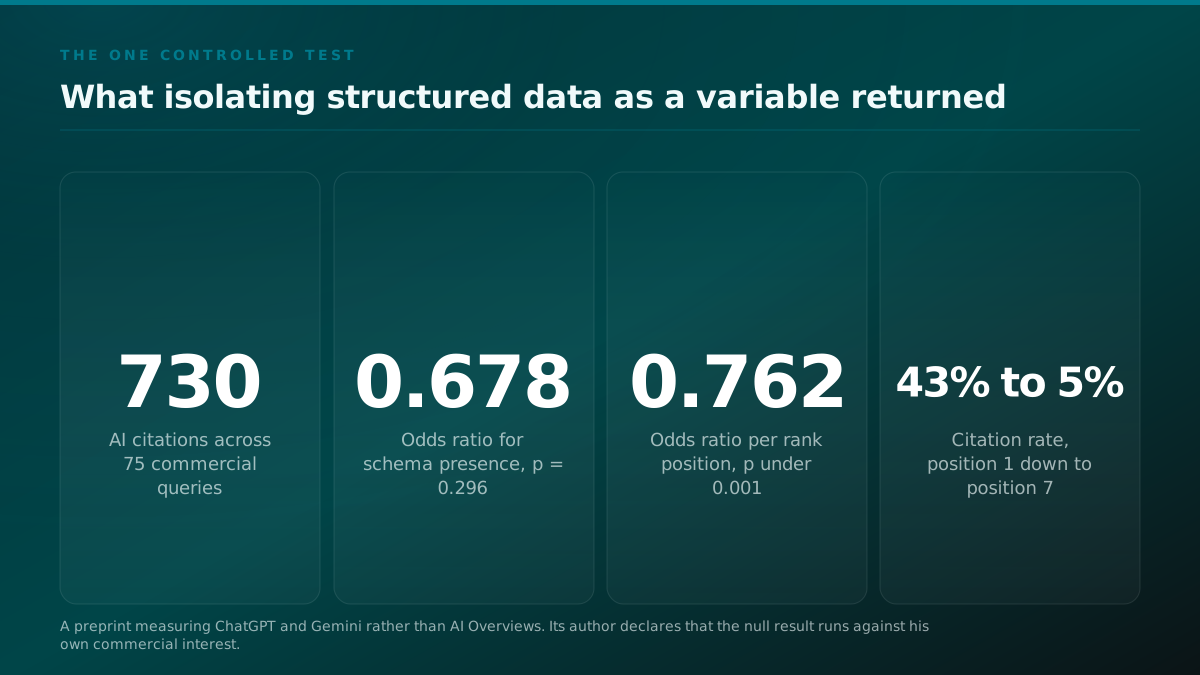
The design is careful in a way that is rare in this field. 730 AI citations across 75 commercial queries and 1,006 unique pages, comparing ChatGPT and Gemini citations against Google's top-10 organic as a control set, analysed with generalised estimating equations and query-clustered standard errors, with domain authority carried as a covariate.
The naive pooled model showed schema negatively associated with citation. The author identified that as an artifact rather than publishing it as a finding: Google's own ranking enriches top-10 results for schema-bearing pages, which inflates schema prevalence in the control set. His within-Google diagnostic makes the point cleanly, finding schema prevalence among cited and non-cited Google pages statistically indistinguishable at 43.1 percent against 44.8 percent.
The corrected model returns a null for schema presence, at an odds ratio of 0.678 with a p value of 0.296, and nulls for entity richness and schema-to-query alignment as well. The dominant predictor is organic rank, with citation odds falling roughly 24 percent per position, and cited-in-43-percent-of-queries at position 1 falling to 5 percent by position 7.
One narrow positive result survives: Product and Review schema carrying concrete populated attributes such as pricing and aggregate rating was cited at 61.7 percent against 41.6 percent for generic Article, Organization and BreadcrumbList markup, most pronounced on lower-authority domains. That is a specific, plausible, testable claim about attribute-rich commercial markup, and it is a much smaller claim than "add schema to win AI Overviews".
Three caveats belong with this study every time it is cited, and we would rather state them than have somebody else find them.
It measures ChatGPT and Gemini, not Google AI Overviews. It is a preprint and has not been peer reviewed. And its author runs an AI search optimization agency, which he declares in the paper, along with the observation that the null result contradicts his own commercial interests. That last point cuts in favour of the finding rather than against it, but it should be visible either way.
There is no equivalent study for AI Overviews specifically. That absence is worth sitting with: the single most recommended technique in this entire field has never been isolated as a variable against the surface it is recommended for.
It is not for want of asking. In August 2026 somebody put the question to a technical SEO community in exactly those terms, asking whether anyone had added or fixed schema on a page and watched something change in AI citations, separate from everything else they were doing at the same time.
Thirty-three replies, twenty upvotes, an upvote ratio of 0.96, and not one before-and-after. The answers ranged from "table stakes" to "frankly speaking, it does nothing", with one reply quoting Google's structured-data line verbatim. The closest anyone came to a positive claim was a reference to studies showing a 20 to 30 percent increase in citations for pages using schema, immediately followed by the same commenter conceding they had not seen any specific test where someone added it and tracked the result.
Has anyone actually tested any of this?
We went looking, using the same standard we would want applied to us: a stated baseline, an intervention, and a way for the result to come out negative.
Across twenty-one practitioner threads from the last three months, spanning technical SEO, general SEO, digital marketing and several answer-engine communities, we found no controlled before-and-after experiment on AI Overview citations. Not a small number. None.
What we found instead falls into three groups, and the pattern is consistent enough to be worth naming.
The positive claims are uncontrolled, and several were withdrawn in their own threads. A widely upvoted post claiming a technique made an assistant the site's top referrer turned out, when asked directly for method, to have been built by copying whatever pattern the already-cited pages had. That is selecting on the outcome, and the community said so. The same author later downgraded one of the claims to a cheap bet rather than a proven lever. Another claim that adding markdown files increased assistant signups came with no baseline, no dates and no site named when asked.
The negative findings are the well-evidenced ones. The strongest measurement in the set found that when an engine did not run a live search, it produced zero citations across all 406 such answers, while still naming brands at roughly the same rate as when it did search. Being named and being cited turn out to be independent. Another found that a brand's own product pages were near worthless for citation compared with roundup and article content on the same domain. A third found that the pages that got cited were, on average, slightly worse written than the ones that did not.
The methodology warnings are the most useful output of the whole corpus, and two of them invalidate a lot of published work retroactively. One practitioner running an automated tracker found a page cited for one query and completely absent for the same query with one extra word in it. Different source list, same page. Another described generating a fresh question set on each run early on and producing what they called beautiful, entirely fake regressions, which were then explained with confident stories about algorithm updates. A rotating prompt set does not measure a trend, it manufactures one.
Set against that, the thread that keeps coming back is the one from a site that does everything right and is still never pulled into the panel.
The operator outranks the pages being cited, has higher authority than them, and has the full technical checklist in place. Forty-seven comments, and the replies split between the standard three-step advice and people saying plainly that AI Overviews do not follow organic rankings and that there is no proven way to optimize specifically for them. When one commenter asked the author of the top-voted standard advice for the research behind it, no answer was given.
That is the honest state of the field. It is not that the advice is malicious. It is that almost none of it has been tested against the surface it names, the people giving it mostly know that, and the few who ran real measurements mostly found out what does not work rather than what does.
The findings that survive scrutiny are all about ceilings
Read the practitioner measurements together and a shape emerges that nobody is selling, because it does not convert.
The strongest single result in that corpus came from running 50 buyer questions across 10 national brands and 4 engines, 2,000 live answers, reading each engine's own disclosure of whether it had run a live web search. Where a live search happened, the brand was cited about 17 percent of the time. Where no search happened, citations were zero, across all 406 such answers. Not low. Zero. Mentions were almost unaffected, at 69 percent against 68 percent, which means being named by an assistant and being cited by it are close to independent events.
The counterintuitive part is which questions did not trigger retrieval. Broad category questions searched about half the time. The buyer-shaped ones, brand A against brand B, or a situational recommendation, mostly did not. So the queries closest to a purchase were the ones most likely to be answered from memory, where no amount of on-page work can reach.
That result is about a different surface from AI Overviews, and we are not going to pretend otherwise, since AI Overviews are grounded in Google's index rather than answering from weights in the same way. It is included because the structure of the finding generalises: if retrieval did not happen, page-level optimization is inert, and almost nothing in the popular advice distinguishes the case where you lost the citation from the case where there was never a retrieval to win.
A second audit, of 158 published articles tracked across several engines including AI Overviews, found something similarly awkward for the content-quality pitch. Articles that got cited scored slightly lower on writing quality than articles that did not, 60.4 against 62.5. The variable that moved was where the piece was published, not how well it was written: the same author's material was cited around half the time on an established industry publication and not at all on their own company blog. Age mattered too, in the opposite direction to the freshness advice, with older articles cited far more often than fresh ones.
That study was published the same day we ran this research, has had no scrutiny from anyone, and is vendor-run on the vendor's own corpus. Treat it as unrefuted rather than as validated. We include it because the direction it points, that placement dominates polish, is corroborated by the third-party-source finding below rather than standing alone.
The mentions correlation, and why it is not a lever yet
The one correlation consistently reported as stronger than links is brand mentions.
An analysis across roughly 75,000 brands reports correlations against AI Overview visibility of 0.664 for branded web mentions, 0.392 for branded search volume, 0.326 for domain rating and 0.218 for backlinks. The distribution underneath is the interesting part and it is not linear: the top quartile of brands by mention volume averaged 169 AI Overview mentions, the next quartile 14, and the bottom half between zero and three.
Two cautions before anybody reallocates a budget on that. It is correlational by construction, and the people publishing it say so. And a threshold-shaped distribution is exactly what you would expect if a third variable, such as simply being a large well-known company, drives both mentions and citations. That does not make the finding useless. It makes it a description of who gets cited rather than an instruction for how to become them.
The practical version of this that does hold up is narrower and comes from a case rather than a correlation. A team spent three months publishing pricing pages on their own blog to correct what an assistant was saying about them, and nothing moved. The actual sources were two comparison articles from 2024 on sites they had never heard of. Getting one corrected, and a newer piece placed on a site the models already cited, changed the answers about five weeks later.
That is a single case with no holdout, and the three months of publishing is arguably its own null arm. But the diagnostic underneath it is free and takes ten minutes: before writing anything to fix an AI visibility problem, find out what the engine is actually reading, because it is usually not you. Ask the question with search on and with search off in a fresh session. If the wrong answer only appears with search off, it is in the weights and publishing will not touch it. If it appears in both, something live and wrong is being retrieved, and that you can go and fix.
Is there a position to compete for inside the panel?
No, and this one is settled by documentation rather than by evidence.
An AI Overview occupies a single position in search results, and all links in the AI Overview are assigned that same position.
An AI Overview holds one position in the results. Every link inside it is assigned that same position. There is no first slot to win, no ordering to climb, and no rank-within-the-panel to report.
Any tool showing you a rank inside an AI Overview is showing you a number Google does not define, derived from the visual order of the panel at the moment of a scrape. Given that the same panel changes roughly every two days, that number would be unstable even if it meant something.
How stable is a citation once you have one?
This is the part of the research that is best established and least discussed, and the reason for the imbalance is not subtle: it does not lead to a product recommendation.
From the field
The best-corroborated finding in this field is the one nobody optimizes for
Two independent instruments, one covering 43,000 keywords over a month and one covering 11,203 keywords across five months, converge on roughly a 70 percent change rate in AI Overviews between observations. The larger study puts average persistence at 2.15 days and finds only 54.5 percent of cited URLs surviving from one observation to the next, while semantic similarity between those answers stays at 0.95. Read those together and the picture is unusually clear: the answer Google gives is stable, and the set of sources it credits for that answer is not. This is the closest thing to a settled empirical result in AI Overview research, it is corroborated across publishers with different commercial interests, and it receives a fraction of the coverage that a single disputed CTR figure gets, because it does not tell anyone to buy anything.
Two volatility studies, published 2025-11-11 and 2025-02-19, both read live 2026-09-10
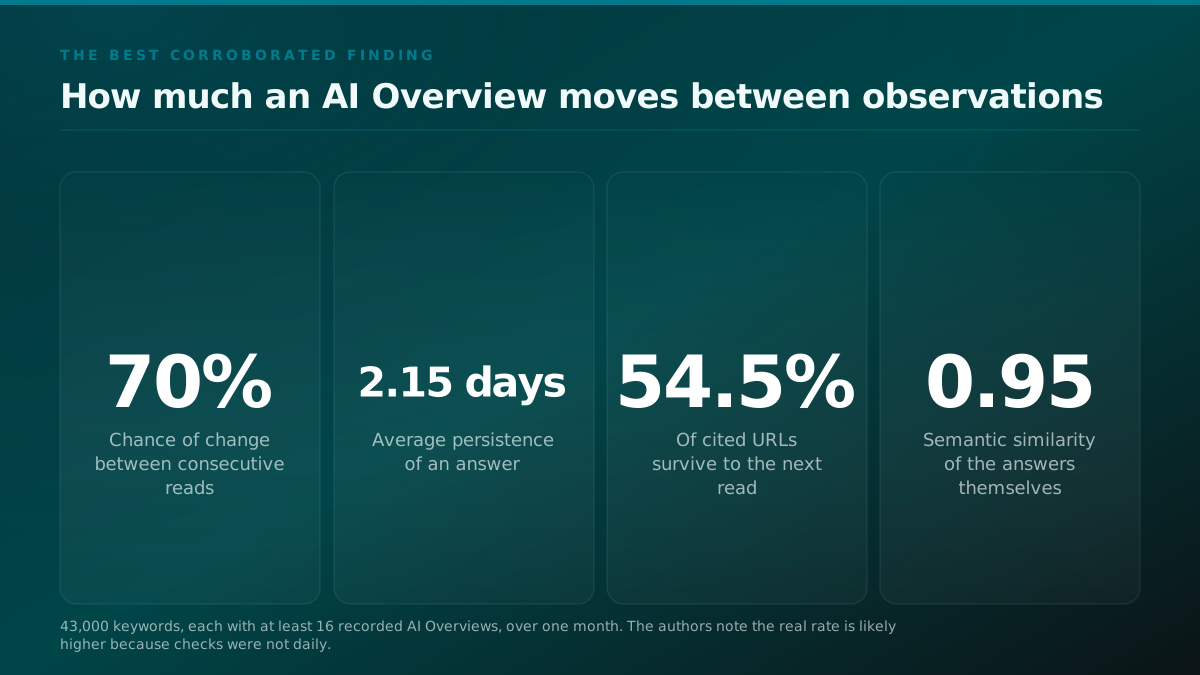
The larger study analysed more than 43,000 keywords, each carrying at least 16 recorded AI Overviews, over a month. It reports a 70 percent chance of an AI Overview changing between one observation and the next, an average persistence of 2.15 days, and only 54.5 percent of cited URLs overlapping between consecutive responses, meaning roughly 45 percent of the sources credited are new each time. Entity overlap runs at 54 percent. Semantic similarity of the answers themselves runs at 0.95.
The authors add a caveat that pushes the finding further rather than softening it: because their checks were not daily, the real change rate is likely higher than measured.
An independent study using different methods across 11,203 keywords and roughly five months found about 70 percent of the pages ranking in AI Overviews changing over two to three months, with AI Overview volatility running consistently above organic volatility.
Two publishers, different instruments, different windows, converging figure. That is what corroboration looks like, and this is the only place in the subject where we have it.
The implication is the interesting part. The answer Google gives is stable at 0.95 semantic similarity, while the set of sources credited for that answer turns over by nearly half between observations. Google is not changing its mind. It is re-picking who gets credit for the same conclusion, repeatedly, on a two-day cycle.
That has a direct consequence for anyone measuring their own visibility. A single observation of your citation state is close to worthless. If you check on Monday and you are cited, and check on Thursday and you are not, you have not learned that something broke. You have sampled a process with a 70 percent change rate twice.
How would you actually tell whether something worked?
This is the question the entire SERP skips, and it is a measurement question rather than an SEO question.
Start with what tracking is actually available. Google states that clicking a link to an external page in an AI Overview counts as a click, and that these are reported in the Search Console performance report within the Web search type rather than broken out separately. The dedicated generative AI insights surface, announced in June 2026 and rolled out to all sites, reports impressions.
So the honest position on attribution is that it is coarser than anybody would like, and that a large share of the impact of AI Overviews on your traffic is not separable from ordinary Search in the console you already have.
Which pushes the measurement burden onto direct observation of the panel itself, and that is where the volatility finding above becomes the binding constraint rather than a curiosity.
Practitioners who track this seriously have arrived at the same conclusion independently, and the thread below is the clearest statement of it we found.
Two findings in it are worth carrying away. The first is that one check is not a reading: the recommendation that recurs is to run a fixed prompt set in fresh sessions, log domain appearance alongside the cited URL, and compare share over time rather than treating any single answer as a rank. The second is sharper, and it is a first-hand observation rather than advice. One tracker reported a page cited for the exact query supabase error 42501 row level security fix and completely absent for supabase error 42501 row level security policy fix. One extra word, a different source list, the same page. If your prompt set is built from paraphrases of your own product description, it will hand you a reassuring number that means nothing.
What the measurement looks like
A noise band, established before anyone claims a lift
12 money queries
Queries in the set
5 identical runs
Repeats per query
60 of 60
Calls that succeeded
7 of 12
Queries that flipped outcome
centred on zero, SD 0.215
Permutation null
51.1 points
Smallest lift this design can see
- Identical queries repeated, so volatility is measured rather than assumed
- A permutation null run with no intervention applied
- The detection floor computed and published, including when it is embarrassing
- A causal lift figure reportedDeliberately absent. The design is roughly four times underpowered, so any lift number it produced would be indistinguishable from the noise band beside it
Here is our own position, published with its numbers, including the number that is unflattering.
We ran a step-zero measurement: 12 money queries, 5 identical repeats each, one model, one day. All 60 calls succeeded. Seven of the 12 queries flipped outcome between repeats that differed in no way at all. Not between Monday and Thursday. Between identical calls.
We then ran a permutation test, 20,000 random splits of the same query set with no intervention applied whatsoever, to see what a difference looks like when nothing has happened. The null difference centred on zero, mean plus or minus 0.0016, with a standard deviation of 0.215.
From those two runs the minimum detectable lift for that design comes out at 51.1 percentage points. Roughly four times underpowered for any effect anyone would plausibly claim. A design of 40 queries by 40 samples reaches 9.9 points.
What our own instrument can and cannot resolve
| Quantity | Measured value | What it licenses us to say | Source |
|---|---|---|---|
| Identical queries repeated 5 times, one model, one day | 7 of 12 queries flipped outcome | Any single reading of a citation state is unreliable. A before-and-after with one observation each side is measuring noise | measured |
| Permutation null, 20,000 random splits, no intervention applied | Centred on zero, mean plus or minus 0.0016, standard deviation 0.215 | The spread you should expect from nothing at all is wide, and a difference inside it is not evidence | measured |
| Minimum detectable lift on the 12 by 5 design | 51.1 percentage points | Roughly four times underpowered. We cannot publish a causal lift figure and do not | derived |
| Design required to reach a usable floor | 40 queries by 40 samples reaches 9.9 percentage points | This is the size of instrument the question actually needs | derived |
as of 2026-09-10
Method: A step-zero run of 12 money queries repeated 5 times against one model on one day, followed by a permutation test of 20,000 random splits of the same query set with no intervention applied. Both are published with their numbers, including the underpowered result, on the measurement post linked throughout.
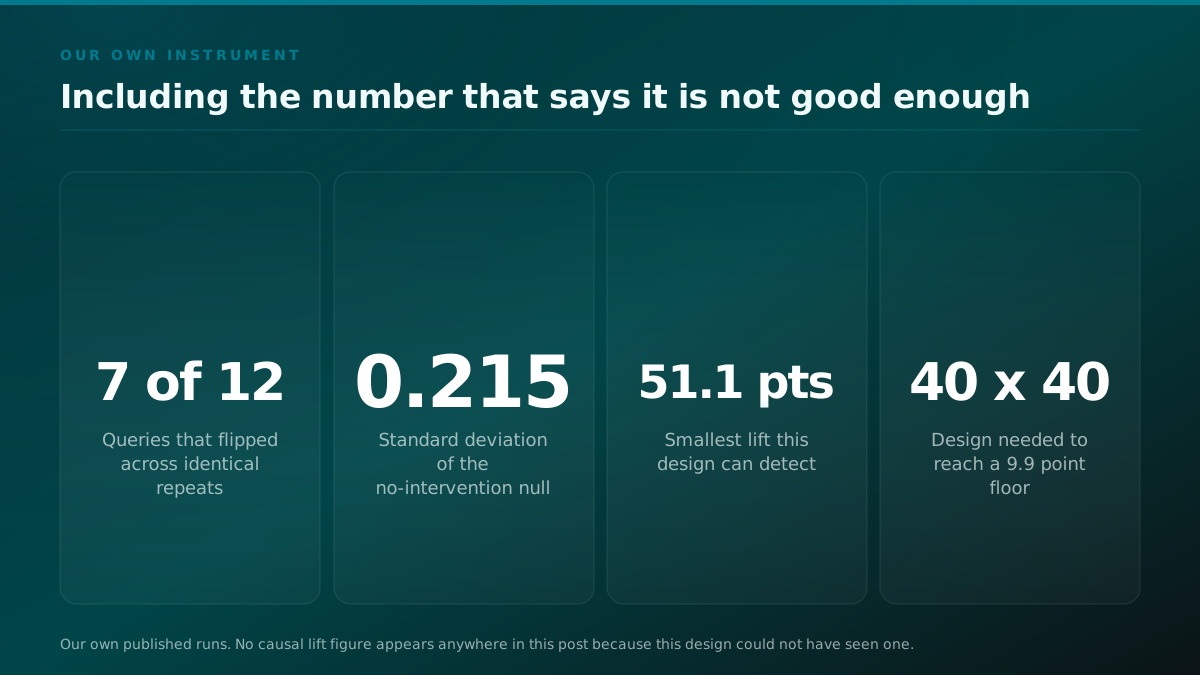
We publish that because it is the number that decides whether any of the rest of this is knowable, and because we would rather be the people who said the instrument was not good enough than the people who reported a lift it could not have seen.
It also explains a decision that might otherwise look like modesty. We have no causal lift figure anywhere on this site. Not a small one, not a hedged one. A design whose smallest resolvable effect is 51.1 percentage points cannot honestly report a 12 point improvement, because 12 points is indistinguishable from the noise the same design produces when nothing at all has happened. Publishing one anyway is how most of the case studies in this field get written, and the arithmetic that would catch it is never shown.
The other reason to publish a detection floor is that it converts an argument into a calculation. Someone can disagree with our interpretation of Google's documentation. Nobody can disagree that a 12 by 5 design cannot see a 10 point effect, because that follows from the spread of the null distribution, and we published the null distribution. The whole point of putting the unflattering number in public is to make the next claim checkable by somebody who does not trust us.
It also sets the standard we would apply to anybody else's claim, including every study quoted in this post. If someone tells you a technique moved their AI Overview citations, the first question is not what the technique was. It is how many queries, how many repeats, and what the spread looked like when they changed nothing. Our own answer to that third question was a standard deviation of 0.215, which is wide, and we had to run 20,000 splits to find out.
For a fuller treatment of how sample size interacts with this, our post on prompt tracking sample size works through why the intuitive number of repeats is usually far too small, and the measuring answer engine optimization lift page describes the design we use when the question is causal rather than descriptive.
Does any of this change for AI Mode?
Mostly no, and the places it does change are worth knowing because they affect measurement rather than content.
Google's documentation treats AI Overviews and AI Mode together for nearly everything discussed above. The same eligibility applies, the same Search Console control governs both, the same snippet controls limit both, and both may use query fan-out. If you were hoping for a separate lever here, there is not one.
The measurement side is different in one specific way. Google states that a follow-up question asked inside AI Mode is essentially a new query. So a conversation that starts with one question and continues through four refinements is five queries, and your visibility across that conversation is not one state but five. Any tool reporting a single AI Mode visibility number for a topic is flattening something that has real structure in it.
There is also a reporting boundary worth being precise about, because it is easy to overclaim in both directions. Clicks on external links inside an AI Overview count as ordinary clicks and land in the standard performance report under the Web search type. The dedicated generative AI insights surface reports impressions. Measured directly, that help page mentions impressions ten times and contains no mention of clicks, click-through rate or position at all. The honest reading of that is not that clicks from these features do not exist, because the performance report documentation says plainly that they do. It is that the dedicated report is an impressions surface, and anyone building a click-based AI Overview dashboard on top of it is building on a metric it does not carry.
What is actually worth doing?
Shorter than any listicle on this SERP, which is the point. Everything below is documented rather than asserted, and where something is merely correlational it says so.
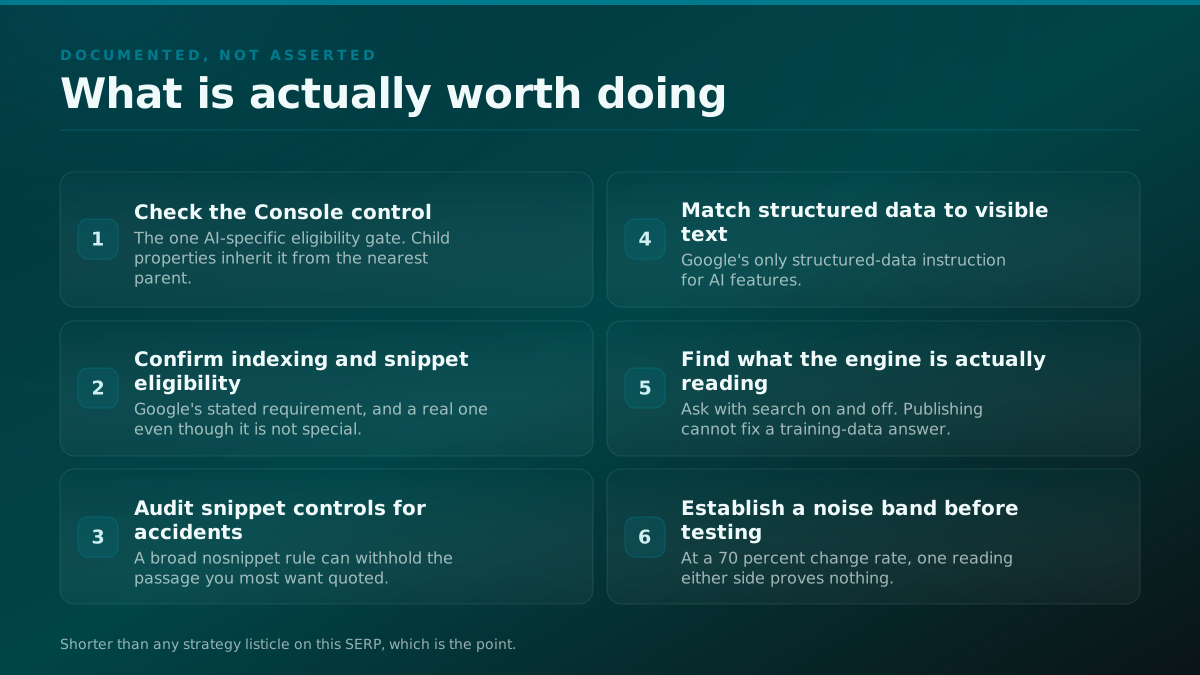
Check the Search Console generative AI control first. It is the one genuinely AI-specific eligibility gate that exists. It defaults to include, and child properties inherit from the nearest configured parent, so an inherited setting on a parent property can exclude a subdomain nobody has looked at. If it says exclude, nothing downstream matters.
Confirm ordinary Search eligibility. Google's stated requirement is that a page must be indexed and eligible to be shown in Google Search with a snippet. That is the bar. Not a special one, but a real one.
Audit your snippet controls for accidents. A nosnippet rule prevents content being used as a direct input for AI features. If a template applies one broadly, you may be withholding the passage you most want quoted. Check the interaction with structured data described above, because the two controls do not compose the way people assume.
Make structured data match the visible text. This is Google's only structured-data instruction for AI features. It is also the rule that governs whether markup survives your snippet controls.
Rank better, with the usual caveat. Every published study agrees rank correlates with citation, and the one controlled experiment finds rank the dominant predictor while its schema variables come back null. Correlation is the right word here. None of these studies randomised anything.
Do not build pages against fan-out queries. Google names this as a scaled content abuse violation when done to manipulate generative AI responses. It also does not expose which fan-out queries it ran, so you would be optimizing against a guess.
Establish your noise band before you test anything. Given a roughly 70 percent inter-observation change rate, a before-and-after with one reading on each side cannot distinguish an effect from the ordinary churn. This is the step that is almost always skipped, and skipping it is what makes the resulting case study unfalsifiable.
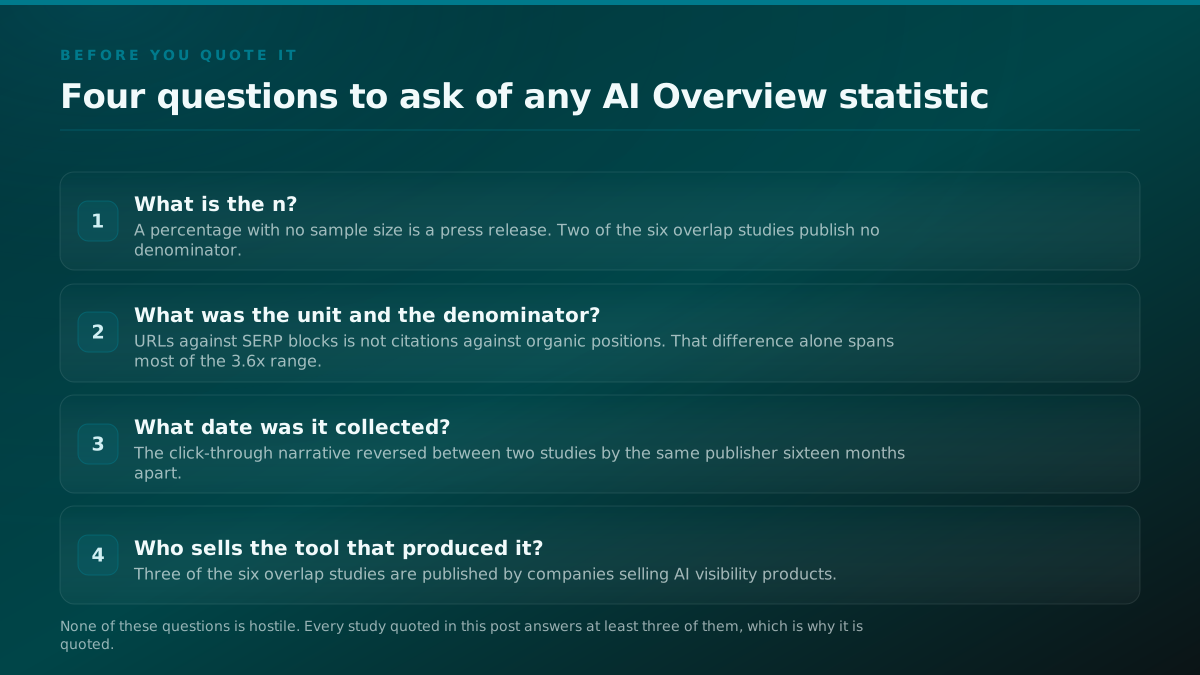
Treat every statistic in this field as an instrument reading. Ask for the sample size, the collection window, and whether the publisher sells the tool that produced it. Three of the six overlap studies quoted above are published by companies selling AI visibility products, and one of those six publishes no denominator at all.
Find out what the engine is actually reading before you write anything. The ten-minute search-on and search-off diagnostic above will tell you whether a wrong or missing answer is coming from live retrieval, which you can act on, or from training data, which you largely cannot. Skipping this step is how a quarter disappears into publishing pages that were never in the retrieval set.
Two of those items are worth expanding for anyone whose buyers are technical, because the question shape differs sharply by audience. We keep a running note on the questions developer tool buyers ask AI, and the pattern there is that the highest-intent queries are also the most specific, which is exactly the class most likely to be answered without a fresh retrieval. The same holds for AI infrastructure buyers. If that is your market, the retrieval question is not a technicality, it is the whole game.
If you want the fuller treatment rather than the summary above, everything we have published on measurement works through the instrument side, and the rest of our original research on AI citations sits alongside it.
TIMELINE
How Google's own guidance on this moved, dated
2025-12-10, the no-special-optimization page
Google's AI features page carries an update stamp of this date and states that there are no additional requirements to appear in AI Overviews or AI Mode and no other special optimizations necessary, along with no additional technical requirements.
2026-05-15, a dedicated guide appears
Google Search Central announces a new resource for optimizing websites for generative AI features, describing its own purpose as including the busting of common AEO and GEO misconceptions.
2026-06-03, generative AI performance reporting
Google announces performance insights for generative AI features, later noted as rolled out to all websites worldwide.
2026-07-10, the guide states a real requirement
The AI optimization guide, stamped this date, states that a site must be included in Search generative AI features in Search Console to be eligible for display, which the older page does not mention anywhere.
2026-08-31, the control reaches every site
The Search generative AI control is rolled out to all websites worldwide, giving every site a documented way to leave AI Overviews and AI Mode while remaining in Search.
2026-09-10, the SERP still sells the opposite
The live United States top 10 for the head term is read for this post. Google's own guide holds position 1, a practitioner thread holds position 2, and the eight pages below them are strategy listicles, five of which are numbered and three of which are published by companies selling visibility tooling.
What this post deliberately does not claim
We have no customers. There is no client engagement behind this, no case study, and no aggregate of anybody's data but our own two published runs. If this post contained a chart showing citation lift from a technique, that chart would be invented, so there is not one.
We also cannot tell you that any of the documented steps above will get you cited. Google documents eligibility gates, not outcomes, and the difference between the two is the whole subject. The gates are necessary. Nothing in the public record establishes that anything is sufficient.
And we cannot give you a causal estimate of our own, because our instrument's detection floor is 51.1 percentage points and we said so above rather than burying it. When we have run a design large enough to resolve something smaller, we will publish that with its numbers too, including if the answer is that the effect is not there.
What we can tell you is that a field whose most-quoted overlap statistic varies by a factor of 3.6 across six studies, whose headline CTR figure has been superseded by its own publisher, and whose most recommended technique has never been isolated as a variable against the surface it is recommended for, is a field where the confident answers are the ones to distrust first.
That includes ours. The difference we are aiming for is that ours come with the number that says how wrong they could be.
One last note on how to read this post in six months, because everything above has a shelf life and some of it is short. The documentation quotations carry Google's own update stamps, and two of the pages we quote already disagree with each other because one was revised and the other was not. The Search Console control is two weeks old at the time of writing. The click-through picture reversed once already and could reverse again. The volatility finding is the most likely to hold, because it has been reproduced by two publishers using different instruments, and the schema null is the most likely to be overturned, because it rests on one preprint measuring an adjacent surface.
If you are reading this after those things have moved, the part worth keeping is not any individual figure. It is the habit of asking, of every number in this field, what was counted, against what denominator, on what date, and by somebody selling what.
If you want to see how we approach this for a specific product surface, our work with developer tools and APIs starts from the same place: establish what moves on its own, then ask what is left.
Sources
Every number above, and where it came from. A figure without a row here is one we should not have printed.
- Google Search Central, AI features and your website
- First-party documentation for AI Overviews and AI Mode. States that there are no additional requirements to appear in either feature and no other special optimizations necessary, that a page must be indexed and eligible to be shown with a snippet, that there is no special schema.org structured data to add, and that AI Overviews are only shown when Google's systems determine it is additive to classic Search. Page carries a last-updated stamp of 2025-12-10. Read at the live document on 2026-09-10 and every quotation in this post was matched against the fetched page text, with a deliberately absent control string checked to prove the extractor was not matching everything.
- Google Search Central, Optimizing your website for generative AI features on Google Search
- The page that ranks first in the United States for the term "ai overview optimization". States that optimizing for generative AI search is optimizing for the search experience and thus still SEO, that the features are rooted in core Search ranking and quality systems, that structured data is not required and no special markup needs adding, that there is no ideal page length, and that a site must be included in Search generative AI features in Search Console to be eligible. Also names generating pages per fan-out query as a scaled content abuse violation. Page carries a last-updated stamp of 2026-07-10. Read live 2026-09-10.
- Google Search Console Help, Search generative AI control
- Documents the control that decides whether a site is included in AI Overviews, AI Mode and generative AI features in Discover. Carries the note that as of 2026-08-31 the control was rolled out to all websites worldwide, states that it is not used as a ranking or inclusion signal affecting other parts of Search, that it does not affect AI training, and that a site excluded through it receives no traffic or impressions from these features. Read live 2026-09-10.
- Google Search Console Help, Performance report metrics
- States that clicking a link to an external page in an AI Overview counts as a click, and that an AI Overview occupies a single position in search results with all links in it assigned that same position. This is the documentation that makes "your rank inside the AI Overview" a category error. Read live 2026-09-10.
- Google Search Central, Google common crawlers and fetchers
- States that Google-Extended lets publishers manage whether crawled content may be used for training future generations of Gemini models, and that Google-Extended does not impact a site's inclusion in Google Search nor is it used as a ranking signal. Page carries a last-updated stamp of 2026-07-14. Read live 2026-09-10.
- Google Search Central, Robots meta tag specifications
- States that nosnippet also prevents content being used as a direct input for AI Overviews and AI Mode, that max-snippet limits how much may be used, and two exceptions that matter. The max-snippet limit does not apply where a publisher has separately granted permission, and structured data remains usable for search results when declared within a data-nosnippet element. Page carries a last-updated stamp of 2026-03-24. Read live 2026-09-10.
- Ahrefs, Update, 38% of AI Overview Citations Pull From The Top 10
- 863,000 keyword SERPs and 4 million AI Overview URLs, data as of January 2026, collected with the publisher's own AI visibility product. Reports 37.9 percent of cited URLs appearing within the first 10 blocks, where ads, featured snippets, People Also Ask boxes and video packs are each counted as a block, with the remainder split between positions 11 to 100 at 31.2 percent and beyond the top 100 at 31.0 percent. Published 2026-03-02, read live 2026-09-10. The publisher sells the tool that produced the data and the second half of the post is a product pitch, which is disclosed here because it is relevant to how the figure should be weighed.
- Ahrefs, 76.10% of AI Overview citations rank in the top 10
- 1.9 million citations drawn from 1 million AI Overviews, but sampling only the three most visible citations in each response. This narrower sampling frame is the reason it is not comparable with the same publisher's later 37.9 percent figure, which sampled all citations after a self-described parsing improvement. Published 2025-07-21, read live 2026-09-10.
- Ahrefs, AI Overviews Change Every 2 Days (But Never Change Their Mind)
- More than 43,000 keywords, each carrying at least 16 recorded AI Overviews, observed over one month. Reports a 70 percent chance of an AI Overview changing between consecutive observations, an average persistence of 2.15 days, only 54.5 percent of cited URLs overlapping between consecutive responses, 54 percent entity overlap, and a semantic similarity of 0.95, meaning the answer stays stable while the sources credited for it churn. The authors state that because checks were not daily the real change rate is likely higher. Published 2025-11-11, read live 2026-09-10.
- seoClarity, The Overlap Between AI Overviews and Organic Rankings
- 362,000 United States desktop queries that triggered an AI Overview on 2025-10-12, yielding 5.1 million citations, with the top 20 organic results extracted per keyword. Body of the page reports AI Overview citations overlapping the top 10 results 32 percent of the time, 56 percent coming from the top 20, and position 1 cited 43 percent of the time. Read live 2026-09-10. Note that the page's own table of contents advertises different figures than its body, which is recorded in this post rather than smoothed over.
- Pew Research Center, Google users are less likely to click on links when an AI summary appears
- 900 United States adults on a probability-based panel who agreed to share browsing activity, covering 68,879 unique Google searches in March 2025, of which 12,593 produced an AI summary. Reports a traditional search result clicked on 8 percent of visits where a summary appeared against 15 percent where none did, a link inside the summary clicked on just 1 percent of visits, and a session ended on 26 percent of pages with a summary against 16 percent without. Published 2025-07-22, read live 2026-09-10. A non-profit with no product in this market, and the only source here measuring human behaviour rather than aggregated console data.
- Semrush, AI Overviews Study, what 2025 SEO data tells us
- More than 10 million keywords tracked January to November 2025 for prevalence. Reports AI Overviews appearing on 6.49 percent of queries in January 2025, peaking at 24.61 percent in July 2025, and falling back to 15.69 percent in November 2025. The pullback from the July peak is the part most 2026 write-ups omit. Published 2025-12-15, read live 2026-09-10. The publisher sells AI Overview tracking and the clickstream vendor named in the methodology is a subsidiary.
- Seer Interactive, AIO Impact on Google CTR, 2026 Update
- 53 brands, 5.47 million tracked queries, 2.43 billion organic impressions, January 2025 to February 2026. Reports organic click-through rate on AI Overview queries climbing from a floor of 1.3 percent in December 2025 to 2.4 percent in February 2026, a cited page earning materially more clicks per impression than an uncited one while still underperforming a query with no AI Overview. Supersedes the same publisher's widely quoted 61 percent decline figure from November 2025. The authors state plainly that they cannot claim causation and that their AI Overview labelling is static rather than real time. Published 2026-04-24, read live 2026-09-10. The publisher is an agency selling consulting in this area.
- Kurt Fischman, Does Schema Markup Predict AI Citation
- 730 AI citations across 75 commercial queries and 1,006 unique pages, comparing ChatGPT and Gemini citations against Google top-10 organic as a control, analysed with generalised estimating equations and query-clustered standard errors. Returns a null for schema presence, entity richness and schema-to-query alignment once an artifact in the naive model is corrected, with organic rank the dominant predictor. Discloses that the author runs an AI search optimization agency and that the null result contradicts his own commercial interests. A preprint, not peer reviewed, and it measures ChatGPT and Gemini rather than Google AI Overviews. Posted 2026-04-14, read live 2026-09-10.
- Our own step-zero measurement run
- 12 money queries times 5 identical repeats, one model, one day. 60 of 60 calls succeeded and 7 of the 12 queries flipped outcome between identical repeats. Published with its numbers on this site.
- Our own permutation test
- 20,000 random splits of the same query set with no intervention applied. Null difference centred on zero, mean plus or minus 0.0016, standard deviation 0.215. The same run puts the minimum detectable lift for that design at 51.1 percentage points, roughly four times underpowered, which is why no causal lift figure appears anywhere in this post.
Questions this answers
- Is AI Overview optimization a separate discipline from SEO?
- Google says no. Its guidance states that optimizing for generative AI search is optimizing for the search experience and thus still SEO, because the features run on core Search ranking and quality systems. There are no additional requirements and no special optimizations documented beyond ordinary Search eligibility.
- What are the AI Overview ranking factors?
- Google documents no separate factor list. The features draw on core Search ranking and quality systems, so the factors are Search factors. The strongest tested correlate of being cited is organic rank position, and every published overlap study agrees that ranking well helps while being nowhere near sufficient.
- Does schema markup get you cited in AI Overviews?
- Google states structured data is not required and there is no special markup to add, though it asks that markup match the visible text. The one controlled study returns a null for schema presence once a ranking artifact is corrected. It measured ChatGPT and Gemini rather than AI Overviews, so treat it as suggestive.
- Can I opt out of AI Overviews without leaving Google Search?
- Yes. Since 2026-08-31 the Search Console generative AI control has been available to all sites worldwide. Google states it is not used as a ranking or inclusion signal affecting other parts of Search. The cost is explicit, and an excluded site receives no traffic or impressions from those features.
- Does Google-Extended block AI Overviews?
- No. Google-Extended governs whether crawled content may train future Gemini models. Google states it does not impact a site's inclusion in Google Search nor act as a ranking signal. It is a training control, not an AI Overviews control, and using it for that purpose does nothing.
- Why are AI Overviews not showing for some searches?
- Google states AI Overviews are only shown when its systems determine the feature is additive to classic Search, and that they often do not trigger. Prevalence also depends heavily on query type, with question-shaped queries triggering them far more often than transactional ones.
- How do I rank higher inside an AI Overview?
- There is no position to rank for. Google's own documentation states that an AI Overview occupies a single position in search results and that all links within it are assigned that same position. Any tool reporting your rank inside the panel is reporting a quantity Google does not define.
- How do I track AI Overview traffic?
- Clicks on external links inside an AI Overview count as ordinary clicks and appear in the Search Console performance report under the Web search type, not broken out separately. The dedicated generative AI insights surface impressions. Expect attribution to be coarser than you want.
- How stable is an AI Overview citation once you win one?
- Not very. One study of 43,000 keywords found a 70 percent chance of change between consecutive observations, average persistence of 2.15 days, and only 54.5 percent of cited URLs surviving to the next observation, while the answer itself stayed semantically stable at 0.95 similarity.
- Which AI Overview statistic should I trust?
- Any figure quoted without a sample size and a collection date should be treated as marketing. Published top-10 overlap estimates span 16.7 to 76.1 percent because they count different units against different denominators. Read the method before the headline, and check whether the publisher sells the tool that produced it.
Keep reading
AI citations
LLM SEO, what it actually is and what the work looks like
Google says its AI features run on the same ranking systems as Search, so the tactics are familiar. What changed is how you tell whether the work landed.
46 min read
AI citations
Reddit is cited by AI. That is not a reason to buy upvotes.
Published Reddit citation shares run from 2% to 46.7%, and one study puts Reddit at 67.8% of every URL ChatGPT retrieves and then declines to cite.
23 min read
AI citations
Schema Markup for AI Search: How to Isolate the Variable (2026)
Ahrefs tracked 1,885 pages adding schema and citations barely moved. Here is how to isolate structured data as a variable, and what a null result looks like.
80 min read