Google Moved Links Up in AI Mode on Oct 15. What It Changes for Getting Cited
Google's October 15 update moves AI Mode inline links higher and tests an official-site box. Which changes add citation surface, and how to measure them.
Citon13 min read
Short answer
What did Google's October 15, 2026 AI Mode link update change for getting cited?
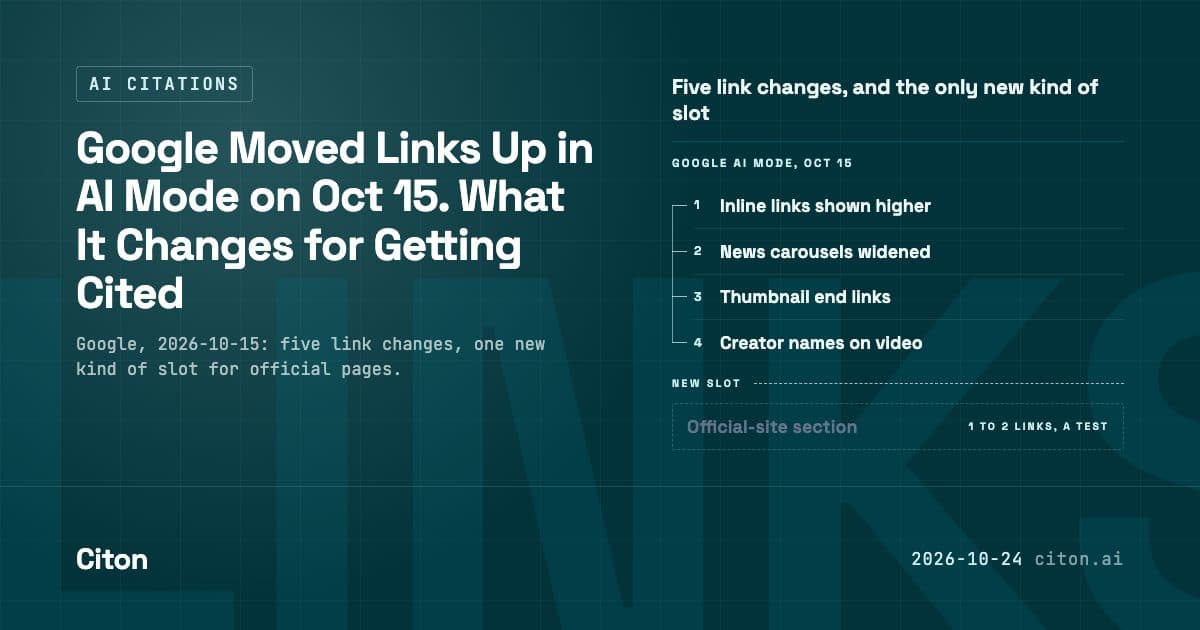
Less than the headlines suggest, and more for some pages than others. On 2026-10-15 Google announced five link changes to AI Mode and AI Overviews: inline links shown higher more often, a test of an official-site section at the top of some answers, wider news carousels, thumbnail links at the end of responses, and clickable creator names in video results. The official-site test is the only new kind of slot, and it holds one or two links for task queries. Google published no click data. Measure it with a frozen query set, repeats and a held-out control from 2026-10-15 onward.
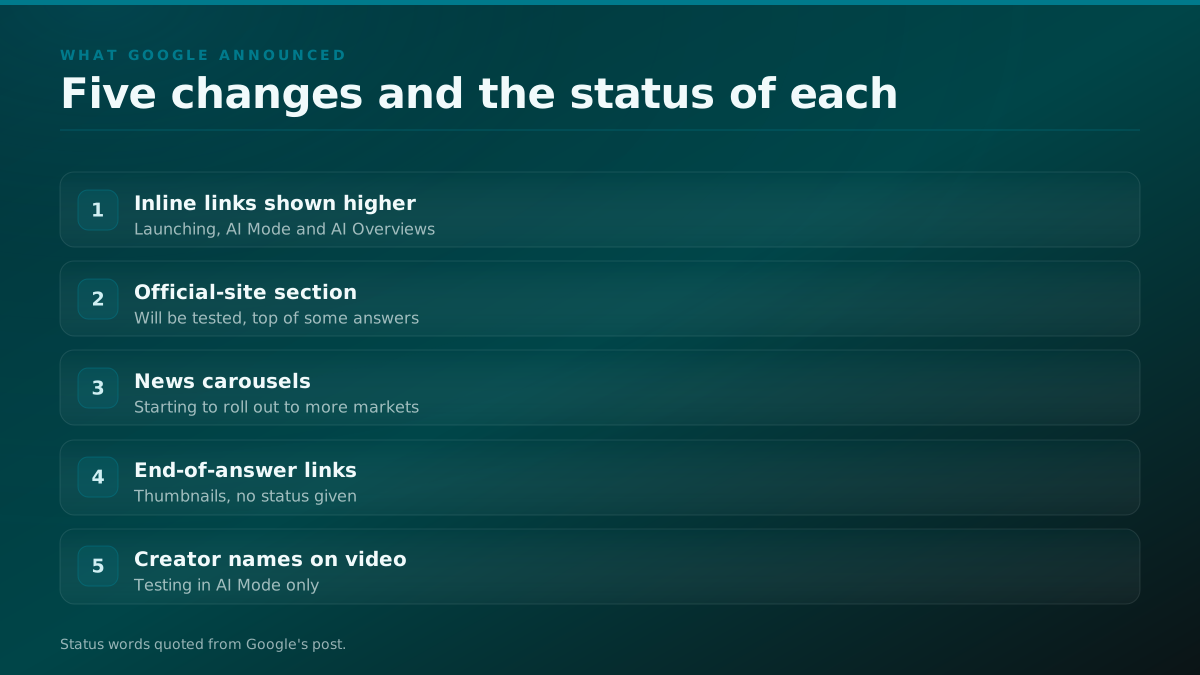
Google changed where links sit in its AI answers on 2026-10-15. In a post titled More ways to connect with the web from Search, Hema Budaraju, VP of Product Management, listed five changes to AI Mode and AI Overviews. Inline links will show higher in responses more often, and an official-site section will be tested at the top of some answers.
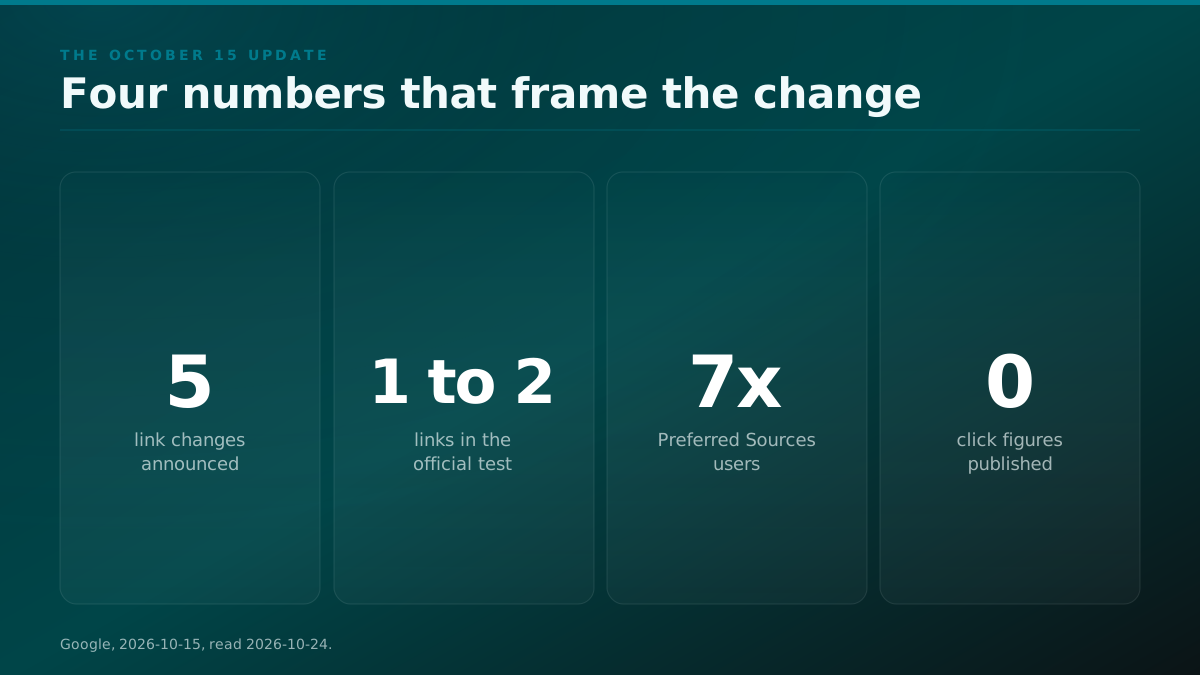
The other three are wider news carousels, thumbnail links at the end of answers, and clickable creator names on video results in AI Mode. Google added one adoption figure: the number of people using Preferred Sources has grown by more than 7x since the start of the year. It added no click figure at all.
This post is for teams at developer-tool and API companies who want to know whether any of this changes how they get cited. It sorts the five changes by how much citation surface each adds. It explains what an official-site section appears to reward and why a higher link is only worth its click-through. It ends with how to measure the effect from 2026-10-15 onward without claiming more than the data shows.
The short version
On 2026-10-15 Google announced five changes to how AI Mode and AI Overviews show links. Inline links will appear higher in responses more often. A new section at the top of some answers will test surfacing the one or two official pages for a task, each with a note on why it is useful. News carousels expand to more countries and languages. End-of-response links get thumbnails. And AI Mode is testing clickable creator names on video results. Two of the five refine features from the May 6 release. Google said Preferred Sources use grew more than 7x this year, but gave no click data for any of it. For a developer tool, the official-site test is the change worth preparing for, and every claim about impact needs a before-and-after with a control, starting from 2026-10-15.
At a glance
The five October 15 changes, and what each one adds
| Change | Status Google gave | New or refined | Adds citation surface? |
|---|---|---|---|
| Inline links shown higher | Launching | Refines May 6 | Some, more inline links (no figure), now placed higher |
| Official-site section at top | Will be tested | New | Yes, one or two links per task |
| News carousels in more markets | Starting to roll out | Expands May 27 | For news publishers only |
| Thumbnail links at end of answer | No status given | Refines May 6 | Same slot, more visible |
| Clickable creator and publisher names on video | Testing since that week | New | Links to a Google profile |
What did Google change in AI Mode on October 15?
Google announced five link changes to AI Mode and AI Overviews on 2026-10-15, and it gave each a different status. Inline links shown higher is the only one Google described as launching, so it is the change most likely to reach your queries now.
The official-site section will be tested. News carousels are starting to roll out to more markets. Creator names on video have been in testing since that week. The end-of-response links carry no status word.
That spread matters before anything else. A change that is launching can reach your queries now, and a change that will be tested may never reach your market. PPC Land counted four status levels in one post and noted that no item names a country or language. Read the list as five separate claims with five separate certainties.
Google's own wording is precise where it counts. Inline links are "links embedded in words or phrases in an AI response." The official-site display surfaces links "in a dedicated section at the top of a response, with context about why each link is useful." The creator-name test applies to video results in AI Mode only, not AI Overviews.
What Google said about each of the five changes
| Change | Google's wording | Surface | Source |
|---|---|---|---|
| Inline links | More inline links, shown higher in responses more frequently | AI Mode and AI Overviews | published |
| Official-site section | A new display at the top of a response | Search AI experiences, test | published |
| News carousels | Additional locations and languages | AI Search features | published |
| End-of-response links | Image thumbnails, more clickable | Some AI responses | published |
| Creator and publisher names | Clickable on video results | AI Mode only, test | published |
as of 2026-10-24
Method: Each cell paraphrases or quotes Google's 2026-10-15 post, read on 2026-10-24. We did not observe these features in live answers for this table. A test may not be visible in every market.
Nick Fox, Google's SVP of Knowledge and Information, summarised the same list on X the same day. His version describes the new section as one that "prominently highlights the 1-2 links you need to complete a specific task or find exact info." That 1 to 2 is the most useful number in the whole announcement for a developer-tool company, and we come back to it below.
Which changes are new, and which refine May?
Two of the five October changes refine features Google shipped on 2026-05-06, and a third expands a format from 2026-05-27. Only the official-site section and the creator-name test are new, and both are tests. Knowing which is which keeps you from crediting October for something that has been live since spring.
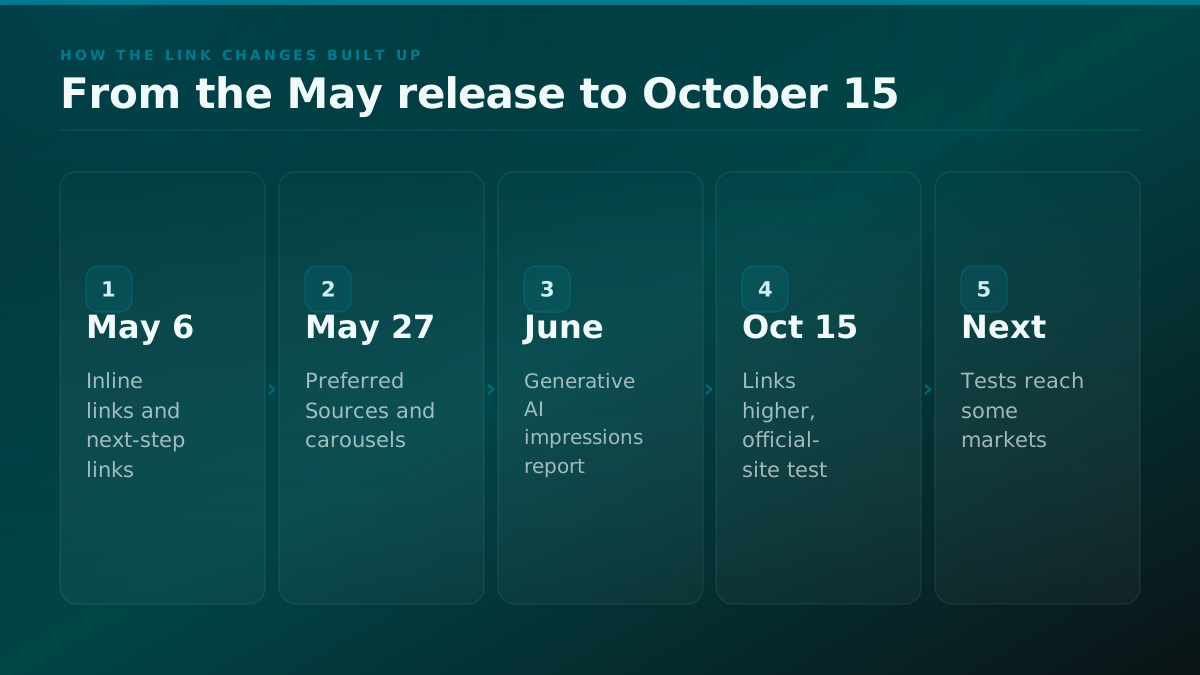
The May 6 release put inline links "right next to the relevant text" and added suggestions for where to go next at the end of many AI responses. 9to5Google's write-up of that release covers the same five items, including desktop hover previews. October moves the inline links higher and gives the end-of-response links thumbnails. Those are placement and design changes to slots that already existed.
The news carousels came with Preferred Sources in AI Mode and AI Overviews on 2026-05-27, in Google's post on finding original content. October takes them to "additional locations and languages globally" without listing which. If your traffic comes from the US, that expansion probably changed little for you.
New versus refined
The May 6 link release set beside the October 15 one
| 2026-05-06 release | 2026-10-15 update | |
|---|---|---|
| Inline links | Links placed next to the relevant text | Placed higher in responses, more often |
| Links at the end of an answer | Suggestions for where to go next | Thumbnails and a more clickable design |
| Official pages | Not present | Tested in a section at the top |
| Creators and publishers | Creator name, handle or community on discussion links | Clickable creator and publisher names on video, test |
| Click data published | Subscription labels clicked significantly more, no figure | None |
Which of the five changes add citation surface?
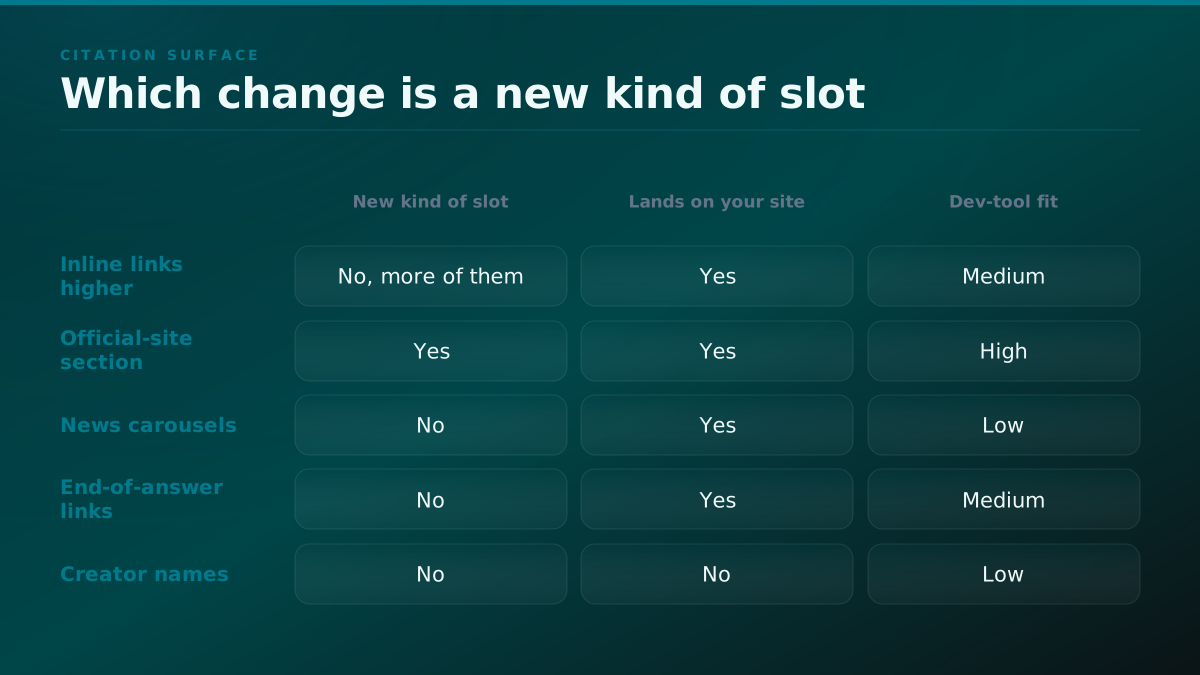
The official-site section, which holds one or two links for task queries, is the only new kind of slot among the five. The other four add more of an existing link type, or move, restyle or extend existing link positions. For a citation strategy, a new slot and a better-placed old slot are different things, and they need different responses.
Google says it has made "continued and substantial increases to the presence of inline links," so there are more inline slots than in May, though it gave no figure. The October update itself moves them higher. If your page was already cited inline, it may now appear earlier; if it was not, more slots raise the odds without promising anything.
End-of-response links work the same way, with thumbnails making the same slot more visible.
Creator names in video results link to a Google-hosted Search profile, not to your site. A click there lands on Google first. News carousels matter if you publish timely coverage, which most developer-tool companies do not.
Which changes add citation surface for a developer tool
| Change | New slot? | Lands on your site? | Relevance to a developer tool | Source |
|---|---|---|---|---|
| Inline links higher | More of them, no figure given | Yes | Medium, same citations placed earlier | derived |
| Official-site section | Yes, 1 to 2 links | Yes | High for docs, pricing, signup | derived |
| News carousels | No | Yes | Low unless you publish news | derived |
| End-of-response links | No | Yes | Medium for deep guides | derived |
| Creator and publisher names | No | No, Google profile | Low unless you publish video | derived |
as of 2026-10-24
Method: Our reading of Google's 2026-10-15 post against the 2026-05-06 post, applied to a developer-tool company. New slot means a link position that did not exist before the update. This is an analysis, not a measurement of live answers.
From the field
The official-site section is the only new kind of slot
Inline links, end-of-response links and news carousels all existed before October 15. The update adds more inline links, with no figure given, and moves or restyles the rest. Creator names link to a profile Google hosts. The official-site section is different. Google described it as a new display at the top of a response for the one or two official places to complete a task, with a note on why each is useful. For a developer tool, that is the change that can put a docs, pricing or signup page somewhere it was not.
Google, 2026-10-15, read 2026-10-24
What does the 7x Preferred Sources figure actually measure?
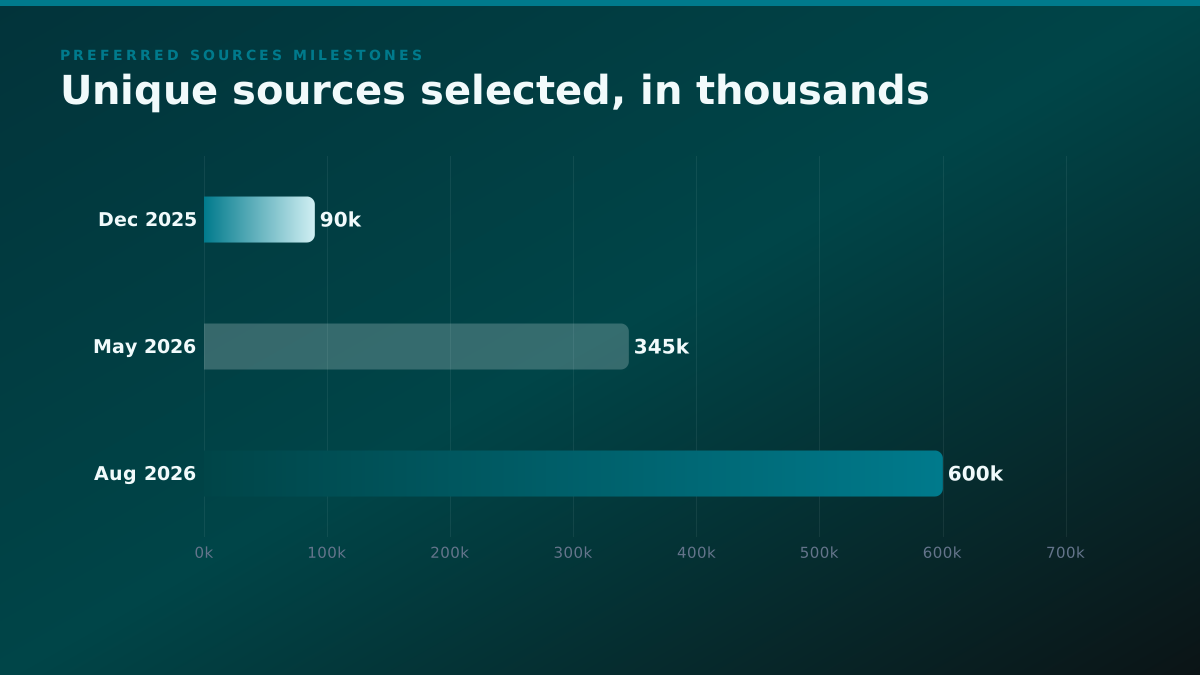
The 7x figure counts people, not sources and not clicks, and Google gave no starting number. Google's earlier milestones counted unique sources selected: nearly 90,000 on 2025-12-10, more than 345,000 on 2026-05-27, and more than 600,000 by 2026-08-20, as PPC Land compiled them. The October number switches unit.
A feature with a small base can multiply quickly, so 7x says the feature is growing and says nothing about its share of searchers. It also does not tell you whether anyone chose your site. For a developer-tool company the bigger point is scope. Preferred Sources mainly highlights coverage in news carousels, and most of your buyers' questions are not news queries.
Treat it as a signal about Google's direction rather than a lever. Google is building more ways for a searcher to say which sources they trust. That rewards being a source someone would choose, which is earned off your own site as much as on it.
Preferred Sources, in Google's own milestones
Unique sources selected as preferred, three reported points
| Point | Value (sources) |
|---|---|
| Dec 2025 | 90,000 sources |
| May 2026 | 345,000 sources |
| Aug 2026 | 600,000 sources |
What would an official-site section reward?
An official-site section appears to reward entity clarity: one canonical page per task, a page that states plainly what it is for, and a product name that matches everywhere. Google said each link comes "with context about why each link is useful," so a page that cannot say in a sentence what task it completes gives Google nothing to write. Google framed it as an expansion of what Search already does when someone looks for a particular site.
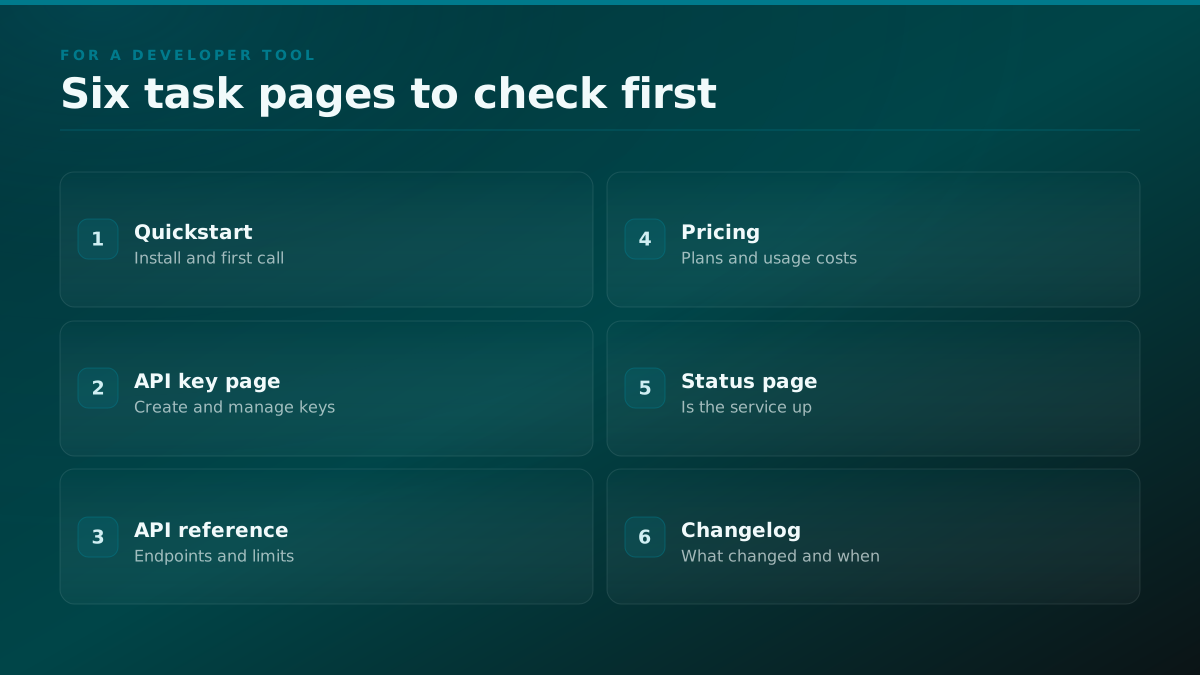
For a developer tool, the tasks are concrete: get an API key, install the SDK, read the rate limits, compare plans, or check whether the service is down. Each has one page that should own it, and that page is the candidate for one of the 1 to 2 links.
Three things lose that slot. Duplicate versions of the same docs page split the signal, and a blog post about the task competes with the task page. A product name that changes between docs, pricing and signup blurs which entity the page belongs to. Our note on making your docs agent-readable covers the structure side, and why documentation is not cited by AI covers the common failures.
Sometimes, there are only one or two official places on the web to complete a specific task or get the exact info you need.
What the test describes
Official links, shown above the answer
1 to 2
Links in the section
Task or exact info
Query type
Why it is useful
Context per link
Test
Status on 2026-10-15
- The page names the task it completes in plain words
- One canonical URL per task, no duplicate versions
- The product name matches across docs, pricing and signup
- A blog post about the task, rather than the task page itself
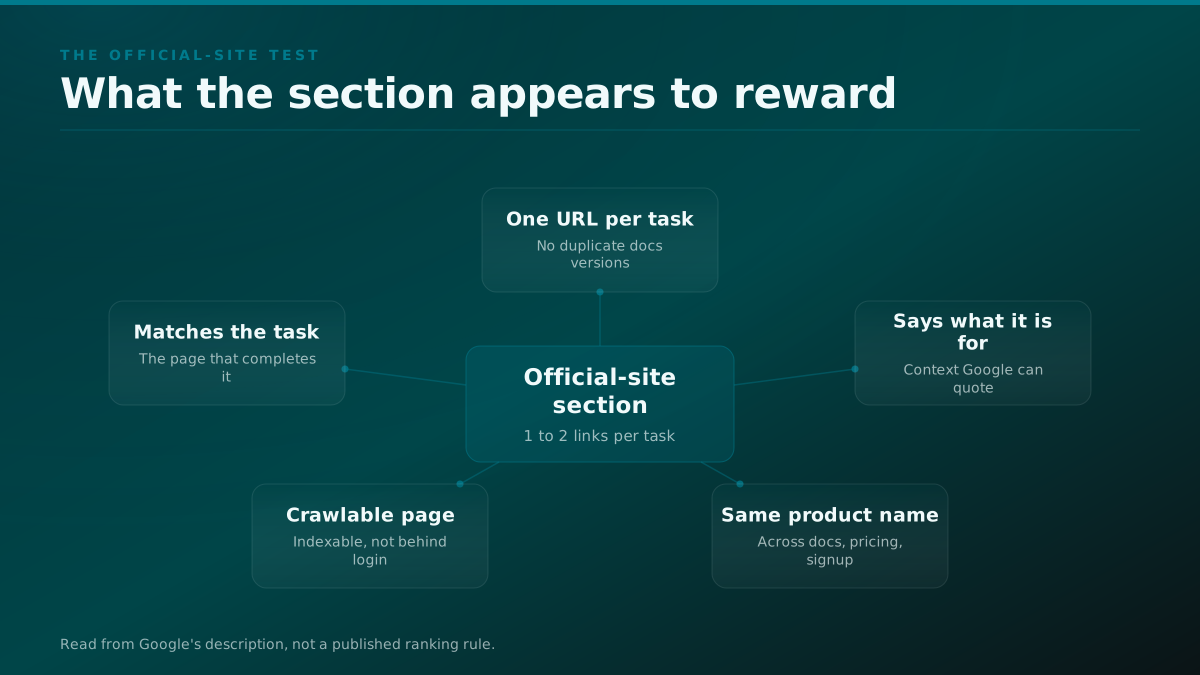
Google has not published how it decides which sites count as official, and PPC Land noted the post gives no examples. So this is a reading of the description, not a ranking factor. The useful part is that every trait above is checkable today and helps with ordinary search too. You lose nothing by fixing it before the test reaches your market.
Is a higher inline link worth more?
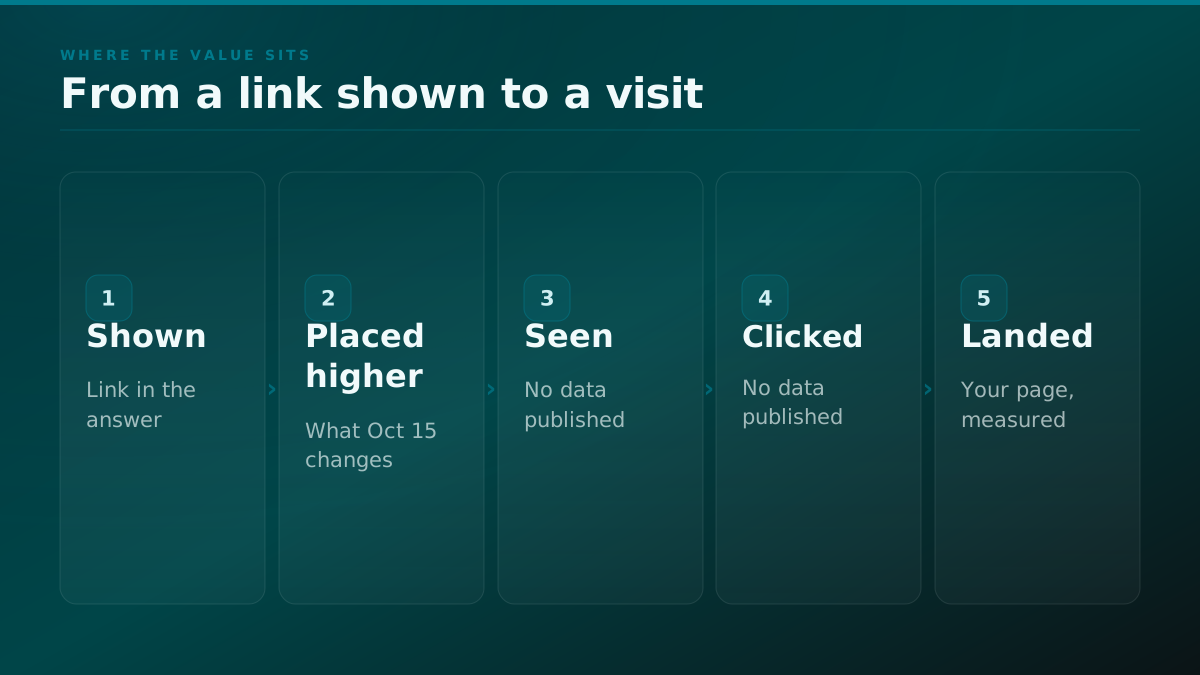
A higher inline link is worth exactly what its click-through is, and Google published no click-through figure. Position inside an answer is a proxy for attention, and attention is a proxy for clicks. The October post describes the first of those and stops. Until there is data on the rest, a higher link is a hypothesis about value, not value.
Reporting does not close the gap either. Search Console's Performance report documentation says an AI Overview "occupies a single position in search results," and a click on an external link inside it counts as a click. A link moved from the bottom of an Overview to the top keeps the same reported position, a point Search Engine Journal's coverage of the update also makes. If clicks change, you will see it in clicks, mixed in with everything else.
The dedicated generative AI reports do not help here. BetaNews reported that those reports count impressions in AI Overviews and AI Mode and still carry no click figures, with Google saying more metrics will come later. Our earlier note on what changes for AI Overview optimization found the same boundary in Google's help pages.
Worth knowing
Google published no click data for any of the five changes
The October 15 post describes links shown higher, more often and with more context. It does not say what share of responses carry inline links, how much higher they sit, or how many people click. Search Console documentation counts an entire AI Overview as a single position, so a link moved up inside it does not change the reported position at all. Any claim that the update raised traffic is, for now, a claim without a source.
Google post and Search Console Help, read 2026-10-24
A link shown higher is still a link shown. Until someone clicks it, the change moved pixels, not outcomes, and Google has not said how many people click.
The independent evidence on clicks points the other way, which is a reason for caution rather than despair. PPC Land summarised a randomized field experiment with 1,065 US participants that found AI Overviews cut outbound organic clicks by 39.8 percent.
More links inside a format that reduces clicks may recover some of them. Whether it recovers enough to matter for your pages is a measurement question, not something to assume.
How do you measure whether the October 15 change moved your citations?
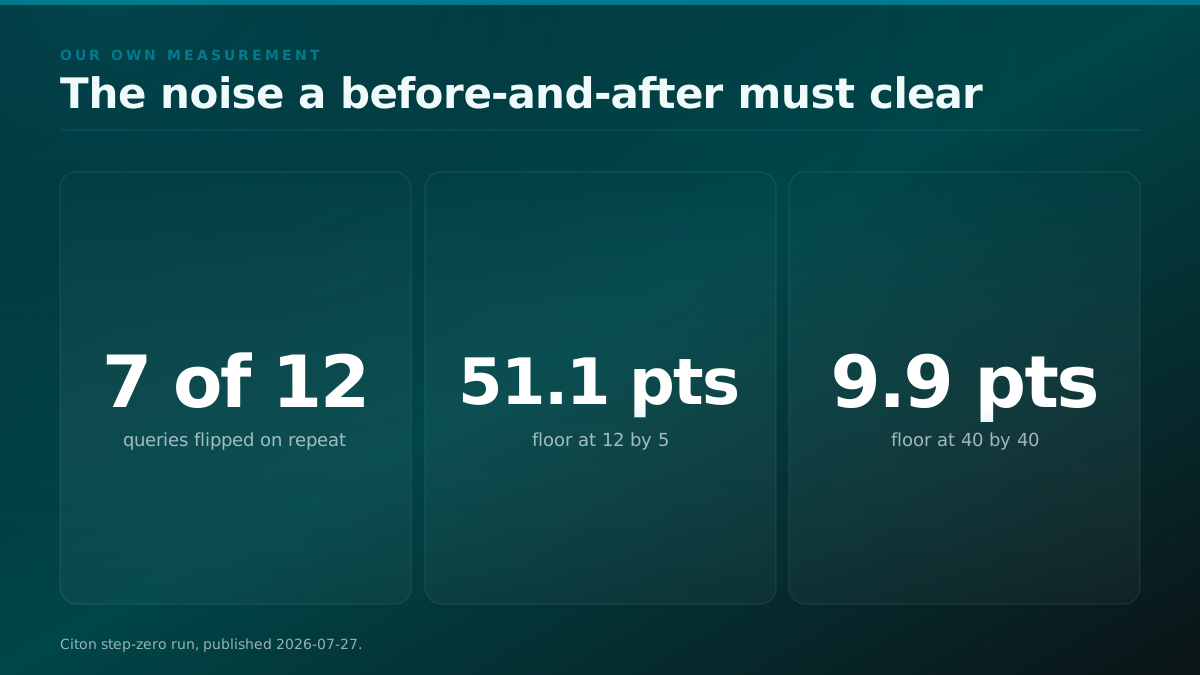
Measure it as a before-and-after with a held-out control, a frozen query set, repeats on every query, and a baseline anchored before 2026-10-15. Anything less cannot separate the update from ordinary noise. That noise is large: in our own step-zero run, 7 of 12 money queries flipped outcome across five identical asks with nothing changed.
Start with the window. A baseline taken after 2026-10-15 already contains whatever the launching changes did, so it cannot measure them. Use readings from before the announcement if you have them. If you do not, you can still measure the tests, because the official-site section and creator names will roll out unevenly and a held-out set will catch the difference as it arrives.
Then size the study before reading it. Our prompt tracking sample size note walks through the arithmetic. A 12 by 5 design can only detect a 51.1 point move, which would hide almost any real effect of a link placement change.
A 40 by 40 design gets the floor to 9.9 points at about 3,200 calls per timepoint, paid twice for a before and an after. We explain why one reading is a draw, not a score, in why a single AI visibility score is noise.
Our own measurement of how much noise a before-and-after has to clear
| Measurement | Result | What it means for the October 15 change | Source |
|---|---|---|---|
| 12 money queries by 5 identical repeats | 7 of 12 flipped, 60 of 60 calls succeeded | A one-read before-and-after cannot see the update | measured |
| Minimum detectable lift, 12 by 5 design | 51.1 points | Only a very large move is visible | derived |
| Minimum detectable lift, 40 by 40 design | 9.9 points at about 3,200 calls per timepoint | A realistic move becomes visible | derived |
n = 60 · as of 2026-07-27
Method: Our own step-zero run and power analysis, published 2026-07-27 at /blog/measurement/why-a-single-ai-visibility-score-is-noise. The first row is measured: 12 queries by 5 repeats on one model on one day. The two floors are derived from that variance. It measures volatility, not a causal lift.
What a before-and-after can see
Minimum detectable lift by measurement design, in points
| Point | Value (pts) |
|---|---|
| 12 queries by 5 repeats | 51.1 pts |
| 40 queries by 40 repeats | 9.9 pts |
STEPS
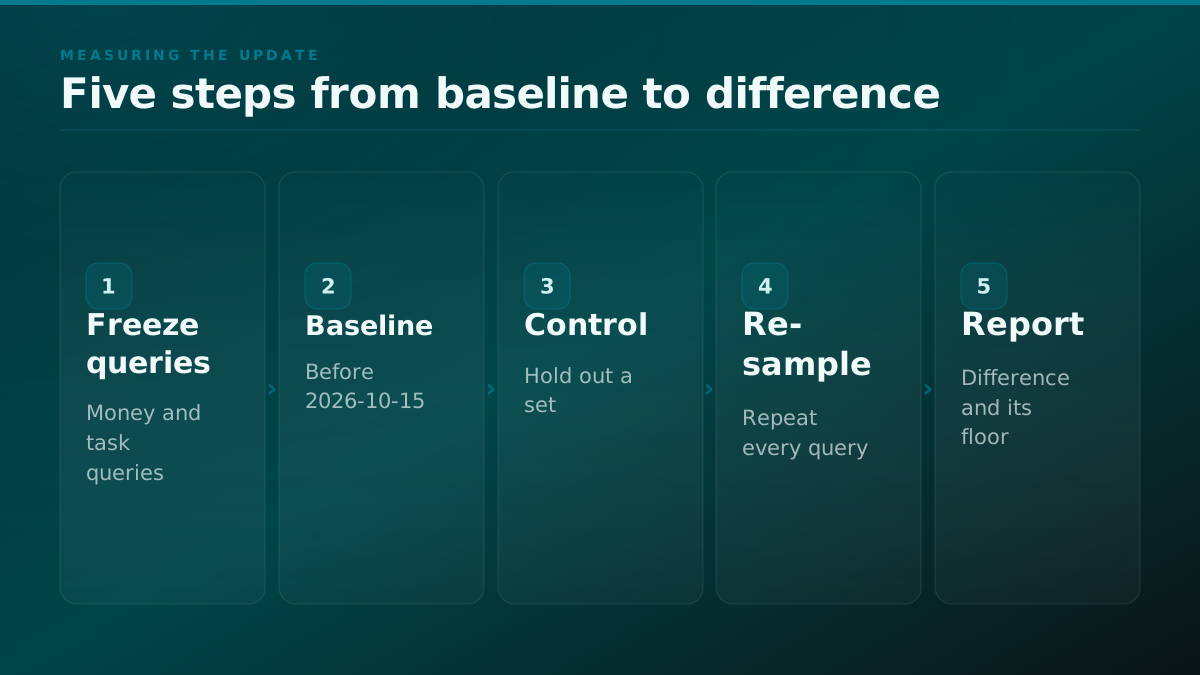
How to measure whether October 15 moved your citations
Freeze the query set
First
Pick the money queries where being cited changes a decision, including task queries such as how to get an API key. Do not edit the list mid-study.
Anchor the baseline before 2026-10-15
Second
Use readings taken before the announcement. A baseline that starts after it already contains the change.
Split off a held-out control
Third
Leave a comparable set of queries unworked, so a market-wide shift from the update moves both arms and subtracts out.
Re-sample with repeats
Fourth
Repeat each query. 7 of our 12 flipped outcome across identical asks, so one read is one draw.
Report the difference and its size floor
Fifth
State the gap between arms and the calls behind it. A 12 by 5 design sees only a 51.1 point move.
Record placement as its own field. For each answer, note whether you were cited, whether the citation was inline, and roughly where in the answer it sat. The October change acts on placement, so a study that only records cited or not cited will miss it entirely. The fuller procedure is in how to track AI visibility, and the source-side problem of reading a proxy instead of the real answer is in measuring ChatGPT citations.
Expect drift that has nothing to do with October. Cited pages rise and fade on their own, as we covered in why half of AI citations are under 13 weeks old. A control set is what lets you subtract that background movement from whatever the update did.
What should you not claim from the October 15 update?
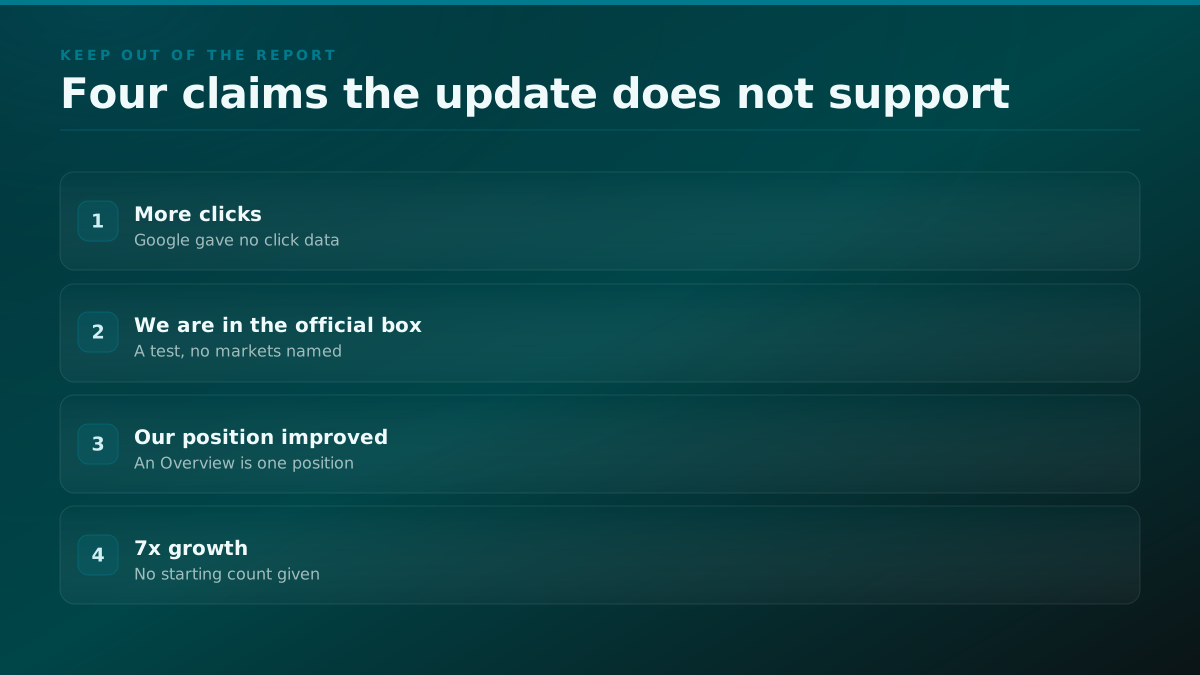
Do not claim the update sent you more clicks, that you are in the official-site section, that your reported position improved, or that a 7x growth rate has a known base. Each of those goes past what Google published on 2026-10-15. A report that makes any of them is telling a story the data cannot yet support.
The click claim fails because Google gave no click data. The official-section claim fails unless you have seen the section on your own queries, since Google named no markets for the test. The position claim fails because Search Console counts an AI Overview as one position, while AI Mode follows standard results-page position rules. The growth claim fails because Google gave no January baseline for Preferred Sources users.
What you can claim is narrower and stronger. You can say which of your task pages are ready for the official-site test. You can say whether your inline citations moved earlier in the answer across a frozen query set. And with a control, you can say whether your AI share of voice changed more than the market's did, the standard we hold our own work to in how to prove AEO caused a citation lift.
What should a developer-tool company do this week?
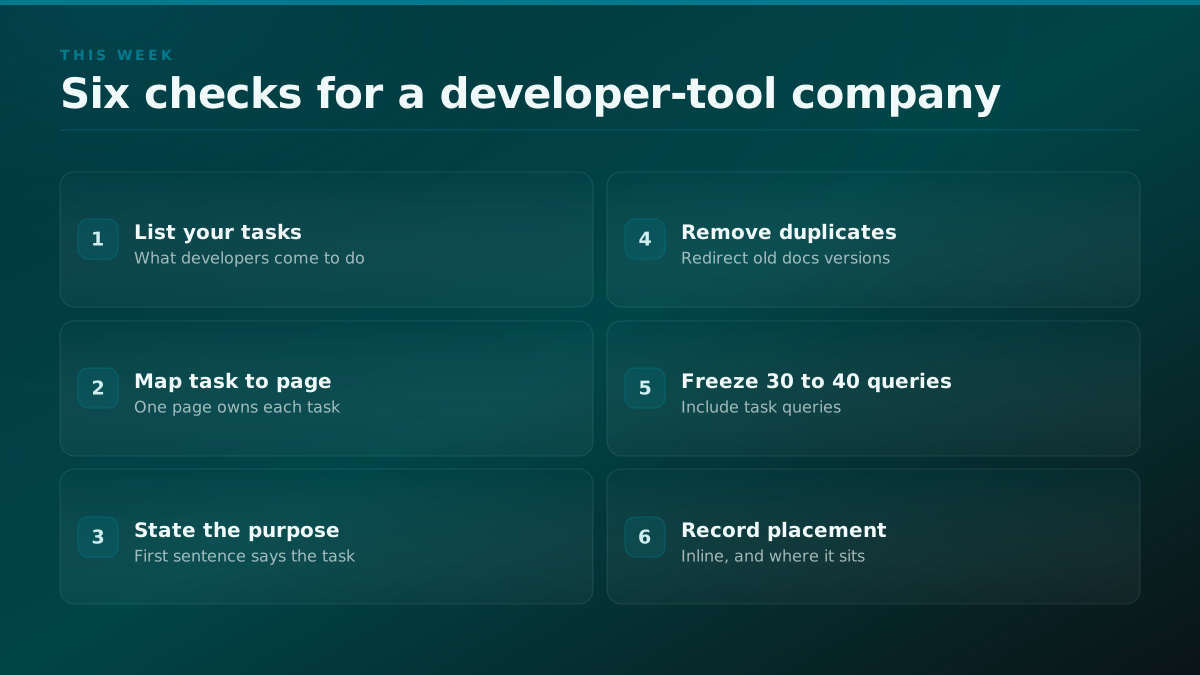
List the tasks a developer comes to you to complete, map each one to the single page that should own it, and start a baseline you can compare against. Those three steps prepare you for the official-site test and give you a way to judge the inline-link change. None of them depends on the test reaching your market first.
Make each task page say what it is for in its first sentence, because Google said the section will carry context about why each link is useful. Remove or redirect duplicate versions of the same docs page. Keep the product name identical across docs, pricing, signup and the status page. If you publish video and qualify, claim a Search profile so the creator-name test has somewhere to point.
Then freeze 30 to 40 money queries, including the task queries, and record placement on every read. A small set gets you a direction, and a larger one gets you a number you can defend. If you are unsure which questions your buyers ask, the developer-tool buyer questions are a starting list.
Where this sits in the work of getting cited
The October 15 update is a change to the display, not to how pages earn a citation. The work of getting cited is still making your pages the ones an assistant reaches for when a buyer asks a question that does not contain your name. What the update changes is how visible that citation is once you have it, and it adds the only new kind of slot, for task pages.
What we sell is that work for developer tools and APIs, measured. Our answer engine optimization work maps tasks to canonical pages, earns citations on and off your site, and measures a difference against a held-out set. We publish how we measure the lift so the method is auditable before any number is, and that method is the answer when a buyer asks how you would know the update helped. If you are weighing a tool against an agency for this, we compare the two in AEO agency or AI visibility tool.
Methodology: what we read and what we did not
Every fact about the five changes comes from Google's 2026-10-15 post and the 2026-05-06 post it builds on, both read on 2026-10-24. The single-position rule is from Search Console Help. Preferred Sources milestones and the randomized click study are secondary, through PPC Land, and are labelled that way.
We did not observe the official-site section or the creator-name test in live answers, and Google named no markets for either. The noise and detection-floor figures are our own, published on 2026-07-27, from a 12 by 5 run on one model on one day. They measure volatility, not a lift from this update. Nothing in this post claims the update raised anyone's citations or clicks.
Sources
Every number above, and where it came from. A figure without a row here is one we should not have printed.
- Google, More ways to connect with the web from Search
- First-party announcement by Hema Budaraju, VP Product Management, dated 2026-10-15. Lists the five link changes to AI Mode and AI Overviews and states that Preferred Sources use has grown by more than 7x since the start of the year. Read 2026-10-24.
- Google, 5 new ways to explore the web with generative AI in Search
- First-party announcement dated 2026-05-06. Introduced links at the end of many AI responses, news subscription labels, firsthand perspectives, inline links next to relevant text, and desktop hover previews. Read 2026-10-24.
- Google Search Console Help, Performance report
- First-party documentation of how AI Overviews and AI Mode are counted. An AI Overview occupies a single position, and a click on an external link inside it counts as a click. Read 2026-10-24.
- Nick Fox on X, 2026-10-15
- Post by Google's SVP of Knowledge and Information summarising the same five changes, including a section that highlights the 1 to 2 links needed to complete a task. Pulled 2026-10-24 with 15,129 views and 107 likes.
- PPC Land, Google pushes links higher in AI answers as Preferred Sources use rises 7x
- Secondary coverage, read 2026-10-24. Notes that two of the five changes refine May 2026 features, that the post carries four different status levels, and that it includes no click-through figure.
- BetaNews, Google moves inline links higher in AI Mode and AI Overviews
- Secondary coverage dated 2026-10-16, read 2026-10-24. Reports that the Search Console generative AI reports count impressions and still carry no click figures.
- 9to5Google, Google making links in AI Mode and AI Overviews a bit more direct
- Secondary coverage of the 2026-05-06 release that the October changes build on. Read 2026-10-24.
- Citon, Why a single AI visibility score is noise
- Our own step-zero measurement, published 2026-07-27. 12 money queries by 5 identical repeats, 60 of 60 calls succeeded, 7 of 12 flipped outcome. Power analysis: a 12 by 5 design detects only a 51.1 point move, a 40 by 40 design reaches 9.9 points.
Questions about Google's October 15 AI Mode link update
- What did Google change in AI Mode and AI Overviews on October 15, 2026?
- Google announced five link changes in a post by Hema Budaraju. Inline links appear higher more often, an official-site section is being tested at the top of some answers, news carousels expand to more countries and languages, end-of-response links gain thumbnails, and AI Mode is testing clickable creator and publisher names on video results.
- Does the official-site section mean my homepage will be shown?
- Not necessarily, and probably not your homepage. Google described the section for the one or two official places to complete a specific task or get exact information, so the page that fits is the task page itself, such as a quickstart, API key page or pricing page. It is also a test, and Google named no markets.
- Will inline links shown higher send more clicks?
- Google did not say. The post gives no share of responses with inline links, no measure of how much higher they sit, and no click figure. Search Console counts an AI Overview as a single position, so the reported position will not move when a link moves up inside it.
- Which of the five changes are new and which refine earlier features?
- Inline links and the links at the end of responses refine features from the [May 6, 2026 release](https://blog.google/products-and-platforms/products/search/explore-web-generative-ai-search/). News carousels expand a format from May 27. The official-site section and clickable creator names on video results are new, and both are tests.
- How should I measure whether the update changed my AI citations?
- Freeze a set of money queries, anchor a baseline before 2026-10-15, hold out a comparable control set, and re-sample with repeats after the change. In our own run 7 of 12 queries flipped across identical asks, and a 12 by 5 design can only detect a 51.1 point move, so size the study before reading it.
- What does the 7x Preferred Sources figure mean for a developer tool?
- Less than it sounds. Google said the number of people using Preferred Sources grew more than 7x since the start of 2026 without giving the starting count. Preferred Sources mainly highlights news coverage in carousels, so for most developer-tool companies it is a minor channel.
Keep reading
AI citations
AI Overview Optimization: What Actually Changes
Google ranks first for "AI Overview optimization" and says no special optimization exists. What the docs state, what the studies measured, what nobody tested.
42 min read
AI citations
Perplexity SEO: How Perplexity Picks the Sources It Cites
Perplexity has published its retrieval pipeline, crawler rules and source review. The ten pages ranking for "perplexity seo" quote none of it. This one does.
46 min read
AI citations
Schema Markup for AI Search: How to Isolate the Variable (2026)
Ahrefs tracked 1,885 pages adding schema and citations barely moved. Here is how to isolate structured data as a variable, and what a null result looks like.
80 min read