Best AI SEO Agency for Developer Tools and API Companies
A five-question checklist for vetting an AI SEO agency, built from what real developer-tool buyers report going wrong, not a ranked vendor list.
Citon24 min read
Short answer
How do you choose the best AI SEO agency for a developer tool or API company?
The best AI SEO agency for a developer tool or API company is the one that passes a five-question checklist, not the one that ranks highest for this search, because the current results are almost entirely agencies describing themselves as the best choice. The checklist: what specific AI-citation deliverable do they produce beyond generic backlinks, how do they measure whether an answer engine actually started recommending you, do they understand that a developer buyer researches inside documentation and package registries rather than review sites, will they name the queries they are targeting before signing, and what would they say if the number did not move. A vendor with real answers to all five has a legitimate claim on the developer-tools and API niche. A vendor who answers with a rising screenshot and nothing else is selling relabeled SEO.
Type "best ai seo agency" into Google today and seven of the ten results are agencies describing themselves as the best choice. Two more are raw Reddit and Quora threads, unresolved arguments rather than answers. None is an independent checklist a buyer could actually run against a vendor before paying them. That gap is not an accident of one search term. It is the shape of the entire category right now, and the buyers showing up in r/SEO already know it, because at least one of them already paid the price of trusting the wrong pitch.
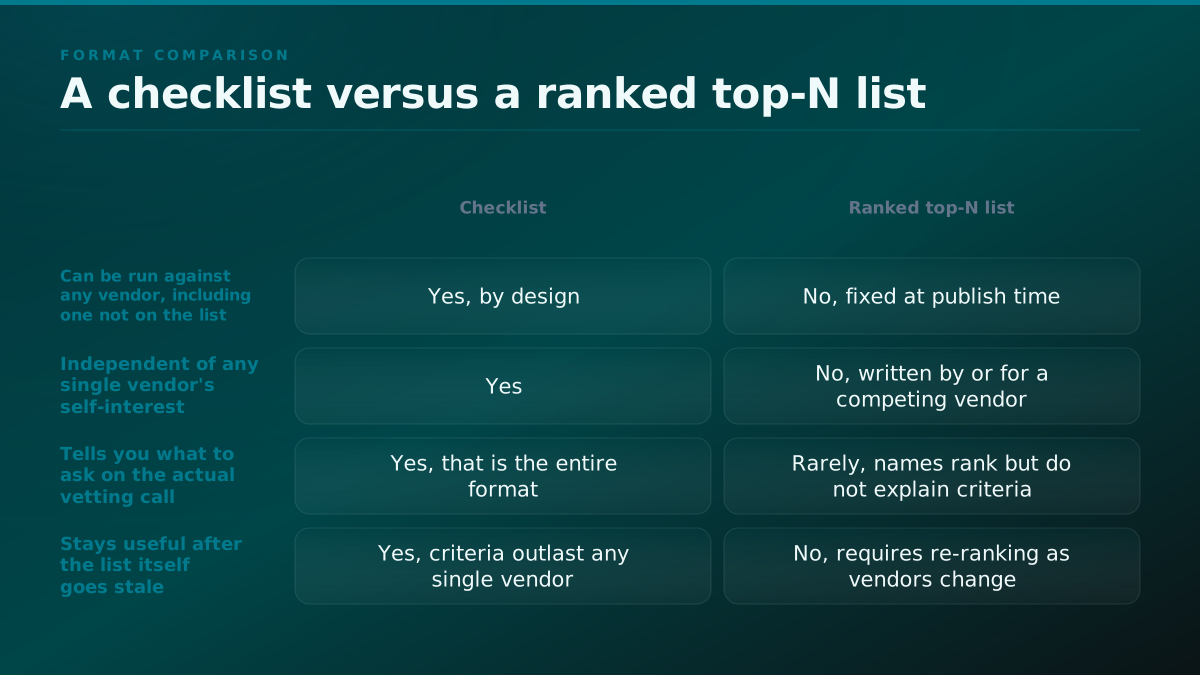
This post is not a ranked list, and it is worth saying why up front rather than at the end. A ranked list of "best" agencies, written by anyone with a stake in the category, inherits the same conflict of interest as the seven self-serving results already occupying the search results. What a buyer searching this term actually needs is not another name to add to the shortlist, it is a way to test any name on that shortlist, including names that never show up in a search result at all because the agency is small, new, or found through a direct referral. The rest of this post is that test: five questions, a twenty-minute call structure, and the specific red flags that show up when an agency's real capability does not match its pitch.
The 4,200 USD question nobody answered
A buyer on r/SEO described paying an AEO agency a four-figure monthly retainer for a local service business. What came back was backlinks and a handful of meta-description edits, the same deliverables that show up on a standard SEO package, just billed under a newer name. A hundred and four comments followed, and the overwhelming majority were some version of the same unanswered question: how would you even know if this worked.
That thread is not an outlier. A second buyer, in a general marketing subreddit, asked whether AEO retainers buy anything beyond a checklist they could implement themselves for free, which is a sharper version of the same underlying concern: is the vendor doing something a buyer genuinely could not do alone, or selling access to information that was never scarce in the first place.
A third thread, from a founder on r/SaaS, skips the skepticism and goes straight to the practical question: what should I even ask on the vetting call. Forty-eight comments followed, mostly other founders comparing notes on vendors nobody in the thread had a confident answer about.
The buyer's question is never "who is the best agency." It is "how would I know if this one is lying to me," and a ranked top-N answers a question nobody in these threads is actually asking.
What "AI SEO agency" actually means, and why the category can't agree on a name
Ask five different practitioners what to call this service and you will get at least three answers: AEO (answer engine optimization), GEO (generative engine optimization), and AIO (AI optimization), sometimes from the same person in the same sentence. A thread in r/b2bmarketing asking about the "best GEO / AEO / AIO agencies for local businesses" uses all three terms interchangeably in its own title, which is a small but telling signal. A category whose own buyers cannot agree on what to call it is a category where the vendors have moved faster than the language buyers need to compare them.
A category that cannot agree whether it is called AEO, GEO, or AIO in the same Reddit thread is a category where the vendors have outrun the buyers' ability to compare them.
Underneath the naming confusion, the actual work these agencies claim to do is fairly consistent: getting a brand mentioned, cited, or recommended when someone asks an AI system a question relevant to that brand, as opposed to only ranking a page in traditional search results. The mechanism differs from classic SEO in a specific way. A search ranking is a single, observable position on a page. A citation inside a generated answer is a probabilistic outcome of a model's training and retrieval process, which means it can change between two identical questions asked minutes apart with nothing else different, a property the reported score alone can never distinguish from real work.
The vocabulary confusion is not purely academic. It has a direct, practical cost during vendor selection, because a buyer searching "best AEO agency," "best GEO agency," and "best AI SEO agency" separately will see three overlapping but not identical sets of results, and a vendor who ranks well for one term and poorly for another is not necessarily worse at the work, they may simply have picked a different label to build their site around. Comparing agencies purely on which term they rank for conflates SEO performance on the vendor's own marketing site with the actual quality of the AEO work they deliver for clients, two things a buyer should evaluate separately and frequently does not.
The breadth of active discussion is itself evidence the category is not niche anymore. A site-restricted LinkedIn search for "best ai seo agency" returns 26 distinct authors posting within a single 90-day window, real breadth rather than one vendor's own repeated posting, which means a buyer has a genuine, ongoing peer conversation to draw on beyond whatever a single vendor's sales deck claims. Review platforms like G2 surface a second, structured layer of the same conversation, buyer-submitted ratings and comparisons that sit alongside the raw Reddit and LinkedIn threads, though a buyer should read a review-platform score the same way this post argues a visibility score should be read: a directional signal, not a substitute for the five questions above.
At least one vendor in this category is marketing directly against the trust problem the Reddit threads describe. An account self-identifying as an AEO agency positions itself around "results before contracts," a pitch that only makes sense if the market's default assumption is the opposite, that a buyer is expected to sign a contract and hope the results follow. Whether or not that specific vendor delivers on the promise, the existence of the pitch is itself evidence that outcome-less retainers are common enough in this category to be worth marketing against directly.
A buyer evaluating that kind of pitch should still apply the same five questions rather than taking the marketing claim at face value. "Results before contracts" is a positioning statement, not a measurement design, and a vendor can genuinely believe they deliver results while still lacking any mechanism to separate their work from what the underlying model would have done anyway. The pitch earns attention. It does not skip the vetting call.
The pattern behind the SERP: agencies grading their own homework
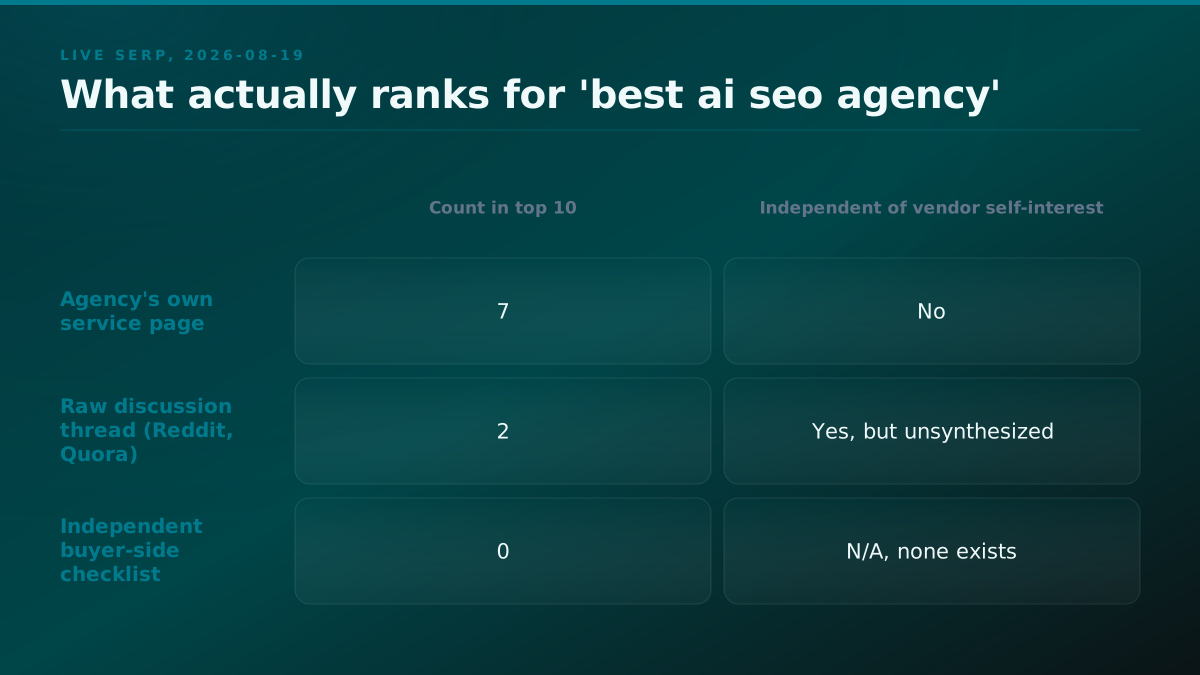
Pull the current top 10 for "best ai seo agency" and the shape is stark. Seven results are agency service pages, each naturally positioning that agency as the top choice. Two more are Reddit and Quora threads, raw discussion rather than synthesis. Zero is an independent, third-party checklist a buyer could run against any vendor, including the ones ranking on this exact page.
What actually ranks for "best ai seo agency" right now
| Result type | Count in top 10 | Independent of vendor self-interest |
|---|---|---|
| Agency's own service page | 7 | No |
| Raw discussion thread (Reddit, Quora) | 2 | Yes, but unsynthesized |
| Independent buyer-side checklist | 0 | N/A |
None of this makes the seven agency pages dishonest. It makes the format structurally incapable of answering the question a real buyer actually has. An agency's own "why choose us" page cannot, by construction, walk a reader through the failure mode described in the 4,200 USD thread above, because admitting that failure mode is common would undercut the pitch on the same page. The gap only closes with a source that has no stake in which agency a reader eventually picks, which is most of the reasoning behind this post's own framing.
The five questions that separate real AEO work from relabeled SEO
Strip the marketing language off any AEO pitch and there are five questions worth asking before signing anything, in this order, because each one gets harder for a vendor without real capability to answer honestly.
At a glance
The five questions, and what a real answer sounds like
| Question to ask | What a real answer sounds like |
|---|---|
| What AI-citation deliverable do you produce beyond backlinks? | Names a specific artifact, a schema change, a documentation rewrite, a structured answer block, not "content and links." |
| How do you measure whether an answer engine actually cited us more? | Describes a repeated-prompt measurement with a stated trial count, not a single before/after screenshot. |
| Do you understand how a developer buyer actually researches? | Talks about documentation, package registries, and Stack Overflow-shaped questions, not generic "best tools for X" queries. |
| Will you name the queries you are targeting before we sign? | Hands over a real, specific query list up front, not "we'll figure that out during onboarding." |
| What would you tell me if the number did not move? | Has an actual answer, including "here's how we'd know it was the model and not the work." A shrug is informative on its own. |
The first question, what specific deliverable beyond backlinks, is the cheapest to fake and the easiest to check. Ask for three examples of the actual artifact, a schema change, a rewritten documentation page, a structured answer block, not a description of a process. A vendor who cannot produce one concrete example is describing a service they have not actually delivered yet.
The second question, how is success measured, is where most pitches fall apart under specific pressure. Our own research on the difference between a score and a proof goes into this in more depth, but the short version matters here too: a single before-and-after reading cannot separate a vendor's actual work from the underlying model changing its own behavior between the two readings. Only a held-out control, queries deliberately left unworked over the same window, gives a buyer a real comparison point.
A vendor claiming their work caused a citation increase owns the burden of showing what would have happened without them. It does not sit with the buyer to disprove a chart they had no part in producing.
Why developer-tool and API buyers need a different framework
The third question on the checklist, whether the vendor understands how a developer buyer actually researches, is the one most generic AEO pitches answer worst, because it is the one their existing playbook usually was not built for.
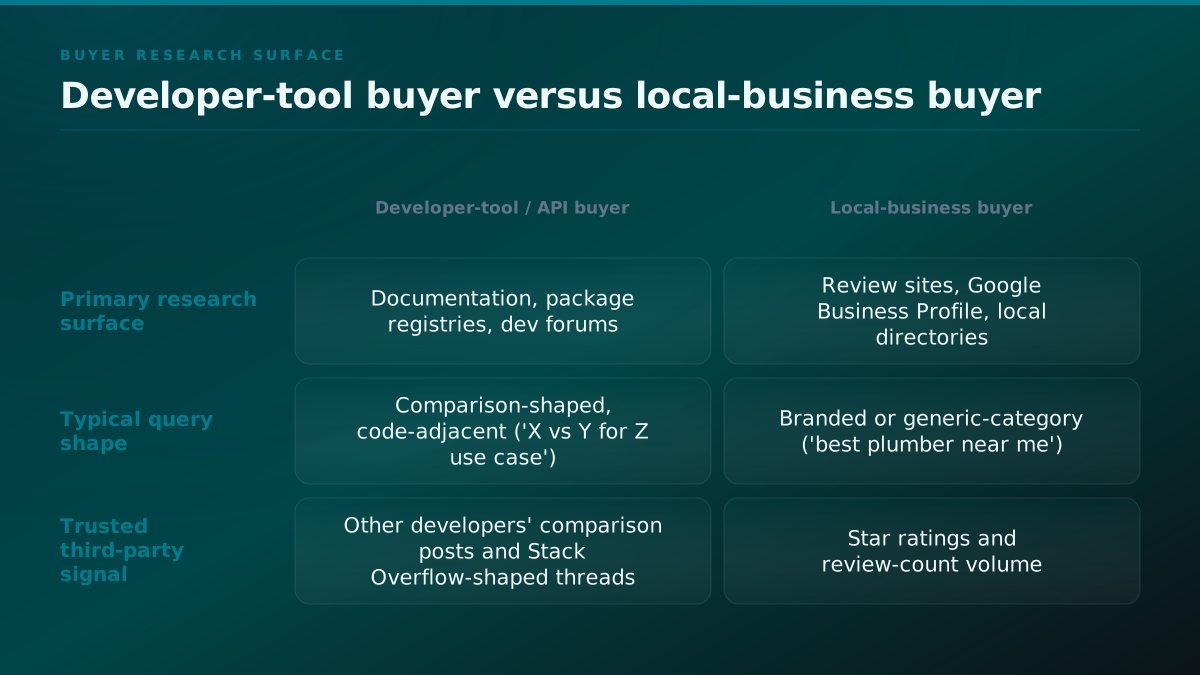
A developer deciding whether to integrate your API is not reading a "best tools for X" listicle written for a general consumer. They are reading your documentation, checking your package registry listing, searching for how other developers describe integrating you, and asking an AI assistant a specific, often code-adjacent question, "does this API support webhook retries," not "what is the best API platform." An agency whose case-study library is entirely local service businesses, restaurants, dentists, contractors, has built a playbook around review sites, local directories, and Google Business Profile signals. None of those three surfaces has much in common with a package registry README or a Stack Overflow-shaped question, and a pitch that does not distinguish between the two audiences is a pitch that has not actually thought about your buyer.
This distinction shows up directly in the buyer evidence. The 4,200 USD post describes a pool-service business, squarely a local-search buyer. The r/SaaS thread and the r/AskMarketing thread are both from founders and operators of software products, a structurally different citation surface, and neither thread gets a confident, specific answer about vendors who actually specialize in it. That gap between the two buyer types, present in the raw evidence and absent from the search results, is exactly where a developer-tool-specific vetting question earns its place on the checklist.
Consider what an AI assistant is actually doing when someone asks it a developer-tool question. A prompt like "what's a good API for sentiment analysis with a generous free tier" pulls from a different corpus than "best local plumber near me." The model is more likely to weight documentation quality, changelog activity, community discussion on developer forums, and whether other developers have written comparison posts naming the product directly, over the kind of review-aggregator and local-citation signals a consumer-facing AEO playbook is built around. An agency optimizing a developer tool's AEO the same way it optimizes a plumber's is optimizing the wrong surface, and the reported citation count can still rise, because general brand-name mention volume is not the same signal as being recommended in a technical, comparison-shaped answer.
This has a direct implication for what to ask on the vetting call beyond the five general questions. Ask whether the agency has ever produced a documentation-facing deliverable, a rewritten API reference page, a corrected changelog entry, a structured FAQ block embedded in developer docs, as opposed to only a marketing blog post. Ask whether they track citation behavior specifically on technical, comparison-shaped prompts ("X vs Y for Z use case") rather than only branded or generic-category prompts. An agency with real developer-tool experience will have concrete, specific answers to both. An agency without it will describe the same generic content-and-links process regardless of which question is asked, which is itself the signal, and one worth listening for rather than talking past on the actual call.
What does an AEO agency retainer actually cost?
Pricing in this category is opaque by default, most agencies quote after a discovery call rather than publishing a rate card, which is itself a minor red flag when it is the ONLY pricing signal a prospect gets. The real market ranges, based on what buyers report paying and how agency economics scale with account complexity, break down by buyer profile.
What an AEO or AI-SEO agency retainer actually costs
| Buyer profile | Typical monthly retainer | What it usually buys |
|---|---|---|
| Local service business (the profile behind the 4,200 USD Reddit post) | 2,000 to 4,500 USD a month | Reddit/community posting, a handful of backlinks, and light schema work, frequently relabeled from an existing SEO package. |
| Small B2B SaaS or early-stage developer tool | 3,500 to 9,000 USD a month | A mix of content, schema, and some measurement, quality varies widely by vendor and rarely includes a real control group. |
| Mid-market or enterprise developer platform | 12,000 to 25,000 USD a month | Dedicated technical writing against documentation and API references, structured-data work at scale, and, from the more rigorous vendors, an actual held-out measurement design. |
| Standalone AEO audit, no ongoing retainer | 1,500 to 5,000 USD one-time | A citation-gap analysis and a prioritized fix list, without execution. |
From the field
A monitoring subscription and an agency retainer are not competing for the same budget line
Otterly.AI's published pricing starts at 29 USD a month for self-serve tracking of brand mentions and citations across ChatGPT, AI Overviews, AI Mode, Gemini, Perplexity and Copilot. That is roughly two orders of magnitude below even the smallest agency retainer in the table above, because it is answering a narrower question, how often are we mentioned, not doing any work to change the answer. A buyer comparing a 29-USD-a-month tool against a 4,000-USD-a-month agency retainer is not comparing two versions of the same purchase; conflating them is one of the more common ways an agency pitch inflates its own perceived value.
The 4,200-USD-a-month figure from the opening Reddit thread sits inside the local-service-business range, which is useful context: that buyer was not overpaying relative to the market, they were paying a normal price for work that turned out to be a normal SEO retainer wearing a new label. The failure was never the price. It was the mismatch between what was billed and what AEO-specific work should have looked like.
Two other cost patterns are worth naming because they distort a buyer's sense of what a fair price looks like. First, an agency quoting well below the ranges above for a developer-tool or enterprise account is not necessarily a bargain; it is more often a signal that the deliverable list matches the local-business tier regardless of the account's actual complexity, the same relabeling problem at a different price point. Second, an agency quoting well above the enterprise range with no mention of a measurement design is charging premium pricing for the same unproven work described throughout this post, dressed up with more account management overhead rather than more rigor.
What does good AEO measurement actually look like?
Question two on the checklist, how success is measured, deserves more depth than a single line on a vetting call can cover, because it is where the entire category's credibility problem actually lives. A vendor showing a rising number on a dashboard has shown you a fact. It has not shown you a cause.
The instrument that closes that gap is a held-out control: a set of queries relevant to your product, split into two groups before any work begins, one group actively worked by the agency and one group deliberately left alone for the same window. At the end of the period, both groups are re-measured with the same instrument, and the number that matters is the difference between them, not either group's raw level. Whatever the underlying model did on its own during that window, a version update, a shift in how it weights a certain kind of source, happened to both groups equally, so that shared movement cancels out of the difference and only the attributable part remains.
This is not a novel technique invented for AEO. It is the standard design for any noisy, comparison-based online metric, borrowed directly from how a controlled experiment isolates cause from coincidence in any field where a single before-and-after reading is not trustworthy on its own. What makes it unusual in the AEO agency market specifically is how rarely it gets applied. A held-out control costs a real, deliberately unworked slice of a client's own query coverage for the length of the engagement, which is a harder thing to sell than a chart that only goes up, and it delays any reportable number until the measurement window actually closes. Both of those properties make it commercially unattractive relative to a single rising screenshot, even though it is the only design that answers the causation question a buyer actually has.
A buyer does not need to run this measurement themselves to benefit from understanding it. Knowing the design exists changes what to ask for: not "can you show me the number went up," but "can you show me the difference between what you worked and what you deliberately left alone." A vendor with a real answer has done the work described in this section, whether or not they use the term "held-out control" by name. A vendor without one is reporting a level, not a difference, and a level cannot rule out the number having moved on its own.
Five red flags worth naming directly
A single warning sign in a pitch is not disqualifying on its own, every real agency has an imperfect deck somewhere. Two or more in the same conversation is a pattern.
Five red flags in an AEO agency pitch, and what they usually mean
| Red flag in the pitch | What it usually means |
|---|---|
| The deliverable list is identical to their SEO retainer, plus the word "AEO" | Backlinks and meta tags relabeled. The work does not change; the invoice does. |
| The proof they show is a single before/after screenshot | No control, no repeated measurement. The number could be the model changing its own behavior, not their work. |
| They cannot name a single query they are optimizing for before you sign | No developer-specific research has happened yet, and may never happen. |
| Every case study is a local service business | Their playbook is built for citations pulled from review sites and local directories, a different surface than documentation and package registries. |
| A vague "trust us" replaces a specific answer to what happens if the number does not move | There is no plan for the outcome they are least incentivized to admit is possible. |
None of these five signals requires specialized expertise to spot. Each is checkable by asking one direct question and listening for whether the answer is specific or generic, which is deliberately how the checklist is designed: a buyer should not need to already understand AEO measurement theory to protect themselves from a bad engagement, they need to know which questions expose the gap between a real capability and a well-rehearsed pitch.
The most common of the five, in practice, is the first: a deliverable list that is a copy of the agency's existing SEO retainer with "AEO" appended to the header. This is not always deliberate deception. Some agencies genuinely believe backlinks and content improve AI-citation likelihood the same way they improve search ranking, and there is a reasonable argument that authoritative backlinks help both. The problem is presenting that as AEO-specific work rather than general SEO that might have a secondary AEO benefit, a distinction the pitch decks in these threads consistently blur.
Running the checklist against the 4,200 USD case, retroactively
It is worth closing the loop on the thread this post opened with, because a framework is only useful if it actually would have caught the problem it is built around. Applying the five questions to the 4,200-USD-a-month engagement described in the opening Reddit thread, based on what the buyer reported receiving:
Question one, what specific AI-citation deliverable beyond backlinks: the buyer describes backlinks and meta-description edits, both classic SEO deliverables with no AI-citation-specific artifact named. Fail.
Question two, how is success measured: no measurement design is mentioned at all in the buyer's account, only the absence of any way to tell whether the retainer changed anything. Fail.
Question three, does the vendor understand the buyer's actual research surface: the account gives no indication the agency distinguished a local service business's citation surface from any other, which for a local business happens to be the right surface by coincidence rather than by design. Indeterminate, leaning fail given questions one and two.
Question four, will they name the queries up front: not mentioned in the buyer's account, and the absence of any query-specific detail in a retrospective description this thorough is itself suggestive.
Question five, what would they say if the number did not move: unanswerable from the account, because the buyer never got a number to begin with, which is arguably a worse outcome than a number they could not trust.
Four of five questions come back as clear or likely fails, using only the information the buyer volunteered publicly with no follow-up questioning. That is the practical value of running a structured checklist instead of a gut read on a sales deck: the failure would have been visible in the first twenty-minute call, months before the first invoice.
How do you run the vetting call?
A twenty-minute call, structured around four questions asked in order, gets a buyer most of the way to a real answer without needing to become a measurement specialist themselves.
STEPS
How to run the vetting call in under twenty minutes
Ask for the query list first
Minutes 0 to 5
Before pricing, before the deck, ask which specific queries they would target for your product. A vendor with real developer-tool experience answers this in the room. A vendor without it stalls or gives you a generic category answer.
Ask what they will not promise
Minutes 5 to 10
A vendor willing to name what AEO work cannot guarantee, model behavior changing on its own, a competitor doing the same work, is more credible than one who promises a number.
Ask for the measurement design in writing
Minutes 10 to 15
Not a slide. A one-paragraph description of how they will separate their work from everything else that could move a citation count. If it does not exist yet, ask when it will.
Ask what happens if the number does not move
Minutes 15 to 20
The answer to this question is the single highest-signal moment of the call. A real answer names a diagnosis process. A non-answer names a renewal date.
The fourth step, asking what happens if the number does not move, is worth dwelling on because it is the single highest-signal moment of the entire call. A vendor with a real measurement practice has thought about this scenario in advance and has an actual diagnostic process: check whether the model itself shifted for the whole category, check whether a competitor launched something, check whether the query set drifted. A vendor without that practice either promises a number they cannot guarantee, or pivots to talking about the contract renewal date instead of the diagnosis. Listen for which one happens.
Three shapes of vendor, and which fits which buyer
Not every buyer needs the most rigorous option available. A team with no budget for active work yet may genuinely be better served by a cheap monitoring subscription than an expensive agency retainer they are not ready to act on.
01 / A self-serve monitoring tool
- Stands out
- Cheap, immediate, and gives you a real number to check weekly, from around 29 USD a month.
- Best for
- A team that wants visibility into whether they are cited at all, with no budget or intent to run active work yet.
- Falls short
- Reports a score with no comparison point. It cannot tell you whether a change was caused by anything you did.
02 / A generalist SEO or marketing agency adding AEO as an upsell
- Stands out
- Familiar relationship, one vendor for everything, and a lower switching cost than hiring a specialist.
- Best for
- A team already happy with the agency's core SEO work and willing to treat AEO as a genuinely experimental add-on line item.
- Falls short
- The case-study library and the playbook are usually built for local or general-consumer search. Documentation-shaped, developer-facing citation behavior is a different surface, and the pitch rarely distinguishes the two.
03 / A specialist that names its measurement design before you sign
- Stands out
- The only option here where a rising or flat number is actually interpretable, because a control exists to compare it against.
- Best for
- A team spending enough on the engagement that "did this work" needs a real answer, not a screenshot.
- Falls short
- Costs more than a generalist upsell and moves slower, since a real measurement design takes time to run before it produces a defensible number.
These three are ordered by rigor, not by which one a given reader should pick. Rank reflects how directly each option answers the causation question, not cost-effectiveness for every situation, and matching the wrong tier to a team's actual stage wastes budget in both directions: a pre-revenue startup buying a 20,000-USD-a-month measurement-grade engagement is paying for rigor it cannot yet act on, and an enterprise developer platform settling for a generalist agency's local-business playbook is under-buying relative to what its spend and its citation surface actually require.
The honest reading of this comparison is that none of the three is universally correct. A self-serve tool like Otterly.AI is the right first step for a team that only wants to know whether it is cited at all. A generalist agency already doing good SEO work can be a reasonable place to add AEO as an experiment, as long as the buyer treats the results as directional rather than proven. A specialist with a real measurement design is the right choice once the spend is large enough that "did this work" needs a defensible answer rather than a comfortable one.
Two objections worth taking seriously
The most common pushback to a framework like this one is some version of "isn't any citation better than none, why does the mechanism matter." It is a fair question, and the honest answer is that it matters for the same reason a fitness tracker that reports steps taken matters less than one that tells you whether you're actually getting fitter. A rising citation count with no control is still information, a directional signal that something in the category is moving, but a buyer renewing a retainer or increasing a budget on that signal alone is making a spend decision on evidence that cannot distinguish "our agency is working" from "the model changed how it answers this whole category of question," and those two explanations call for opposite next actions.
The second objection is that a small buyer cannot realistically demand a held-out control from every vendor they talk to, the smaller AEO shops genuinely may not have the infrastructure to run one. That is also fair, and the response is not to demand perfection from every vendor at every budget tier. It is to know what tier of rigor you are buying at a given price, and to size expectations accordingly. A 2,500-USD-a-month local retainer is reasonably expected to include content and schema work and reasonably not expected to include a formal measurement design. A 20,000-USD-a-month enterprise engagement, by contrast, should be expected to include one, and a vendor at that price point without a real answer to question two on the checklist has not earned the premium the price implies.
What should you do if you already signed a contract that fails the checklist?
Some readers arriving at this post are not evaluating a new vendor, they are already three months into a retainer that fails two or three of the five questions above and are trying to decide whether to renew. The checklist still applies, just retroactively, and there are three concrete moves worth making before the renewal date rather than after.
First, ask the vendor directly for the measurement they have run so far, naming question two specifically. A vendor with a real answer will produce something, even an imperfect one. A vendor who has never been asked this question that plainly will often, in practice, be the moment the relationship's actual maturity becomes visible, either they scramble to produce a retroactive analysis, which is itself informative about how much measurement infrastructure genuinely exists behind the reporting, or they concede the reporting has been descriptive rather than causal all along.
Second, request the actual query list they have been targeting, if one exists, and check it against what a developer researching your product would plausibly type into an AI assistant. A query list built for a local-business playbook, heavy on branded terms and thin on comparison-shaped, technical phrasing, is a visible symptom of the mismatch described earlier in this post, and it is checkable in an afternoon without needing the vendor's cooperation at all.
Third, decide what "no measurement infrastructure yet" actually means for the renewal decision, rather than treating it as an automatic red card. A smaller agency doing genuinely good content and schema work, honest about not yet running a formal measurement design, is a different and more defensible situation than an agency claiming causal credit for a number it cannot explain. The checklist is a diagnostic, not a verdict machine; what it should change is whether a renewal decision gets made on trust or on evidence, not automatically which way that decision goes.
What should "best" actually mean for this search?
The buyers behind every thread cited in this post were never asking "who is #1." They were asking some version of "how do I avoid becoming the next 4,200 USD post," which is a fundamentally different question than a ranked list answers. A ranked list is optimized to be shared and skimmed. A checklist is optimized to be argued with, tested against a real pitch, and revised when a vendor gives an answer the framework did not anticipate, which is a better property for a decision this consequential to have. A ranked list tells you who spent the most on the content that happens to be ranking today. A checklist tells you what to ask regardless of which name eventually gets picked, including a name that is not on any list at all, a smaller, newer, or more specialized vendor a buyer finds through a direct referral rather than a search result.
If nothing else in this post survives the reading, the five-question checklist and the twenty-minute call structure are the two things worth keeping. Run them against any pitch, including a pitch from a company that cites its own research the way this post does, and treat a vendor's willingness to be tested by its own logic as one more data point rather than an exemption from the test.
That last point deserves to be stated plainly rather than left implicit. This post is written by an AEO practice with zero named client engagements as of this writing, a fact stated openly rather than hidden, because the argument this post makes, that a claim should survive being tested rather than taken on trust, would be self-defeating if it exempted its own author. What we can point to instead of a client roster is our own published measurement work: a step-zero run showing how often an identical query flips its answer between identical repeats, and a permutation test showing what a null result looks like with no intervention applied at all. Both are published with their raw numbers, not summarized into a single reassuring line, on the same domain this post lives on. A reader applying question two of the checklist to us specifically should expect nothing less than the standard this post asks of every other vendor.
A last practical note, worth stating plainly rather than assuming it is obvious: none of the five questions in this post require a buyer to have technical measurement expertise themselves. They require asking a specific question and paying attention to whether the answer is specific back, a skill closer to interviewing than to statistics, and one every founder or marketing lead evaluating any vendor already has.
For a deeper look at why a rising visibility score alone cannot prove an agency's work caused it, see our research on scores versus proof. For the broader service this checklist points toward, see answer engine optimization, and for what a developer-tool or API buyer's own AI-citation questions tend to look like, see the questions developer tool buyers ask AI. Current pricing for this work is scoped per engagement, for the same reason a measurement design cannot be sized without first seeing the query set it will run against, not because the number is a secret being withheld from a page that would otherwise carry it.
Two buyer questions sit underneath this choice and are worth answering before you shortlist anyone. The first is why an assistant names a competitor rather than you, because the answer decides whether the work is on-site or off it. The second matters if you ship a server rather than a service: whether an MCP server needs this work at all, where the recommendation and the install are the same event. A third sits above both of the first two: whether this is worth hiring out at all, or something a team can run in-house, which the checklist above is built to help answer either way.
Sources
Every number above, and where it came from. A figure without a row here is one we should not have printed.
- r/SEO, "spent 4,200 USD on an AEO agency for a pool business and got nothing. what am i missing??"
- 61 upvotes, 104 comments, 2026-08-19 (topic-radar pull). A buyer describes a monthly AEO retainer that produced generic backlinks and meta-description edits, no AI-citation-specific deliverable and no way to tell whether anything changed in how AI assistants talk about the business.
- r/AskMarketing, "Are AEO agency services worth the cost or are most just giving you a checklist to implement yourself?"
- 16 upvotes, 61 comments, 2026-08-19 (topic-radar pull). A prospective buyer asking the exact question this post's framework is built to answer.
- r/SaaS, "I need a good AI / AEO SEO agency"
- 5 upvotes, 48 comments, 2026-08-19 (topic-radar pull). An unresolved thread asking what to ask an agency on the vetting call before committing budget.
- r/b2bmarketing, "Best GEO / AEO / AIO agencies for local businesses?"
- 4 upvotes, 37 comments, 2026-08-19 (topic-radar pull). Buyers using GEO, AEO and AIO interchangeably in the same thread, evidence the category has not settled its own vocabulary yet.
- @mostlymktgX on X, self-identified AEO agency handle
- 2026-08-19 (topic-radar pull). Markets a "results before contracts" position, direct evidence that at least one vendor in this category is already marketing against the exact trust gap this post describes.
- LinkedIn, "best ai seo agency" site-restricted search
- Saturates the 30-result cap with 26 distinct authors within a 90-day window (via linkedin_demand.py, firecrawl.dev, never a scrape of linkedin.com itself), 2026-08-19. Real breadth, not one vendor's own repeated posting.
- Otterly.AI, self-serve AI-visibility monitoring pricing
- Published pricing starting at 29 USD a month for a self-serve tool that tracks brand mentions and citations across ChatGPT, AI Overviews, AI Mode, Gemini, Perplexity and Copilot. Cited to show the floor of what a monitoring subscription costs, as distinct from an agency retainer that runs work on a buyer's behalf.
- G2, buyer-submitted software review platform
- Surfaces buyer-submitted ratings and comparisons for AI-visibility and AEO tooling, a structured second layer of buyer conversation alongside the raw Reddit and LinkedIn threads cited throughout this post.
- Our own research on what an AI-visibility score can and cannot prove
- A held-out control, a set of queries deliberately left unworked, is the only design that separates a vendor's actual work from the underlying model changing its own answers. Published with the method and the raw numbers on this site.
Questions this answers
- What is an AI SEO agency, and how is it different from a regular SEO agency?
- An AI SEO agency, also called an AEO or GEO agency, works to get a brand cited inside AI-generated answers (ChatGPT, Perplexity, AI Overviews), rather than only ranking a page in blue-link search. Many agencies selling this actually run the same backlink and content playbook as a regular SEO retainer, relabeled, the exact pattern buyers describe throughout this post.
- How much does an AI SEO or AEO agency retainer cost?
- A local service business typically pays 2,000 to 4,500 USD a month. A small B2B SaaS or early-stage developer tool typically pays 3,500 to 9,000 USD a month. A mid-market or enterprise developer platform typically pays 12,000 to 25,000 USD a month. A standalone AEO audit costs 1,500 to 5,000 USD.
- What questions should I ask an AEO agency before signing?
- Five. What specific AI-citation deliverable do they produce beyond generic backlinks. How do they measure whether an answer engine cited you more. Do they understand how a developer buyer researches. Will they name the queries they are targeting before you sign. What would they say if the number did not move.
- Is AEO the same thing as GEO or AIO?
- The terms are used interchangeably by buyers, sometimes in the same sentence, which is itself evidence the category has not settled its own vocabulary. All three generally refer to optimizing for citation and recommendation inside AI-generated answers rather than for a traditional search-results position.
- Why do so many "best AI SEO agency" results look like advertisements?
- Because most of the current top-ranking results for that exact search are agencies' own service pages, each naturally positioning itself as the top choice. As of this writing, 7 of the top 10 results for "best ai seo agency" fall into that category, with 2 more being raw, unsynthesized discussion threads and zero being an independent buyer-side checklist.
- Can an AEO agency prove their work caused a citation increase?
- Only with a real measurement design, specifically a held-out control, a set of queries deliberately left unworked over the same period, so whatever the underlying model did on its own can be subtracted from the reported change. A single before-and-after screenshot cannot make this distinction, and most agency reporting today is exactly that single screenshot.
- Does a developer-tool company need a different AEO approach than a local business?
- Yes. A developer evaluating an API is reading documentation, package registries, and technical comparison threads other developers wrote, a different citation surface than the review sites and local directories most AEO agencies build their playbook around. An agency whose case-study library is entirely local businesses has not necessarily built anything that transfers.
Keep reading
AI citations
LLM SEO, what it actually is and what the work looks like
Google says its AI features run on the same ranking systems as Search, so the tactics are familiar. What changed is how you tell whether the work landed.
46 min read
AI citations
Does Google index Reddit comments? What actually counts
Reddit's robots.txt disallows every crawler, yet Google shows Reddit with full descriptions. Here is what is actually indexed, measured rather than assumed.
25 min read
AI citations
AI Citation Decay, Half-Life, and When a Drop Is Real
A competitor platform now tracks how long an AI citation survives. We checked the idea against our own volatility data. A single drop is not proof of decay.
23 min read