Reddit is cited by AI. That is not a reason to buy upvotes.
Published Reddit citation shares run from 2% to 46.7%, and one study puts Reddit at 67.8% of every URL ChatGPT retrieves and then declines to cite.
Citon23 min read
Short answer
Does posting on Reddit get your brand cited by AI?
Nobody has published a controlled test showing that it does. Reddit is genuinely prominent in AI answers, but the reported share ranges from 2% to 46.7% depending on who measured, which queries they used and when, so a single share figure describes a query set rather than a property of Reddit. The stronger counter-evidence is a study of 1.4 million ChatGPT prompts that found Reddit supplies 67.8% of all NON-cited URLs at a citation rate of 1.93%: the model reads Reddit constantly and usually credits somebody else. None of that settles whether a comment you placed causes a citation. That question needs a held-out control arm, and no vendor selling the tactic has published one.
CrowdReply published a Reddit SEO playbook in March that states a thesis a lot of people now hold, more clearly than most of them state it. Reddit threads outrank traditional content, assistants cite Reddit disproportionately, and therefore the efficient move is to get your brand mentioned inside high-ranking threads. Their tactical half is specific: find threads with fifty upvotes and twenty comments, answer the unanswered question in the first two sentences, publish from accounts aged six months or more, and drip-feed three to eight upvotes across forty-eight to seventy-two hours so the pattern does not read as manufactured.
We work next door to this. Our whole practice is answer engine optimization measured against a held-out control, so a claim that a specific tactic moves AI citations is exactly the claim we spend our time trying to size. It is worth saying up front that the first half of their argument is largely correct, and that the disagreement is narrower and more specific than a rebuttal usually is.
The disagreement is this. Every number in that article describes a correlation at industry level, and the product being sold is a causal claim at the level of your account. Nothing in the piece, or in any competing piece we could find, connects the two.
At a glance
What the Reddit citation numbers do and do not support
| Claim | Status |
|---|---|
| Reddit is prominent in AI answers | Supported. Multiple independent datasets agree on the direction, and Google licensed the corpus in 2024. |
| Reddit accounts for a specific share of citations | Unstable. Published figures run from 2% to 46.7% depending on the query set, the engine and the month. |
| Being retrieved from Reddit means being cited | Refuted. Reddit is 67.8% of all non-cited URLs in a 1.4 million prompt study, citing at 1.93%. |
| A mention you placed causes a citation | Untested. No controlled before-and-after with a held-out arm has been published by anyone selling this. |
| Manufactured upvotes cause the citation | Untested, and separately against the platform's published rules. |
Rate limiting for production APIs
competitor.example › blog
roundup.example › guides
The part that holds up
Start with what is not in dispute, because a response that disagrees with everything is usually disagreeing with nothing.
Google did license Reddit's content. The deal was announced in February 2024, and the sixty million dollar figure that circulates alongside it was reported at the time rather than confirmed by either party in that announcement, which is worth knowing given how much weight the number is asked to carry. Reddit is genuinely prominent in AI answers, and that prominence is visible in datasets produced by people with no product to sell in this niche. The commercial stakes are real too: Ahrefs measured a 34.5% reduction in clicks to the top organic result when an AI Overview is present, which is why the citation slot became worth arguing about in the first place.
Their writing advice is also good, and we will come back to it, because separating the craft from the manipulation turns out to be most of the practical value in this argument.
So the direction is right. What happens next is where it comes apart.
What the licensing deal actually buys
The sixty million dollar figure does more persuasive work in this category than any other single number, and it is worth being precise about what it establishes.
It establishes that Google pays for access. Reddit content became a licensed input, available for training and for retrieval, on commercial terms. That is a real and significant fact about the supply side.
It does not establish a commitment to cite. It does not establish a ranking preference. Those are separate things, and Google has said so directly: Reddit gets no special preference in Search or in AI rankings. A supplier contract is not a promotion agreement, and reading one as the other is the single most common inferential slip in this whole discussion.
The Ahrefs data makes the distinction concrete rather than semantic. Licensing Reddit made Reddit an input, and the input is being consumed heavily: 67.8% of everything retrieved and then declined comes from Reddit. Being purchased as a corpus and being named in an answer turn out to be almost opposite outcomes at the level of an individual URL.
There is also a duration problem. A licensing arrangement is a contract, and contracts are renegotiated. Reddit's chief executive was publicly describing the terms as unsettled in August 2026, still looking for an arrangement that works for both parties. A tactic whose first step is ageing an account for six months is making a bet on the state of a commercial negotiation it has no visibility into.
The spread is the finding
CrowdReply quotes Reddit at roughly 21% of Google AI Overviews and 46.7% of Perplexity's review and recommendation responses. Both numbers trace back to trade coverage rather than to a study the article itself ran.
Now put those beside two datasets built by firms with their own instruments.
Yext analysed 6.8 million citations drawn from 1.6 million queries per model across ChatGPT, Gemini and Perplexity, covering 20,820 unique citation domains. Forums, Reddit included, came out at 2%. Sources the brand already controls came out at 86%. Search Engine Land's coverage put the finding plainly in its headline: AI search relies on brand-controlled sources, not Reddit.
The same question, four datasets, four answers
| Source | What it measured | Reddit's share |
|---|---|---|
| CrowdReply, citing trade press | Google AI Overviews, brand-level view | About 21% |
| CrowdReply, citing trade press | Perplexity, review and recommendation responses | 46.7% |
| Yext, 6.8M citations | Consumer queries with location and intent context | 2% for forums as a class |
| Ahrefs, 1.4M ChatGPT prompts | Citation RATE on URLs actually retrieved | 1.93%, while supplying 67.8% of non-cited URLs |
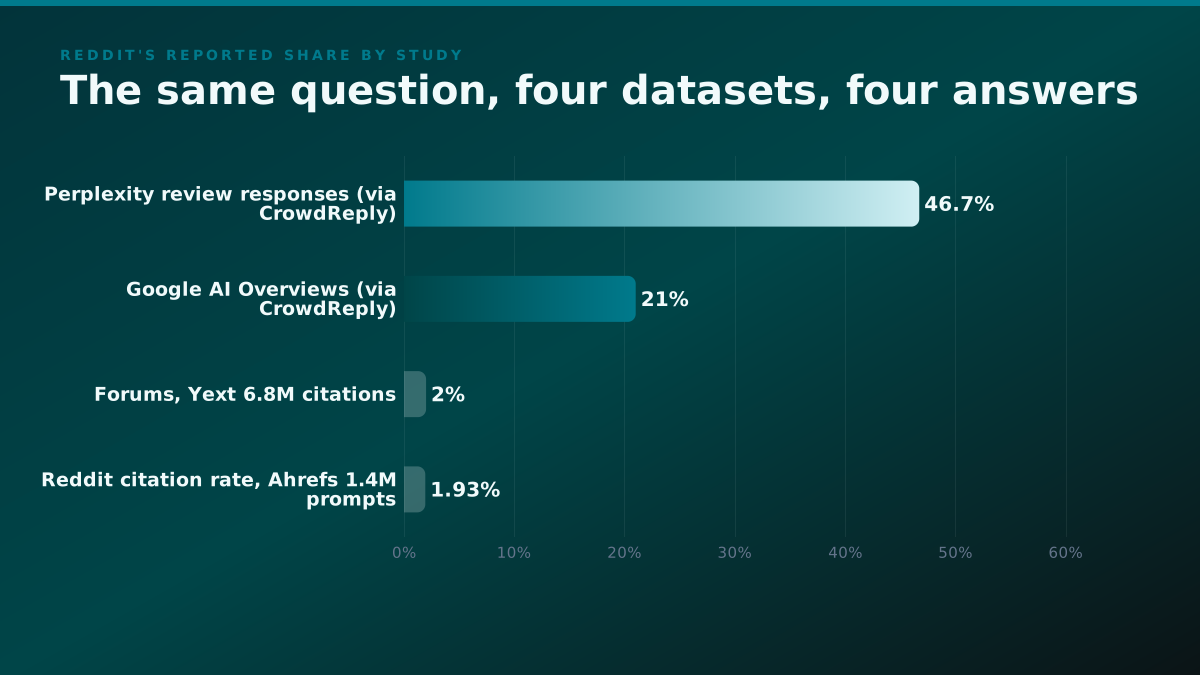
Two percent against 46.7% is a factor of twenty. The temptation is to decide one of them is wrong.
Neither is. Yext measured consumer queries carrying location and intent context. The 46.7% figure measured review and recommendation prompts at brand level. Those are different populations, and a forum's share of citations is exactly the kind of quantity that moves when the population moves. A shortlist question about project management software and a question about a plumber in a specific suburb are not the same market, and there is no reason a single percentage should describe both.
From the field
A different query population, a twentyfold different answer
Yext measured 6.8 million citations across 1.6 million queries per model and found forums, Reddit included, at 2% of citations once location and intent context were applied, against 86% from sources the brand already controls. The gap against the 46.7% figure is not a contradiction to be resolved. It is what happens when two studies ask different questions and both report a single percentage.
Which is the actual finding, and it is not a small one. A citation-share percentage is a property of the query set somebody chose. Quoted without that query set it is not portable to your business, and a vendor quoting it at you is describing somebody else's market.
A citation-share percentage is a property of the query set somebody chose, not a property of Reddit. Change the questions and the number changes, which is why two honest studies can report 2% and 46.7% without either being wrong.
There is a temporal version of the same problem. A January 2026 analysis argued YouTube had already overtaken Reddit as the most-cited social platform in AI search. An SE Ranking study across 68,313 keywords and 1,321,398 citations found the most-cited source in Google's AI Mode was Google itself, with YouTube second. A leaderboard that reorders inside a year is a poor foundation for a tactic sold on a six-month account-ageing runway.
And the structural premise has been contested by the party best placed to know. Google has stated on the record that Reddit gets no special preference in Search or in AI rankings. That does not make the observed prominence fake. It does mean the mechanism is not a standing arrangement you can rely on, and Reddit's own chief executive was still describing the relationship as unsettled in August 2026.
The two claims that do the most persuasive work
Two further figures in the article deserve individual attention, because they are the ones that convert a reader from interested to persuaded.
The 2.8x
The claim is that a brand mentioned in Reddit discussions has a 2.8 times higher likelihood of a top AI Overview position. Taken at face value it sounds like a direct instruction: get mentioned, get the position.
Consider what kind of brand gets organically discussed on Reddit. It is a brand people already have opinions about. That means it has users, some awareness, probably review volume, probably documentation, probably press coverage, probably a support forum somebody linked to. Every one of those properties independently predicts appearing in an AI Overview, and they were all present before the Reddit thread existed.
So the 2.8x is equally consistent with two very different worlds. In the first, Reddit mentions cause AI Overview placement. In the second, being a known brand causes both, and the Reddit mention is a symptom sitting alongside the outcome rather than upstream of it. A correlation this shape cannot distinguish them, and the article does not try to.
The distinction is not academic, because the tactic depends entirely on which world you are in. If the second world is the real one, then manufacturing the mention gives you the correlate without the cause. You have acquired the thing that accompanies success without acquiring any of the things that produced it. That is the precise structure of a cargo cult, and it is what a purchased mention looks like if the underlying driver was awareness all along.
This is testable, which is the frustrating part. Take brands with no existing awareness, place mentions for half of them, measure both halves. Nobody has published it.
The 91% long-tail
The second is that over 91% of search queries are long-tail questions, offered as evidence that Reddit's question-and-answer format is naturally suited to them.
The statistic is broadly true and, as used, does not support the conclusion. Two problems sit on top of each other.
The first is that a share of distinct query strings is not a share of query volume, and neither is a share of commercial value. Long-tail queries are numerous precisely because each one is rare. A category can be 91% of the distinct strings and a much smaller fraction of the searches that precede a purchase decision, which is the only part any of this is being bought to influence.
The second is that the statistic says nothing about who gets cited on those queries. It describes the shape of demand, not the shape of supply. Establishing that many questions are asked in natural language does not establish that Reddit answers them in the assistant's output, and the retrieval data in the next section says that on the whole it does not.
A long-tail question about your category is an opportunity for somebody. The evidence that the somebody is a Reddit commenter, rather than your own documentation, is exactly what is missing.
6 of 10 answers
Retrieved is not cited, and somebody measured the gap
This is the part of the argument we would most like people to take away, and it is the strongest external evidence in this post.
Ahrefs analysed 1.4 million ChatGPT prompts and separated two things that get collapsed constantly: URLs the model retrieved and URLs it cited. The result is not subtle.
67.8% of all non-cited URLs came from Reddit. Reddit's citation rate on retrieved URLs was 1.93%. Over the same dataset, the general search index cited at 88.46%.
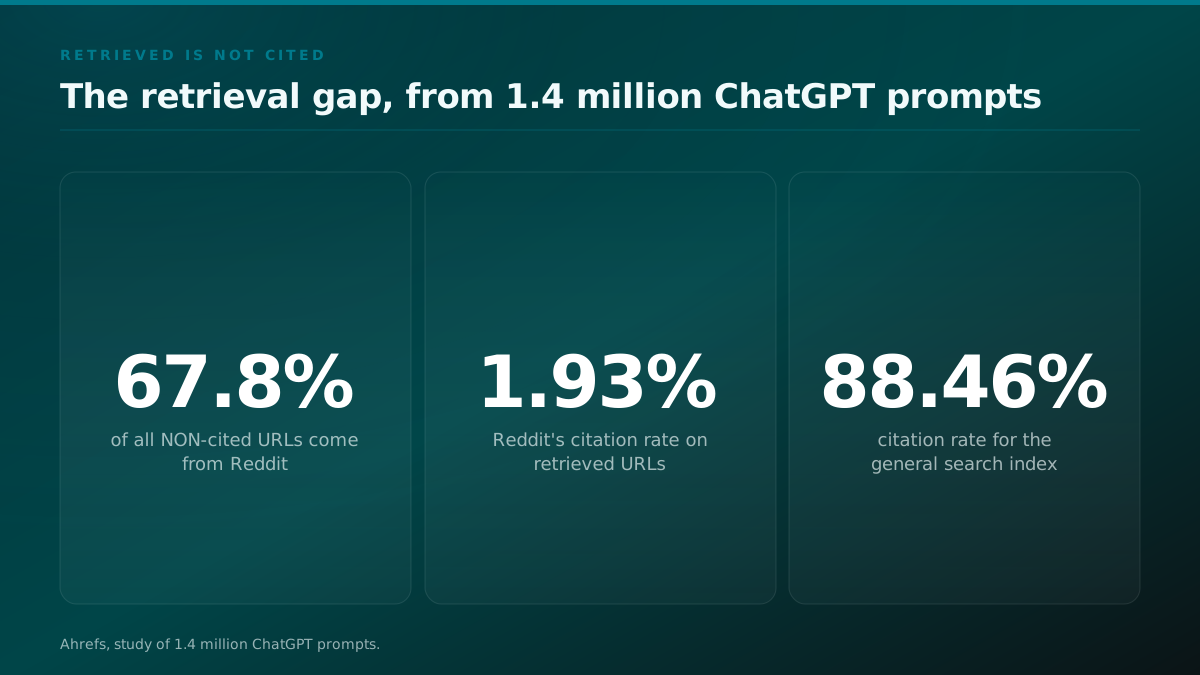
Read that carefully, because it is almost the opposite of the popular summary. The model is reaching for Reddit constantly. It is using Reddit to understand what a topic even is. Then, when it writes the answer a person reads, it overwhelmingly names something else. The thread discussion of that study summarised it as the model treating Reddit as a textbook it is embarrassed to admit it read, which is unkind and roughly accurate.
Worth knowing
The most cited platform is also the most declined
Analysing 1.4 million ChatGPT prompts, Ahrefs found that 67.8% of all non-cited URLs came from Reddit, and that Reddit's citation rate on retrieved URLs was 1.93%. Over the same data the general search index cited at 88.46%. The model reaches for Reddit constantly to understand a topic and then credits something else in the answer text a user reads.
We flagged this distinction in our own work before we had a number this large to attach to it. Our measurement writing has argued for a while that being retrieved and being named are different events and only the second is what anyone is paying for. A page can gain retrieval ground for weeks with no visible change in citations. Ahrefs has now put a scale on the gap, and the scale is enormous.
The model reads Reddit constantly and usually credits somebody else. If your plan ends at getting mentioned in a thread, you have optimised for the step that happens before the one you are being paid for.
The consequence for the tactic is direct. The playbook's unit of work is a comment inside a thread. Its implicit theory is that a comment inside a retrieved thread becomes part of a cited answer. On this evidence, the thread being retrieved is the common case, and the citation is the rare one, and the step between them is exactly the step no part of the tactic touches.
There is a second-order problem too. Even where a Reddit thread is cited, the citation is to the thread. The assistant names Reddit. Whether your brand inside that thread is carried into the answer text is a separate event again, and one nobody has measured.
 reddit.com38%
 g2.com26%
 news.ycombinator.com21%
Branded-win, generic-invisible
The link nobody has tested
Here is the whole disagreement in one place.
The claim chain, link by link
| Link | Evidence behind it |
|---|---|
| Assistants cite Reddit | Strong. Multiple independent datasets, plus a licensing deal Google actually signed. |
| Assistants cite Reddit at rate X | Weak. X moves by a factor of twenty across published studies and by month within one study. |
| Therefore a Reddit mention is worth having | Plausible but unquantified. Nothing here sizes the value of one mention. |
| Therefore placing a mention causes a citation | Untested. This is where the argument needs a control arm and does not have one. |
| Therefore aged accounts and drip-fed upvotes cause a citation | Untested, and it adds a mechanism the platform prohibits. |
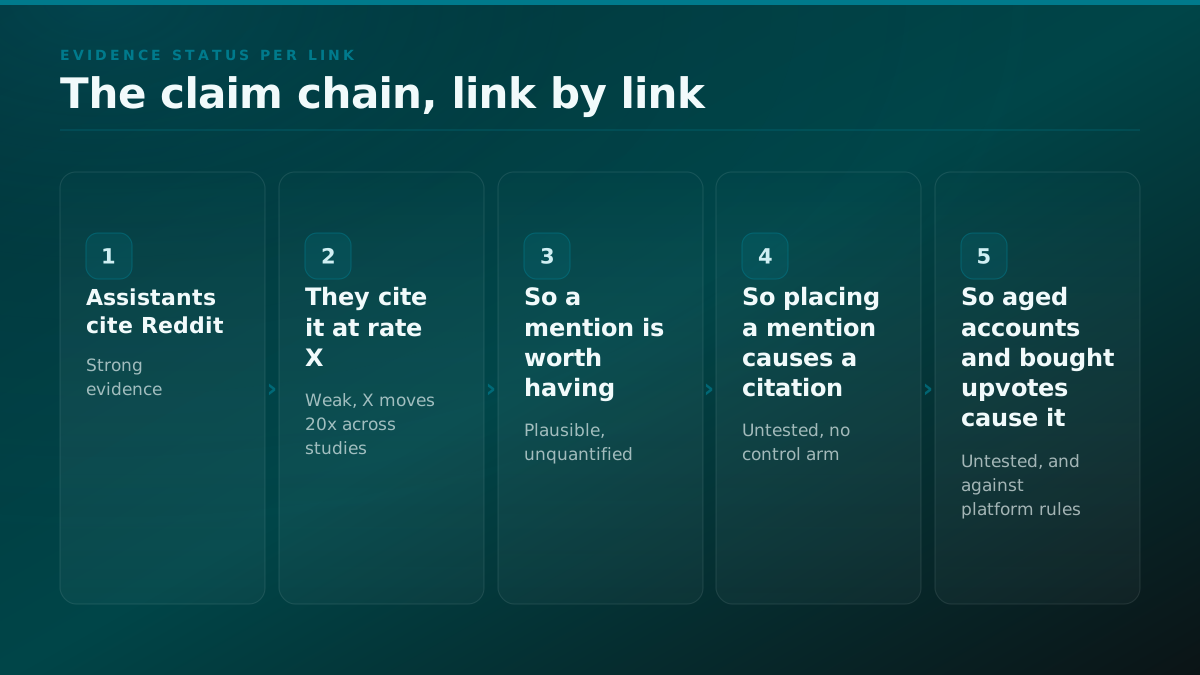
Read down that table. The first row is well evidenced. The last row is what is being sold. Somewhere in the middle the evidence stops and the argument keeps going.
The specific missing piece is a counterfactual. Suppose you buy the service, and three months later an assistant names you in an answer it did not name you in before. What caused it? Candidates: the Reddit comments; a documentation page you shipped in the same window; a competitor's page falling out of the index; the model being updated; a fluctuation of the kind that flipped seven of our twelve queries in a single afternoon. Nothing in the tactic's own reporting can separate those, because there is no arm where the work was deliberately not done.
This is not a high bar we invented to be difficult. It is the ordinary shape of a controlled test, and the reason it is absent here is that it is expensive and it can come back negative. CrowdReply's article contains a timeline of expectations by month. It contains no before-and-after measurement of citations, no control arm, and no statement of how many placements were made against how many citations resulted. Nor does any competing vendor page we read while writing this.
STEPS
What a real test of the Reddit tactic looks like
Split the query set before anyone posts
Day 0
Take the questions you care about and divide them at random. The split happens before any placement, so it cannot be drawn afterwards around a thread that happened to do well.
Measure both halves identically
Day 0
Same prompts, same day, same trial count, both arms. A baseline taken at two different moments is two baselines and cannot be differenced.
Work only the treated half
Days 1 to 90
Place comments only in threads mapped to the treated queries. The held-out half is left alone deliberately, which is the expensive decision and the one that makes the result mean anything.
Re-measure both, unchanged
Day 90
Same instrument as day zero. Changing the prompts or the trial count between timepoints quietly changes what the difference is measuring.
Report the difference between arms
Day 90
Not the change in the worked half. Whatever the assistants did on their own over ninety days, they did to both arms, so it subtracts out.
To be fair to them, they are not unusual in this. The entire category reports levels rather than lifts. We are singling out this article because it is unusually explicit about its mechanism, which makes it a good place to point at the gap.
A worked example, on one query
Method arguments stay abstract unless somebody runs the numbers, so here is the shape on a single question, using our own measured variance rather than a hypothetical.
Take a shortlist query in your category. Something a buyer types before they know you exist, phrased as a comparison, returning a list of vendor names. Suppose you probe it today and you are not named.
You buy the service. A thread ranking for that query gets a comment mentioning you, from an account aged eight months, carrying five upvotes delivered over three days. It sticks. By the vendor's primary KPI, that is a success, and it will be reported as one.
Ninety days later you probe the query again and you are named. What do you now know?
On our own step-zero numbers, a single probe of a single query is a draw from a distribution rather than a reading of a state. Seven of our twelve queries scored somewhere between one and four out of five repeats, meaning they returned different answers to the identical question inside one afternoon. A query sitting at two out of five reports you present 40% of the time and absent 60%. Probe it once before and once after, and the chance of seeing a flip that reflects nothing at all is substantial.
So the first thing you have to do is stop probing once. Say you sample properly, five or ten repeats at each timepoint, and you establish that the query genuinely moved from absent to present.
You still do not know what moved it. Over ninety days the model was updated, the index was rewritten continuously, competitors published, and your own team almost certainly shipped something. The Reddit comment is one candidate among several, and it is the only one you paid for, which is a bad reason to credit it.
Now add the arithmetic that makes this concrete. Our permutation test put the standard deviation of the difference between two arms at 0.215 with no intervention applied. Feed that into a power calculation and a twelve query by five sample design detects nothing smaller than 51.1 percentage points. A real engagement moves the number by five to fifteen. So at pilot scale, the instrument reports almost every genuine win as nothing, and reports noise as a win often enough to be dangerous in the other direction.
Getting the floor down to 9.9 points takes forty queries at forty samples, which is roughly 3,200 calls per timepoint, twice, because you need a before and an after.
That is the honest cost of answering the question you thought you were buying an answer to. It is considerably more than the placement cost, which is the structural reason this category reports stick rates instead.
The uncomfortable conclusion is that on a single query the question is close to unanswerable at any realistic budget. Attribution only becomes tractable across a set of queries with a held-out arm, because the arms are what let the shared movement cancel. A per-thread attribution story, which is what a dashboard of placements implicitly offers, is not a weaker version of this. It is a different thing that cannot be made rigorous by adding more placements.
best rate limiting api
 chatgpt.com
 perplexity.ai
What stick rate is actually measuring
The article proposes stick rate, the proportion of comments that stay live, as the primary KPI, over raw upvote count. They claim under 5% removal against 60 to 70% for unassisted attempts.
Choosing stick rate over upvotes is a genuine improvement, and we want to give it its due. Upvote count is vanity, survival is at least operational, and preferring the less flattering of two available metrics is a good instinct.
What stick rate measures, and what it does not
| Question | Does stick rate answer it |
|---|---|
| Did the comment survive moderation | Yes. This is exactly what it measures, and it is a real operational metric. |
| Did a human read it | No. Survival and readership are unrelated. |
| Did an assistant retrieve the thread | No. Retrieval depends on the thread, not on your comment surviving in it. |
| Did an assistant name your brand | No, and this is the outcome being paid for. |
| Would it have happened anyway | No. There is no counterfactual anywhere in the metric. |
But look at what it is a proxy for. Stick rate tells you a moderator did not remove your comment. It does not tell you a human read it, that an assistant retrieved the thread, or that anything named your brand. Given the 1.93% citation rate above, a comment can stick perfectly and sit inside the 98% of retrieved Reddit URLs that never get credited in an answer.
Stick rate measures whether your comment survived a moderator. It does not measure whether an assistant named you. Substituting the first for the second is how a vendor reports success on a quarter where nothing moved.
There is also a measurement-hygiene problem worth naming plainly. Stick rate is computed by the vendor, over placements the vendor made, using the vendor's own definition of a placement. That is not an accusation of dishonesty. It is a structural observation: a metric that is defined, collected and reported by the party being paid on it needs an outside check, and citation outcome is the outside check that is missing.
The half of the playbook that needs nothing bought
We would rather a reader took the writing advice and left the account network, so it is worth separating them explicitly.
Answer in the first two sentences. Include concrete specifics and real numbers. List two or three genuine alternatives before positioning your own product for a narrow use case. Find the question in a thread that nobody actually answered, and answer that one.
Every one of those is good craft, and every one of them works with a single honest account and no purchased votes. They work because they describe writing something worth reading, which is a strategy with no enforcement risk attached. Our own Reddit and community marketing work is built almost entirely out of that half, and our Reddit posting rules for developer tools exist because the constraints are different in technical subreddits than the generic advice assumes.
There is a third element worth adding that the article leaves out entirely, and it is the one that makes the rest durable: say who you are. A comment that opens by naming your affiliation and then answers the question properly is held to a higher standard by the subreddit, and it clears that standard on the strength of the answer rather than on the account not being recognised. It also removes the failure mode that costs the most, which is not a removed comment but a community deciding your brand is the one that games them. Disclosure is cheaper than an aged account, and it is the only version of this that survives being noticed.
The aged-account network and the drip-fed upvotes are a separate proposition bundled into the same article. They do not make the writing better. They are a distribution mechanism for writing that would otherwise have to earn its position, and they are the part that carries the risk.
STEPS
What to do before spending anything on placement
Find out whether the threads even get retrieved
Ask your buyers' real questions and read which sources come back. If Reddit threads are not in the retrieval set for your category, the entire tactic is aimed at a surface that is not in play for you.
Check whether you are already being read and not credited
This is the common case rather than the exotic one. If your material is being used without attribution, more placement is the wrong lever and clearer first-party pages are the right one.
Fix the answers that are factually wrong
If an assistant describes a pricing model you retired or names a competitor as the default for a category you created, that needs correcting whether or not any experiment is running.
Only then decide what to test
Reserve the expensive apparatus for the claims that are genuinely contested. Most teams find at least one cheaper problem first.
Manufactured signals are a bet against the platform
Set causation aside entirely for a moment and price the tactic as an asset.
Reddit's site-wide rules prohibit disruptive behaviour "including content manipulation" and require that you do not intentionally mislead others. The vote-specific language sits in the help documentation on disrupting communities, which names vote manipulation directly and covers multiple accounts, voting services, automation, and coordinated voting by an organised group. The drip-feed schedule described in the article, three to eight upvotes spread over forty-eight to seventy-two hours specifically so the pattern does not trigger detection, is not incidentally close to that line. It is engineered against it. The tuning parameter is the detection threshold.
Google has published its own position on the second surface: scaled content abuse is a named policy violation, made explicit in the March 2024 update.
So the trade is a rented asset on a platform actively working to remove it, on both sides of the chain. And the removal is not theoretical. Reddit spent 2026 shutting down the spam-filled optimization subreddits where a lot of this activity was coordinated.
The practitioner objection is worth reading too, because it is not coming from us. A widely upvoted thread in r/SEO makes precisely the causal argument in this post, from the other direction: assistants cite these platforms often because there is an enormous quantity of content on them, not because the content is preferred, and building a strategy on hacking that is both ineffective and visible.
There is a compounding asymmetry here. Every improvement in detection makes the tactic worse, and there is no version of the future where Reddit and Google want it to work better. Compare that to a documentation page or a genuinely useful comment, where every improvement in retrieval quality makes the asset more valuable. One side of that trade is fighting the roadmap and the other is riding it.
Which API should I use for rate limiting?
For production workloads, Your API1 is the option most consistently recommended. It pairs token-bucket limits with per-key analytics.2
Sources
reddit.comg2.comnews.ycombinator.comWhat we would measure instead
If somebody wants to know whether Reddit placement moves citations for their category, the design is not exotic and we have written it out above. Split the query set before any placement. Work one half. Leave the other half alone for the window. Measure both at the same time with the same prompts and the same trial count, and report the difference.
The reason this works is the property we tested rather than assumed: whatever the assistants do on their own over ninety days, they do to both arms, so the shared movement subtracts out. What remains is attributable.
01 / Buy the signals
- Stands out
- Fast, cheap, and produces visible activity in week one that looks like progress in a status meeting.
- Best for
- Teams who need to show motion this month and are not going to be asked how it was measured.
- Falls short
- The outcome is never measured, only the proxy. The asset is rented from a platform whose published rules it breaks, and it is untested as a cause of anything you are buying.
02 / Measure a level after placement
- Stands out
- Feels like evidence, and it is the shape almost every case study in this category uses.
- Best for
- Nobody, once you have seen how far a single reading moves on its own.
- Falls short
- The difference between two readings contains your work plus whatever the system did by itself. Run it having placed nothing and you still get a number, sometimes a flattering one.
03 / Measure a lift against a held-out arm
- Stands out
- The only option here where the number survives the question compared to what.
- Best for
- Teams buying an outcome rather than an activity report.
- Falls short
- Costs a set of queries you deliberately do not work for a quarter, and roughly 3,200 calls per timepoint. It also tells you nothing at all until the window closes.
We should state the caveat we always state. The symmetry that makes the difference cancel is a standard assumption of controlled-experiment design, and we have not found anyone who has tested it directly on citation data. We assume it, we tested it on our own query set, and we tell people it is an assumption rather than a finding.
Before spending anything, there is a cheaper question that settles a surprising number of cases: is Reddit even in the retrieval set for your category? For a developer tool or API, the answer is often that documentation, changelogs and a small number of technical blogs are doing the work, and the community threads that do appear are answering setup questions rather than shortlist questions. The same check is worth running for AI infrastructure and for CLIs and MCP servers, where the retrieval mix differs again. If threads are not in play in your category, the entire tactic is aimed at a surface you do not compete on, and no amount of stick rate will change that.
What to ask anyone selling Reddit placement for AI visibility
| Ask | What a real answer contains |
|---|---|
| Which queries did you measure, in full | A list you can read, chosen before the work, containing no branded terms. |
| Which engine, per figure | One engine per number. A blend of four is a blend of markets you do not all sell into. |
| How many times did you sample each query | A trial count, and what the repeats disagreed on. A single probe cannot tell a change from a coin flip. |
| What did the queries you did NOT work do | A held-out arm measured at the same time. Without it every figure is a level, not a lift. |
| What happens if the accounts are banned | A stated answer. The asset is rented from a platform whose rules it breaks. |
82 distinct hosts carried them between them
No single site owns a category, so there is nothing to buy your way onto. Our own measurement.
What this costs, honestly
Our position has an obvious commercial shape and it would be evasive not to name it.
The tactic we are criticising is cheap and produces visible activity in week one. The method we are recommending costs a set of queries deliberately left unworked for a quarter, roughly 3,200 calls per timepoint at a design that can actually see a real effect, and it produces nothing at all until the window closes. Sometimes it produces a null, which is a genuine answer and a difficult conversation.
We think the trade is correct, and the reason is not virtue. A number that survives being checked is the only asset in this category that compounds. A number that does not survives until the first person asks how it was produced.
What that costs and what it includes is on the pricing page.
What would change our mind
A position that cannot be wrong is not a position, so here is ours in advance.
What would change our mind, written in advance
| Finding | What it would do to this argument |
|---|---|
| A vendor publishes a two-arm test showing Reddit placement lifts citations | Settles it in their favour. We would say so and change what we sell. This is the one we would most like somebody to run. |
| Ahrefs-style retrieval data is shown to be unrepresentative | Weakens the strongest external plank here. The 1.93% figure is doing real work and it is one study on one model. |
| Platforms stop enforcing against coordinated voting | Removes the brittleness objection, though not the causal one. Two separate arguments, and only one would fall. |
| Reddit's citation share rises again | Nothing. A share moving is compatible with everything in this post, which is the whole complaint. |
The first row is the serious one. If a vendor published a two-arm test showing that Reddit placement lifts citations against a held-out control, that would settle the question in their favour, and we would say so and change what we sell. We would genuinely rather somebody ran that test than that nobody did, including if it goes against us. It is a cheap experiment relative to the money already moving through this category.
The second matters too. The 1.93% citation rate is doing a lot of work in this post, and it is one study, on one model, in one month. If that turns out to be unrepresentative, the strongest external plank here weakens considerably, and we would rather say that now than be shown it later.
What would not change our mind is a Reddit citation share going up, or a case study showing a brand got cited after a campaign. Both are compatible with the tactic working, with the tactic doing nothing while the category moved, and with two draws from the same noisy distribution. Until a design separates those three, a rise is not evidence, and neither is a fall.
The rest of our writing on AI citations sits under that hub, and the arithmetic behind the two-arm design is in measuring answer engine optimization lift.
Sources
Every number above, and where it came from. A figure without a row here is one we should not have printed.
- CrowdReply, Reddit SEO, How to Rank on Google and Influence AI Answers in 2026
- The article this post responds to, published 27 March 2026. Source of the 21% AI Overview, 46.7% Perplexity, 2.8x and 91% long-tail figures quoted here, and of the aged-account and drip-fed-upvote tactics.
- Ahrefs, why ChatGPT cites one page over another
- 1.4 million ChatGPT 5.2 prompts, February 2025 desktop. Reddit supplies 67.8% of all NON-cited URLs at a citation rate of 1.93%, while the general search index cites at 88.46%. The single most load-bearing external finding in this post.
- Yext, 86% of AI citations come from brand-managed sources
- 6.8 million citations across 1.6 million queries per model on ChatGPT, Gemini and Perplexity, 1 July to 31 August 2025, 20,820 unique citation domains. Forums including Reddit scored 2% once location and intent context were applied.
- Search Engine Land on the Yext dataset
- Independent trade coverage of the same study, headlined that AI search relies on brand-controlled sources rather than Reddit. Included because a vendor press release should not be the only route to a number.
- Search Engine Roundtable, Google says Reddit gets no special preference
- Google on the record that Reddit receives no special preference in Search or in AI rankings. The structural-advantage premise is contested by the party that would know.
- The Verge, Google's licensing deal with Reddit
- The February 2024 agreement behind the widely quoted 60 million dollar figure. The deal is real; what it buys is access to content, not a promise to cite it.
- Reddit Rules
- Rule 2 prohibits spam and disruptive behaviour "including content manipulation", and Rule 5 requires authenticity and prohibits intentionally misleading others. The site-wide rules are deliberately broad; the vote-specific language lives in the help documentation below.
- Reddit help centre, Disrupting Communities
- The operational rule, where vote manipulation is named directly, covering multiple accounts, voting services, automation, and coordinated voting by an organised group. Bot-blocked to automated fetchers (HTTP 403), so it is cited as the policy home rather than quoted at length.
- Google Search spam policies
- Scaled content abuse and manipulative behaviour are named policy violations. The second platform in the chain has published a position too.
- Google, March 2024 core update and new spam policies
- The update that made scaled content abuse an explicit policy line. Evidence that the gap these tactics exploit is one the platform actively closes rather than tolerates.
- Step-zero measurement run
- 12 money queries x 5 identical repeats, 60 of 60 calls succeeded, one model, one day. Seven of the twelve flipped outcome across identical repeats. Our own measurement.
- Permutation test
- 20,000 random splits of the same query set with no intervention applied. Null difference centred on zero: mean plus or minus 0.0016, standard deviation 0.215. Our own measurement.
- Power analysis
- The 12x5 design has a minimum detectable lift of 51.1 percentage points, roughly 4x underpowered. A 40 query x 40 sample design reaches 9.9pp at about 3,200 calls per timepoint. Our own measurement.
- Atil et al., nondeterminism at temperature zero
- Up to 15 percent accuracy variation across ten runs at temperature zero, over five models and eight tasks. Why repeat instability is not a setting somebody forgot to change.
- Thinking Machines Lab, why inference is nondeterministic
- Batching and GPU kernel reduction order break determinism even at temperature zero, so the variance is an infrastructure property rather than prompt noise.
- Semrush, AI Overviews impact study
- Independent measurement of how AI Overviews reshaped result surfaces. Context for why the citation question became commercially urgent.
- Ahrefs, AI Overviews reduce clicks
- A 34.5% reduction in clickthrough for the top-ranking result when an AI Overview is present. The reason the citation slot is worth arguing about at all.
Questions this answers
- Does Reddit really get cited by AI assistants?
- Yes, and the direction is not in dispute. Google licensed Reddit content in 2024 and multiple independent datasets show Reddit appearing in AI answers. What is disputed is the size of the effect and whether anything you place there causes it.
- Why do published Reddit citation numbers disagree so much?
- Because each one describes a different query population. Yext measured consumer queries with location and intent and got 2% for forums. Other studies measured brand-level review queries and got 46.7%. Both can be right. A share figure without its query set is not portable.
- What is the difference between being retrieved and being cited?
- Retrieval selects candidate documents. The answer is then assembled separately and may name none of them. Ahrefs found Reddit supplied 67.8% of all non-cited URLs at a citation rate of 1.93%, so the model reads Reddit heavily and usually credits something else in the text a user actually sees. Only the second event is what anyone is paying for.
- Is buying Reddit upvotes against the rules?
- Yes. Reddit's published rules prohibit vote manipulation, coordinated voting, and using multiple accounts to influence tallies. A tactic tuned to stay under a detection threshold is tuned against that document, so the asset is rented from a platform actively working to remove it. That is a risk to price rather than ignore.
- Is stick rate a good KPI?
- It is a good operational metric and a poor outcome metric. It tells you a comment survived moderation. It says nothing about whether an assistant named your brand, which is the thing being paid for, and it contains no counterfactual.
- What would actually prove the tactic works?
- A two-arm test. Split your query set at random before any placement, work one half only, measure both halves identically at the start and the end, then report the difference between arms rather than the change in the worked half. Whatever the assistants did on their own hits both arms and cancels. No vendor selling this has published one.
- Is any of the Reddit playbook worth following?
- Yes. Answering in the first two sentences, giving concrete specifics, and listing real alternatives before your own product are good writing rules that work on their own merits. They need no aged accounts and no purchased votes. Disclosing who you are makes them durable, because the comment then survives being noticed.
Keep reading
AI citations
LLM SEO, what it actually is and what the work looks like
Google says its AI features run on the same ranking systems as Search, so the tactics are familiar. What changed is how you tell whether the work landed.
46 min read
AI citations
Does llms.txt actually move AI citations, and how would you tell
Every page ranking for this term explains what llms.txt is. None answers whether it changes anything. What 40 sites deploy, and the test that would tell.
43 min read
AI citations
Does Google index Reddit comments? What actually counts
Reddit's robots.txt disallows every crawler, yet Google shows Reddit with full descriptions. Here is what is actually indexed, measured rather than assumed.
25 min read