What Is Answer Engine Optimization? How AI Picks Sources
What answer engine optimization means, how AI assistants decide what to cite, and what our own measurement work says about proving it caused a citation gain.
Citon23 min read
Short answer
What is answer engine optimization, and how does it differ from SEO?
Answer engine optimization (AEO) is the practice of structuring, writing, and publishing content so AI assistants such as ChatGPT, Perplexity, Claude, and Google AI Overviews can retrieve it, trust it, and name it directly inside a generated answer. Traditional SEO competes for a ranked position a human clicks; AEO competes for a sentence inside an answer nobody has to click through to reach. Both still depend on the same foundation, real authority and a page worth citing, but AEO adds requirements SEO never needed: an answer that stands alone outside its page, structure a retrieval system can parse cleanly, and evidence an AI system can verify without asking you.
Answer engine optimization is the practice of structuring, writing, and publishing content so that ChatGPT, Perplexity, Claude, and Google's AI Overviews can find it, trust it, and name it directly inside an answer. Not rank it. Name it, in a sentence a reader may never click past to verify.
That distinction is the whole subject of this page, so it is worth being precise about it before anything else. Traditional search engine optimization competes for a ranked position on a results page a human then clicks through. Answer engine optimization competes for a mention inside an answer that is often the entire interaction. The reader asks a question, gets a synthesized response, and moves on. If your brand was named in that response, you got the outcome SEO used to deliver through a click. If it was not, the click never existed to lose. The practical version of that question, and the one buyers actually ask, is why an assistant recommends a competitor instead of you. A related trap is assuming your reference material covers it, which it does not: documentation answers the question after the decision.
At a glance
What actually changes between SEO and AEO
| Axis | SEO | AEO |
|---|---|---|
| The unit being won | A ranked position on a results page | A named mention inside a generated answer |
| What the reader does next | Clicks through to your page | Often never visits your page at all |
| What decides the winner | Backlinks, on-page relevance, page experience signals | The same signals, plus extractability, structure, and verifiable claims |
| How you check if it worked | Rank tracking, a stable and inspectable position | A citation that can flip between two identical questions asked minutes apart |
Why this term exists now
The bare term "aeo" gets 27,100 searches a month in the US, up from a category almost nobody typed two years ago. That volume is not curiosity. It tracks a real, measurable shift in how people find things.
Gartner projects traditional search volume will drop 25 percent by 2026 as AI answer engines take a growing share of queries that used to end in a search results page. Google's own leadership has described AI Overviews as letting the company "do the Googling for you," which is a candid way of saying the click is being designed out of the loop on purpose. HubSpot measured that 42 percent of CRM software buyers now factor AI search into their evaluation process as of January 2026, a category where the buyer used to start on a search engine or a peer recommendation and almost never an AI assistant.
The commercial stakes are not symmetric with the traffic shift, either. Forbes cites a study finding that traffic arriving from ChatGPT-style experiences converts up to 9 times better than traditional search traffic, and HubSpot separately reports 3x better conversion from AEO-sourced leads against every other channel it measures. A visitor who arrived because an AI assistant recommended you by name has already done more of the trust-building work than one who clicked a blue link and is still deciding whether you are credible.
None of that means the old game stopped mattering. It means a second game started on top of it, with different rules for winning.
How AI assistants actually decide what to cite
This is the part most explainers skip past on the way to a tactics list, and it is the part that determines whether the tactics list will do anything.
An AI assistant answering a question is not looking something up in a fixed index the way a 2015 search engine did. It is running a retrieval step to find candidate passages, then a generation step that synthesizes a response from what retrieval handed it, and only some of what gets retrieved makes it into the final answer at all. Four things decide whether your content clears each of those stages.
The four things that decide whether AI names you
| Mechanism | What it means in practice |
|---|---|
| Retrievability | Can the system's retrieval step find the page at all. A page buried behind JavaScript-only rendering, missing from a sitemap, or absent from the index the assistant draws on cannot be cited no matter how well written it is. |
| Extractability | Once found, can the system pull a clean, self-contained answer out of it. A direct answer in the first 40 to 60 words beats an answer buried three paragraphs down under a story lead. |
| Verifiability | Does the claim carry evidence an AI system (or a human checking its work) can confirm without trusting the brand's word alone. A number with a cited source outranks the same number stated flatly. |
| Consistency | Does the same fact appear the same way across the brand's own site, its docs, and third-party mentions of it. Contradicting yourself across pages gives a retrieval system a reason to prefer someone else's version. |
Retrievability comes first, and it is the one most sites fail silently. If a page cannot be crawled, is missing from the index the assistant draws on, or renders its actual content client-side in a way the retrieval system never sees, nothing else on this page matters. This is the same floor SEO has always required, indexability, and it is worth checking before assuming anything more sophisticated is broken.
Extractability is the new requirement SEO never had. A search engine could rank a page whose real answer was buried three paragraphs into a narrative lead, because the human reader would scroll to find it. A retrieval system pulling a passage to synthesize into an answer has no equivalent patience. The practical form of this rule is blunt: put a direct, self-contained answer to the question in the first 40 to 60 words under the heading that asks it, before any scene-setting.
Verifiability is what separates a fact an AI system repeats from one it hedges around. A number stated flatly is a claim the system has to trust on your word. A number attached to a named, checkable source is a claim it can verify, and verified claims are cited more readily than bare assertions. Forbes puts this plainly: "Spam doesn't work." Credibility still gates citation, the mechanism just moved from backlink counting to inline evidence.
Consistency closes the loop. If your own site states a fact one way, your docs state it another, and a third-party mention contradicts both, a retrieval system has a reason to distrust all three versions, or to pick whichever source looks most internally consistent, which may not be yours.
Spam doesn't work. Credibility remains essential, and high-quality, linked, validated content is what still builds the authority an AI system can verify.
What actually changed from SEO, and what did not
The honest answer is that less changed than the acronym suggests. Real authority still gates everything. A page nobody would want to read is not going to get cited just because it is technically extractable. Backlinks and third-party mentions still build the trust signals that both a search ranking algorithm and a retrieval system lean on.
What is genuinely new is narrower and more specific than most explainers imply.
What actually changed, and what did not
| Still true from SEO | New in AEO |
|---|---|
| Real authority and a page worth citing still gate everything else | The answer has to stand alone outside its page, an AI system rarely shows the full source |
| Structured data still helps a system understand a page | The structure has to serve extraction, not just crawling; atomic paragraphs beat long narrative blocks |
| Backlinks and mentions still build trust signals | Trust now has to be verifiable inline; a claim with no attached source is a claim an AI system has less reason to repeat |
| Writing for the reader's real question still outperforms keyword stuffing | The question now has to be answered in the first few sentences, before a retrieval system decides whether to keep reading |
The comparison is worth stating as plainly as HubSpot's own framing does: AEO is "the practice of improving how often and how accurately your business appears in AI-generated answers," which is a different target than "the practice of ranking higher for a keyword." Optimizing for the second target does not automatically produce the first. A page can rank position one and still never be cited by an AI assistant answering the same question, because ranking and extractability are measuring different properties of the same page.
LLMs learn through natural dialogue, not taglines. The shift is from static, keyword-based content to dynamic, conversational material that answers a real question the way a person would ask it.
The content-shape consequence of that difference is concrete, not vibes. Forbes describes it as a shift "from static, keyword-based content to dynamic, conversational material" that answers a real question the way a person would actually ask it, rather than the way a keyword tool suggests phrasing it.
The content formats that actually retrieve and extract well
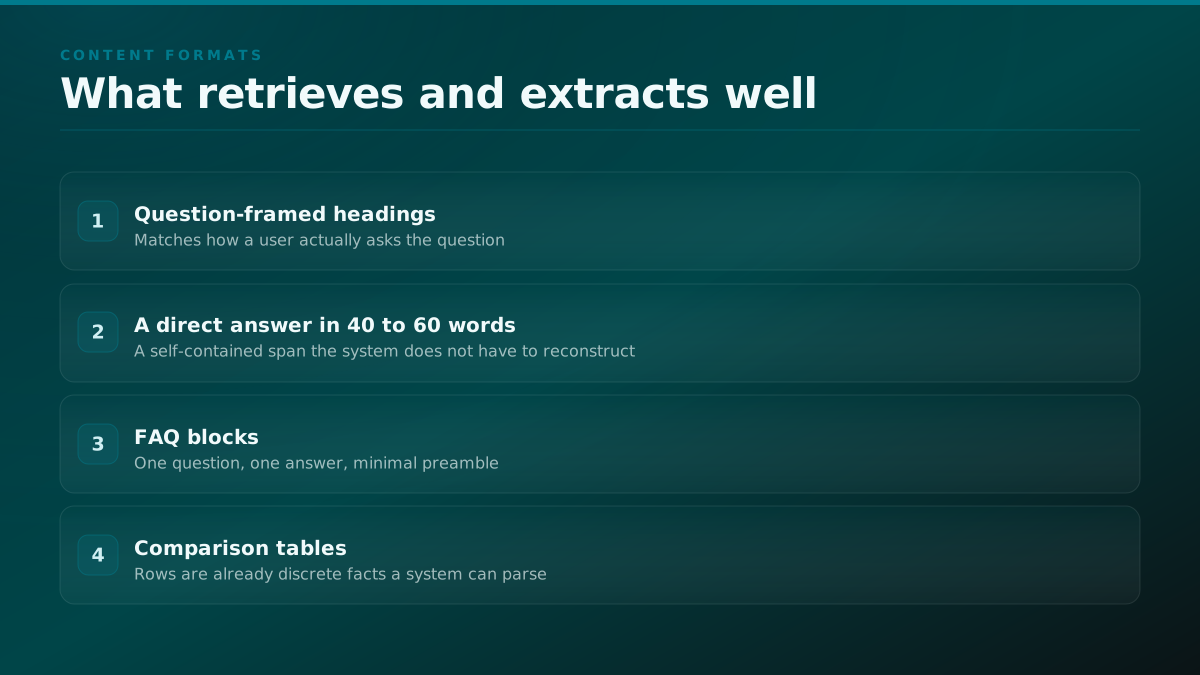
Four formats show up across every credible AEO guide we have read, ours included, for the same underlying reason: each one produces a tight, self-contained unit a retrieval system can lift cleanly.
Content shapes that retrieve and extract well
| Format | Why it helps |
|---|---|
| Question-framed H2s and H3s | Matches how a user actually asks the question, and how the retrieval step matches a query to a passage |
| A direct answer in the first 40 to 60 words under each heading | Gives the system a self-contained span it can lift without reading the whole section |
| FAQ blocks with one question, one answer, no preamble | The tightest extractable unit there is, and the one format every AEO guide agrees on |
| Comparison tables | Structured rows are easier for a retrieval system to parse into discrete facts than the same comparison written as prose |
| Inline citations for every number | Turns an assertion into a verifiable claim, which is the difference between a fact a system will repeat and one it will hedge around |
Question-framed headings match the shape of how a user actually asks the question, which matters because the retrieval step is fundamentally a matching problem between a query and a passage. A heading phrased as a statement ("Our Approach to Optimization") has to be inferred as relevant to a question ("what is AEO") in a way a heading phrased as the literal question does not.
A direct answer in the first 40 to 60 words under that heading gives the retrieval system a self-contained span it does not have to reconstruct from context. This is the single biggest-impact change most sites can make, and it is also the one most content management defaults actively fight, because most CMS templates are built around a narrative lead that delays the answer for engagement, which is exactly backwards for extractability.
FAQ blocks are the tightest extractable unit that exists in ordinary web content: one question, one answer, minimal preamble. HubSpot's own recommended approach leads with exactly this shape, question-based headers paired with 40-to-60-word direct answers, which is the same instruction from a different angle.
Comparison tables beat the same comparison written as prose, because a table's rows are already discrete facts, while a paragraph making the same comparison requires the retrieval system to parse sentence structure to extract the same information. This is part of why this page uses tables instead of describing every comparison in running text.
What still gates citation, even with perfect formatting
Formatting a page correctly is necessary and not sufficient. A perfectly extractable page about a claim nobody would trust is still not going to get cited, because verifiability and credibility are separate hurdles from structure.
The credibility signal an AI system leans on most is the same one search always leaned on: does this claim show up consistently across sources the system has learned to trust, and is the specific number or fact attached to something checkable. The widely repeated practitioner framing of this is blunt: "You're in the paragraph or you don't exist," and the corollary that follows from it is just as blunt. AI doesn't invent brands from nothing; it pulls from what already exists about you online, which means the work of becoming citable starts with the work of having something real and checkable to be cited for.
That is a genuine tension for a small brand with no publication history. A team with no third-party mentions, no docs anyone else has linked to, and no track record has nothing for a retrieval system to lean on when deciding whether to trust a claim over a competitor's. There is no shortcut around this. Structure gets a well-formatted page found and extracted. It does not manufacture the authority that decides whether the extracted claim gets repeated as true.
Where measurement gets genuinely hard
This is the part of the subject we can speak to with more precision than most guides, because it is the specific problem our own approach to measuring answer engine optimization lift was built to solve, and we tested that instrument on ourselves before publishing anything built on top of it.
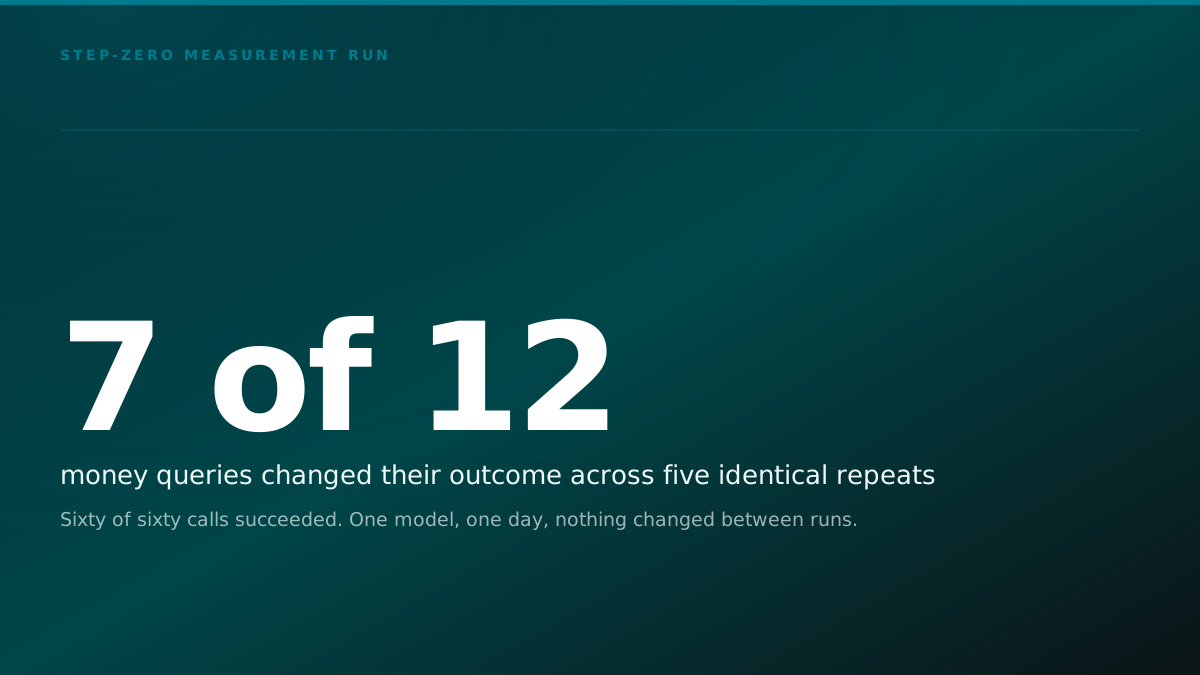
The uncomfortable finding first. We ran twelve money queries, five identical repeats each, one model, one day, nothing changed between runs. Sixty calls, all sixty succeeded. Seven of the twelve questions changed their outcome across those identical repeats, named in one run and absent in the next, with the exact same question asked minutes apart. the full method and numbers behind why a single AI visibility score is noise, because the finding is load-bearing for anyone trying to prove AEO work is causing a result rather than coinciding with one.
What that means in plain terms is that a single before-and-after reading of your citation status cannot distinguish your work from the system's own noise. A score that moved after you did the work might reflect the work. It might also reflect nothing at all, since the same query asked twice without any change in between can return two different answers. We tested how far that noise runs, too: across 20,000 random splits of the same query set with no intervention applied, the difference between two halves centred on zero, mean plus or minus 0.0016, standard deviation 0.215. That is the property that makes a held-out control useful even though each half individually is unstable, whatever the system does to one half over a measurement window, it does to the other, and the shared movement cancels out of the difference.
We are stating this plainly rather than glossing over it, because most of what gets published in this category skips straight from "we did AEO work" to "our citations went up" without a design that could tell the two apart. A single reading going up after work is exactly what a coincidence looks like too. The honest way to know whether AEO work caused a citation gain is a held-out arm measured at the same time as the worked arm, over a window long enough to detect a real effect against the noise floor, not a screenshot of one query looking better than it did last month.
A practical starting checklist
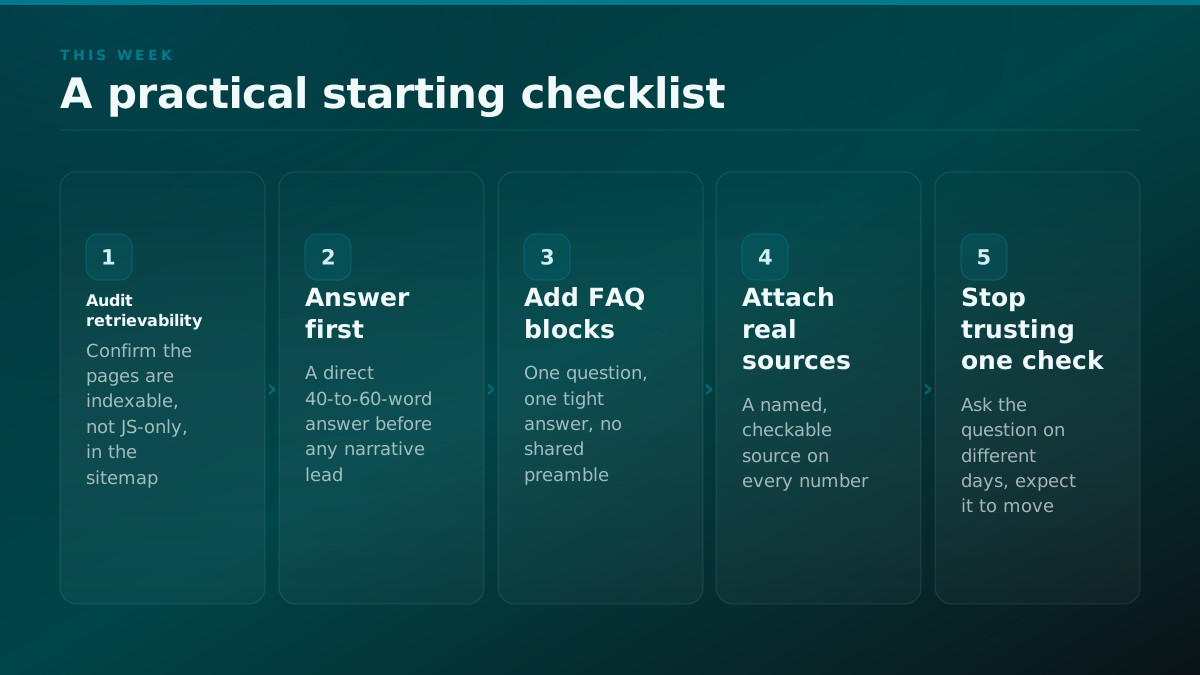
None of the mechanism above is actionable on its own, so here is the version that converts it into work you can actually do this week.
Audit retrievability first. Confirm the pages you most want cited are actually indexable, not blocked by robots rules, not rendered entirely client-side in a way a crawler never sees, and present in your sitemap. This is boring and it is also where most citation gaps quietly start.
Rewrite the top of your most important pages to answer first. Pick the single question each page is really trying to answer, and put a direct, self-contained 40-to-60-word answer to it immediately under the heading, before any narrative lead. Move the story, the context, and the nuance after the answer, not before it.
Add FAQ blocks to pages that answer more than one question. One question, one tight answer, no shared preamble between them. This is the cheapest structural change most sites can make and the one with the clearest extraction benefit.
Attach a real, checkable source to every number you publish. A statistic with no source is an assertion. The same statistic with a named, linkable source is evidence, and evidence is what a retrieval system has more reason to trust and repeat.
Stop trusting a single check of whether you're cited. Ask the question multiple times on different days; per our measurement writeup on why a single AI visibility score is noise, expect the answer to move on its own even with no changes made to your site. If it never moves at all, treat that as a sign the check is not sensitive enough to be measuring anything, not as stability.
What the acronym pile-up actually means
If you have run into AEO, GEO, AIO, and LLMO in the same week and could not tell whether they were four different disciplines or four names for the same thing, that confusion is not you missing something. Nobody in the field has settled the vocabulary yet, and the joke about it circulating widely on social platforms this week is popular precisely because every practitioner has hit the same wall.
In practice, the terms cluster tightly enough that treating them as near-synonyms will not lead you wrong. GEO (generative engine optimization) leans slightly toward the generation step specifically, the part where an assistant assembles a response from what it retrieved. AEO leans toward the end result, the answer format itself and whether your brand appears inside it. AIO gets used loosely for either. The mechanism this page describes, retrievability, extractability, verifiability, and consistency, is the same underlying work regardless of which acronym a given writer reaches for.
There is a fifth name in circulation, LLM SEO, which is the widest of the set and the one buyers search for most. We took the whole pile apart against Google's own published position, and set out what the work looks like layer by layer, in LLM SEO, what it actually is and what the work looks like.
What it costs to be absent rather than cited
Most of the argument above is about what to do. It is worth spending a paragraph on what happens if nothing is done, because the cost is easy to underestimate precisely because it is invisible in the tools most teams already watch.
A brand that never shows up in an AI assistant's answer to its own category question does not see that failure in Google Analytics, because there was no click to log. It does not see it in a rank tracker, because ranking and citation are different events. The only way to see the absence is to ask the question the way a buyer would ask it and read the answer, which is exactly the kind of manual, repeated check most teams do not have a standing process for. The active thread asking how to raise AEO visibility 3x in three months is, read carefully, a team that already noticed the absence and is now trying to reverse it under time pressure, which is a harder position than starting the structural work before the gap becomes visible.
The asymmetry that makes this worth taking seriously now rather than later is the same one behind every early-category land grab: the sources an AI assistant leans on today are disproportionately likely to still be the sources it leans on next year, because retrieval systems favor established, already-verified, already-linked content over an unproven new entrant, all else equal. A category where the citable sources have not yet consolidated is a category where showing up early with genuinely extractable, verifiable content has more relative effect than the same work would have once three incumbents have already accumulated the citation history a retrieval system defaults to.
That is not a claim we can prove with a controlled experiment, because there is no held-out version of "the internet before AEO consolidated" to compare against. It is closer to the observation that being an early, well-sourced answer to a question that has not yet accumulated a settled canonical source is structurally easier than displacing one that has, which is true of search rankings too and is not a new idea, just a newly relevant one for this specific mechanism.
What we would tell you not to do
Two failure modes show up repeatedly in how brands approach this, both worth naming directly.
The first is treating AEO as a keyword-stuffing problem with a new vocabulary. Cramming "answer engine optimization" and its synonyms into a page does nothing for extractability and nothing for verifiability. The mechanism above does not reward the presence of a phrase. It rewards a page structured so a real answer can be lifted cleanly and trusted once lifted.
The second is buying a visibility-tracking tool, watching a single number, and treating any upward movement as proof the work is paying off. We built and tested our own version of exactly that instrument before publishing this page, and the finding was that a single reading is not trustworthy evidence of anything, your own or a vendor's. the numbers behind why a single AI visibility score is noise, and it applies to any tool making the same kind of claim, not only to ours.
Where schema markup fits, and where it stops helping
Structured data comes up in nearly every AEO conversation, usually as the first tactic somebody suggests, and it deserves a more precise treatment than "add schema and you're done," because that framing overstates what schema actually does.
FAQPage, HowTo, and Article schema give a retrieval system an unambiguous, machine-readable statement of what a page contains and how its parts relate to each other. That is genuinely useful. It removes ambiguity a system would otherwise have to infer from prose structure alone, and it is one of the cheapest changes a technical team can ship. What schema does not do is write the answer for you. A FAQPage block wrapped around a vague, hedge-filled response is still a vague, hedge-filled response, just one a system can now parse with more confidence about where it starts and ends. The mechanism section above, retrievability, extractability, verifiability, consistency, is unaffected by whether the content inside a schema wrapper actually satisfies any of those four requirements.
The practical order of operations that follows from this: fix extractability first, because that changes what the content actually says. Add schema second, because that changes how confidently a system can parse what you already fixed. Doing it in the reverse order produces a page that is easy to parse and still says nothing extractable, which is a common and avoidable failure mode.
The commercial side of this cluster
Search demand for AEO service terms is smaller than the definitional demand and considerably more concentrated, which is worth naming plainly rather than treating this page as purely educational. Terms like "aeo agency" and "aeo services" carry real, low-competition commercial search volume, distinct from the informational demand behind the bare term "aeo" this page primarily targets.
That split matters for how a buyer should read any AEO content, including this page. An explainer written by a vendor with something to sell is not automatically wrong, but it is worth checking whether the vendor's own definitions and claims survive the same verifiability standard the content argues for. Every source cited above is a real, external, independently published page, not a self-referential claim, which is a deliberate choice consistent with the argument the rest of this page makes: a claim without an attached, checkable source is weaker evidence than the same claim with one, whether the reader is an AI retrieval system or a person deciding whether to trust a vendor.
Where this leaves a developer tool or API buyer specifically
The mechanism above is general, but the stakes differ by category, and a developer tool or API vendor sits in one of the categories where it matters most. A developer evaluating an API rarely starts by typing a brand name into a search bar. They ask an assistant a comparison question, "what's a good option for X," and the assistant's answer is frequently the entire evaluation set that developer will ever see. If your product is not named in that answer, you were never in the running, not because you lost a bid, but because the shortlist was generated without you on it.
The specific questions developer-tool buyers ask AI assistants, and how those questions differ from what they type into a search engine, is worth understanding in its own right rather than assuming the same content strategy transfers unchanged. A comparison page written to rank for "X vs Y" in a search engine is not automatically structured to be extracted cleanly into an assistant's answer to "what's the best option for X," even when it is targeting the same underlying decision.
Not every answer engine works the same way
Treating "AI search" as one target is a common shortcut, and it produces worse strategy than treating each surface separately, because the mechanism differs enough between them to matter.
A conversational assistant like ChatGPT or Claude, answering a question typed directly into a chat interface, retrieves and synthesizes with comparatively few competing candidates to choose from, and the resulting answer can name one option or several depending on how the question was asked. Google's AI Overview sits on top of a search index the company already ranks conventionally, so a page's ordinary SEO strength still correlates with AI Overview inclusion, even though inclusion and ranking are not the same event. Perplexity leans more heavily on visible, numbered citations as part of its actual answer format, which makes it the surface where a clean, attributable source arguably matters most, because the citation itself is user-facing rather than hidden in a system's reasoning.
The practical consequence is that a brand chasing "AI visibility" as a single undifferentiated target is optimizing for an average of three different mechanisms, which is close to optimizing for none of them well. the same blended-metric problem behind why a single AI visibility score is noise: a number that blends four surfaces with four different retrieval mechanisms is not decomposable, so a real gain on the surface your buyers actually use can be masked by noise on three surfaces they never touch.
What a probe against a new domain typically shows
The paragraphs above are not theory alone. Run a live probe against Google's AI Overview for a head term a new domain wants to own, five separate trials on the same day, using the same instrument described in our measurement writeup, and a predictable pattern shows up before any content-quality difference matters. The Overview fires on nearly every attempt, meaning Google serves a synthesized answer rather than a plain results page, with several distinct sources referenced per firing.
A domain with no publication history and no backlink profile yet is cited in none of those firings. That is the honest, expected starting point, not a verdict on the page's quality, and it is worth stating plainly rather than only in an internal tracking sheet, because a page arguing that verifiable, checkable claims matter more than confident assertions should apply that standard to its own starting position too. The sources an Overview does reference in this scenario are typically dominated by exactly the kind of established, already-linked editorial content this page cites throughout, which is itself a small piece of evidence for the mechanism described above: authority accumulated elsewhere is what a retrieval system leans on when multiple candidates could plausibly answer the same question.
Overview fired
5 of 5
Median sources
5
New brand cited
0 of 5
A representative five-trial pattern for a domain with no publication history yet, the Overview fires nearly every time and a newcomer is still named in none of them, until authority accumulates elsewhere.
What that means operationally is not "AEO does not work." It means the floor before AEO's structural advice pays off is the same floor SEO always had, real authority has to exist somewhere for a retrieval system to find and trust. A page can be perfectly extractable, perfectly structured, and still lose to a source with more accumulated third-party validation on the exact same question. Structure decides who wins among plausible candidates. It does not manufacture candidacy from nothing.
The buyer question underneath all of this
Everything above is the mechanism. The question a buyer evaluating an answer engine optimization agency or consultant actually needs answered is narrower: what should an engagement include, and how would you know if it worked.
A credible engagement should include, at minimum, an audit of retrievability across the pages that matter most (not a generic site-wide crawl score), a rewrite pass targeting the extractability gap specifically (answer-first restructuring, not just adding an FAQ block and calling it done), a verifiability pass that attaches real sources to unsupported claims, and a measurement plan that accounts for the noise problem described above rather than reporting a single before-and-after number as proof. The active discussion on whether AEO tooling is repeating an earlier SEO-tooling pattern, opaque scoring, unclear methodology, is a reasonable thing to ask any vendor about directly, ours included.
You're in the paragraph or you don't exist. AI doesn't invent brands; it pulls from what already exists about you online.
What a buyer should be skeptical of is any pitch that leads with a visibility score as the proof point rather than as a directional signal. The score can move for reasons that have nothing to do with the work performed, in either direction, and a vendor unwilling to discuss that possibility is either unaware of it or hoping you will not ask.
The honest state of what is measurable today
We are not going to close this page with a promise that following the checklist above guarantees a citation, because nothing in the mechanism supports that promise. Retrievability and extractability remove reasons a system would pass you over. They do not manufacture the authority a system uses to decide whose claim to trust when two sources disagree.
What we can say with more confidence than most of what gets published in this category: a single before-and-after reading of your citation status is not evidence of anything, ours or anyone's, because the same question asked identically twice can return two different answers. A held-out control measured at the same time as your worked pages is the only design we have tested that separates real movement from the system's own noise, and even that design needs enough queries and enough repeats to see an effect smaller than the noise floor, which is arithmetic we have published separately rather than asserted here.
The mechanism in this page, retrievability, extractability, verifiability, consistency, is what decides whether you are in the running. Whether you actually get picked, and whether you can prove it when you do, is a harder and more honest question than most of this category is currently willing to answer.
If there is one sentence worth carrying away from all of the above, it is this: structure gets you considered, and evidence gets you trusted, and neither one is optional. A page can be flawlessly formatted for extraction and still lose to a competitor with a thinner page and a longer publication history, because format only decides who is legible to the system, not who the system believes. Conversely, a genuinely authoritative source that buries its own answer three paragraphs into a narrative lead is handing that authority to whichever competitor structured the same fact more cleanly. Most teams are underinvesting in one of the two and assuming the other will compensate. It rarely does.
Sources
Every number above, and where it came from. A figure without a row here is one we should not have printed.
- Answer engine optimization, definitional overview
- AEO defined as "the discipline of engineering content to become the cited source in AI-generated responses," contrasted against ranking for clicks. Cites Gartner projecting traditional search volume down 25 percent by 2026, and a quote from Google leadership that AI Overviews let Google "do the Googling for you."
- HubSpot, AEO guide
- 42 percent of CRM software buyers now factor AI search into their evaluation process (measured January 2026). HubSpot reports 20 percent more AI-driven traffic among beta users of its own AEO tooling, a 1,850 percent increase in qualified leads from its own strategy, and 3x better conversion from AEO-sourced leads versus other channels.
- Forbes, what brands need to know about AEO
- Defines AEO as structuring content so LLMs can "understand, reference and recommend" a brand, and cites a study finding traffic from ChatGPT-style experiences converts up to 9x better than traditional search traffic. Also argues credibility still gates citation: "Spam doesn't work."
- Coursera, what is answer engine optimization
- Educational overview positioning AEO as a response to the shift from ranked search results toward direct, synthesized answers.
- Our own step-zero measurement run
- 12 money queries x 5 identical repeats, 60 of 60 calls succeeded, one model, one day. 7 of the 12 questions changed their outcome across identical repeats. Full method and numbers published separately.
- Our own permutation test
- 20,000 random splits of the same query set with no intervention applied. Null difference centred on zero, mean +/-0.0016, standard deviation 0.215.
Questions this answers
- What does AEO stand for?
- Answer engine optimization. The practice of structuring and publishing content so AI assistants such as ChatGPT, Perplexity, Claude, and Google's AI Overviews can retrieve it, trust it, and name it directly inside a generated answer, rather than only ranking it on a results page a human has to click through.
- Is AEO the same thing as GEO?
- Close enough in practice that most practitioners use them loosely, though GEO (generative engine optimization) technically emphasizes optimizing for the generation step, and AEO the answer format itself. Neither term has fully standardized yet, which is part of why the acronym pile-up (AEO, GEO, AIO, LLMO) is a running joke in the field.
- How is AEO different from traditional SEO?
- SEO competes for a ranked position a human clicks through to reach. AEO competes for a named mention inside an answer the reader may never click past. The foundation, real authority and a page worth citing, still applies to both. AEO adds a requirement SEO never had, an answer that stands on its own outside its page.
- Can you measure whether AEO work actually caused a citation gain?
- Not from a single before-and-after reading. In our own step-zero test, 7 of 12 identical queries changed outcome across 5 repeats with nothing changed between runs. A single reading cannot tell your work from the system's own noise; a held-out control measured at the same time can.
- Does structured data (schema markup) still matter for AEO?
- Yes, though it is one input among several rather than a guarantee. Schema helps a retrieval system understand what a page is about and what claims it makes, but extractable prose, a direct answer near the top, and a verifiable source still do more of the actual work of earning a citation.
- Do AI assistants tell you when they cite your content?
- No native alerting exists across ChatGPT, Perplexity, or Google AI Overviews. The honest way to know is to run the same query repeatedly (identical questions can flip outcome between runs) and to watch direct traffic and referral patterns from AI-driven sessions rather than trust a single check.
- What is the fastest way to become citable on a specific question?
- Publish a direct, self-contained answer to that exact question in the first 40 to 60 words of a page dedicated to it, attach a verifiable source to every number in it, and make sure the page is actually indexable. None of that guarantees a citation. All of it removes the reasons a system would pass you over.
Keep reading
AI citations
AI Overview Optimization: What Actually Changes
Google ranks first for "AI Overview optimization" and says no special optimization exists. What the docs state, what the studies measured, what nobody tested.
42 min read
AI citations
Perplexity SEO: How Perplexity Picks the Sources It Cites
Perplexity has published its retrieval pipeline, crawler rules and source review. The ten pages ranking for "perplexity seo" quote none of it. This one does.
46 min read
AI citations
LLM SEO, what it actually is and what the work looks like
Google says its AI features run on the same ranking systems as Search, so the tactics are familiar. What changed is how you tell whether the work landed.
46 min read