Reddit Blocks 23M Spam Views a Day. A Citation Signal.
Reddit published its spam enforcement numbers for users and moderators. Read from the AI-citation side, it is an argument about which sources deserve quoting.
Citon26 min read
Short answer
Does a platform's spam enforcement affect whether AI engines cite it?
Probably, but indirectly, and nobody outside the model providers can currently prove it. Google states that its generative AI features are "rooted in our core Search ranking and quality systems," and those quality systems have priced spam, manipulation and thin content for two decades. A platform that blocks 23 million spam views a day and revokes roughly 2 million inauthentic votes a day is investing in the exact property those systems already reward. The honest position is that authenticity enforcement is an input to the ranking layer answer engines read from, not a separate AI-specific ranking factor, and that no public dataset yet isolates its effect on citation share.
On 6 July 2026, Reddit published a post about spam. It reported blocking 23 million spam views a day before any human sees them, catching around 25,000 new spammy posts and comments daily, and revoking close to 2 million inauthentic votes every day. It reported cutting the average time between detecting hateful or violent content and acting on it to under five seconds.
The post is addressed to users and moderators. It reads as a safety update, which is what it is. It uses the words authentic, real, human and safe repeatedly.
It never once uses the word citation.
That absence is the interesting part. Read the same document from the side of whoever is deciding which sources an AI assistant should quote, and it stops being a safety update and becomes something closer to a prospectus.
At a glance
What Reddit reported, and what it means from the citation side
| Reddit's number | Why a citation system would care |
|---|---|
| 23 million spam views blocked per day, before a human sees them | Manipulated content that never surfaces cannot be retrieved, chunked, or quoted back to anyone. |
| Roughly 2 million inauthentic votes revoked per day | Votes decide visibility. Cleaning votes cleans the ranking that a retrieval pass reads first. |
| Detection to enforcement under five seconds on hate and violent content | A crawl catches whatever state a page is in. Latency decides what a crawler finds there. |
| False positives down more than 40 percent | Precision matters both ways. Over-removal would strip the human answers that make the corpus worth citing. |
| 21 years of bot defense | This is not a new program written for the AI era. It is an old one whose output now has a new consumer. |
How much spam does Reddit block per day?
Reddit reports blocking 23 million spam views per day before any human user sees them, catching roughly 25,000 net new spammy posts and comments daily, and revoking nearly 2 million inauthentic votes per day. Those three figures come from the company's own 6 July 2026 post and are worth restating precisely, because most coverage rounded them into a general impression of progress rather than a set of specific, checkable claims.
Reddit reported four figures on the spam side. It blocks 23 million spam views per day before they reach a human user. It catches roughly 25,000 net new spammy posts and comments per day. It reduced spam exposure for users by about 20 percent between January and March 2026, measured against the prior three months, with a further 10 to 15 percent drop in overall spam account exposure. And it revokes nearly 2 million inauthentic votes per day.
On the harmful-content side it reported four more. Average detection to enforcement on content containing hate or violence is under five seconds. Enforcement actions on that content increased by more than 200 percent. Exposure to potentially harmful content fell by more than 40 percent. And false positives, meaning legitimate content wrongly removed, fell by more than 40 percent as well.
The company also made a point of saying this is not new work. In its own words it has been fending off bots for 21 years, and before AI-generated filler there was ordinary filler. The framing is deliberate: this is presented as a continuation, not a launch.
Our work to keep Reddit authentic and safe is at the core of who we are.
Who the document was written for
Every choice in the post points at users and moderators. The examples are moderator tools. The closing line asks readers to hit the report button. The comparison window is chosen to show user-visible improvement.
This matters because it means the document is not making the argument this post is about. Nobody at Reddit wrote a paragraph explaining that clean content is more citable. There is no claim here to fact-check about AI search, because no such claim was made.
Per our own sourcing rules, that is silence rather than denial. Reddit did not say enforcement has nothing to do with citation. It said nothing about citation at all. What follows is our argument, built on their numbers, and we will keep saying which parts are theirs and which are ours.
From the field
Every enforcement number in this post is self-reported
Reddit measured its own spam exposure, chose the comparison window, and published the result. No independent party audited the 20 percent reduction or the 23 million figure, and a platform grading its own homework is exactly the shape of evidence this site refuses to accept from AEO vendors. The numbers are used here as evidence of INVESTMENT and DIRECTION, which self-reporting can support, not as evidence of OUTCOME, which it cannot.
Reddit, How We're Keeping Reddit Real and Safe in the AI Era
Which sources do AI engines cite most?
It depends on the engine and on the intent behind the question, and the honest answer is that no single source dominates across the board. What the best available measurement shows is that encyclopedic, video and community platforms lead most intent categories, with a brand's own site leading only when the user already typed the brand name. Before arguing about why enforcement might matter, it is worth establishing that this corpus is genuinely being cited, and that part is measured by somebody other than us.
Conductor ran a seven-month analysis from September 2025 through March 2026 across seven AI engines and seven intent categories, producing 1,056 data points, one per engine per intent per month. For each combination they identified the top-cited domain and its share of total citations.
The result is not a story about one platform winning. Wikipedia dominates ChatGPT Search across Education, Recommendations, Comparison and Purchase intents. YouTube is the top citation source for Google AI Overviews, Gemini and Perplexity across multiple intents. Brand-owned domains lead for navigational queries, which is unsurprising. And Reddit leads Support-intent citations for ChatGPT in five of the seven months measured.
What a seven-month citation study actually found
| Engine | Top-cited source type | Note |
|---|---|---|
| ChatGPT Search | Wikipedia | Led Education, Recommendations, Comparison and Purchase intents |
| ChatGPT | Led Support-intent citations in five of seven months | |
| Google AI Overviews | YouTube | Top source across multiple intent categories |
| Gemini | YouTube | Same pattern as AI Overviews |
| Perplexity | YouTube | Same pattern again |
Read the shape rather than the leaderboard. Four of the five leading source types are places where people wrote things for other people: an encyclopedia, a video platform, a discussion forum. The exception is a brand's own site, and only for queries where the user already typed the brand name.
That is the observation this whole post rests on, and it is somebody else's measurement, not ours.
Two details in that study deserve more weight than the headline. The first is that the pattern splits by INTENT rather than by topic. Reddit did not lead overall; it led Support queries, the ones where somebody is trying to find out whether a thing actually works and what goes wrong with it in practice. That is precisely the class of question where a vendor's own page is least useful and a stranger's account of using the product is most useful, and a retrieval system appears to have worked that out.
The second is that the engines disagree with each other. If citation selection were a single shared property of good content, seven engines would converge on roughly the same sources. They do not: one leans encyclopedic, three lean video, and the intent slicing differs per engine. That disagreement is a caution against any confident single explanation of what gets cited, including a tidy one about authenticity. Whatever is going on has at least an engine-specific component, and anyone claiming a universal formula is describing something other than this data.
What survives both caveats is the part that matters here: for a large share of commercially interesting questions, the thing being quoted is a corpus of things humans wrote to help each other, hosted on platforms that are now spending seriously to keep that corpus human.
The realisation has also left the industry entirely. A guide to where AI gets its information collected 17,279 upvotes on a general-interest subreddit, and a post framed as a surprise that AI gets its facts from ordinary people collected 19,508 upvotes and 2,730 comments. These are not marketing communities. The provenance question is now a mainstream one.
It is worth noticing what those two threads are not. They are not complaints about accuracy, and they are not arguments about whether AI is good. They are people registering, at scale, that the answers they are being given were assembled out of things other people wrote, often without those people knowing. Once that is common knowledge, the question of whether a given source is genuinely human stops being a technical concern for search engineers and becomes something a reader can care about directly. Platforms respond to what readers care about.
Why does ChatGPT cite Reddit so often?
Because for a particular class of question it is the best available evidence. The seven-month study found Reddit leading Support-intent citations for ChatGPT in five of seven months, and Support intent means somebody asking what actually breaks, what the limits are in practice, and whether a product survives contact with real use. For that question a vendor page is close to worthless, because every vendor claims their product works. A thread of people describing what went wrong is the only source that carries the information, and no amount of publishing on your own domain substitutes for it.
This is worth separating from the more common explanation, which is that a commercial agreement between Reddit and a model provider explains the citation volume. Such agreements exist and plainly matter for access. They do not explain the INTENT SPLIT: an access deal would raise citations across the board, not concentrate them in the one category where user testimony is genuinely the strongest evidence available. The pattern in the data looks like a retrieval system finding the most useful source for a specific question type, which is what it was built to do.
How do AI search engines choose which sources to cite?
According to Google's own documentation, they do not choose separately at all. Its generative AI features run on the same core Search ranking and quality systems that already order organic results, with no distinct AI ranking factor and no special markup required. Sources are surfaced by being indexed, being retrievable against a rewritten sub-query, and carrying a passage that supports a specific claim. Here is where the argument has to slow down, because that first-party source partly disagrees with the easy version of it.
Google publishes guidance on optimizing for generative AI features. Three statements from it matter here.
First: its generative AI features on Search are, in Google's words, "rooted in our core Search ranking and quality systems." Not a parallel system. The same one.
Second: there is "no special schema.org markup you need to add," and no need to create new machine-readable files, AI text files, or markup to appear in Search. Google is explicit that no distinct AI ranking factors exist to optimize toward.
Third, on what does matter: create valuable, non-commodity content, be helpful and reliable and people-first, provide a unique point of view, and do not "just recycle what others on the internet have already said, or could easily be produced by a generative AI model."
From the field
Google's own documentation says there is no separate AI ranking layer
Google states that its generative AI features on Search are "rooted in our core Search ranking and quality systems," that there is "no special schema.org markup you need to add," and that publishers should not "just recycle what others on the internet have already said, or could easily be produced by a generative AI model." Read carefully this cuts against the lazy version of this post's argument and supports the careful one. There is no new AI-specific authenticity factor to optimize for. There is the old quality system, which has priced manipulation for twenty years, now feeding a second consumer.
Google Search Central, optimizing for generative AI features
A lot of what is currently sold under the heading of answer engine optimization is priced as though a secret AI-specific ranking layer exists and can be gamed. Google's own documentation says it does not. We sell into this category and we would rather say that plainly than let a reader assume we agree with the version that sells better.
Does spam enforcement affect whether AI cites a platform?
Probably, indirectly, and not provably with anything currently public. The mechanism is that answer engines retrieve from an index scored by quality systems that have penalised manipulation for two decades, so a platform reducing manipulation is improving the property those systems already reward. What does not exist is any dataset isolating that effect on citation share. So here is the join, and here is exactly where it stops being documented.
Answer engines retrieve from an index that a ranking and quality system has already scored. Those quality systems have priced spam, manipulation and thin content for two decades, long before anything generative was reading them. A platform that blocks 23 million manipulated views before publication and revokes 2 million inauthentic votes a day is improving the exact property those systems have always rewarded.
That is not a new AI factor. It is an old factor whose output acquired a second, much more literal consumer. Classic search ranked your page and sent someone to it. An answer engine reads it, paraphrases it, and puts a name next to the claim. The cost of quoting a manipulated source is higher than the cost of ranking one, because the second one is attributed.
Authenticity enforcement is not a new AI ranking factor. It is an old quality factor that suddenly acquired a much more literal consumer, one that does not just rank your page, it reads it out loud and puts your name on the answer.
STEPS
Where platform enforcement sits in the path from page to citation
Content is created, or manufactured
Step 1
At this point a genuine answer and a coordinated fake are the same shape. Nothing downstream can tell them apart on the text alone.
The platform's own defenses run, or do not
Step 2
This is the step Reddit's post is about. Blocking 23 million spam views before a human sees them decides what exists to be found later.
Search and crawl systems index what survived
Step 3
Google's core ranking and quality systems evaluate the surviving corpus. These systems have priced manipulation and thin content for two decades.
A prompt triggers retrieval against that index
Step 4
Query fan-out rewrites one question into several, and candidate passages are pulled from what the ranking layer already trusts.
A passage is selected to support a claim, and named
Step 5
Selection favours passages that clearly support a specific claim. Being retrievable is necessary; being quotable is what earns the name in the answer.
Now the honest part. Nothing in the public record isolates the effect of a platform's enforcement investment on its citation share. We looked. No model provider publishes it, no independent study we could find controls for it, and Reddit's own post does not attempt the connection.
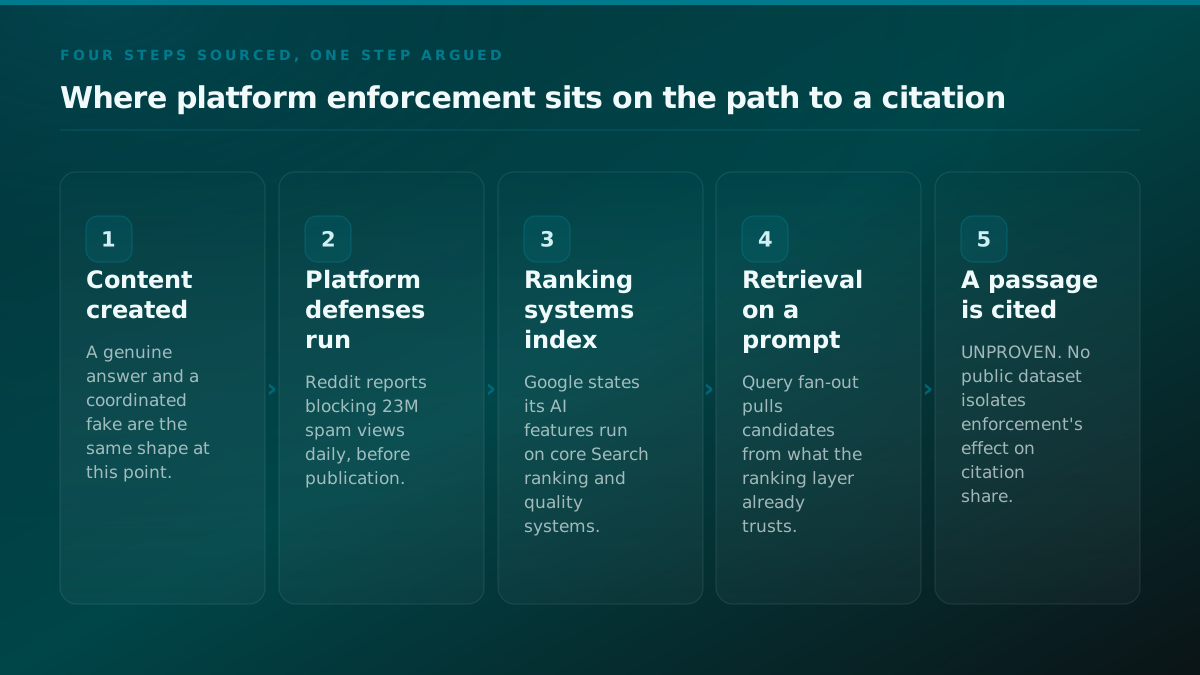
What we have is a documented chain with one dashed link. Steps one through four are sourced. The final step, the claim that enforcement measurably moves citation share, is an argument from direction. We have marked it that way in the diagram rather than drawing a solid line and hoping nobody asks.
Three ways to read the same announcement
A document can be honest and still support more than one reading. Reddit's post supports at least three, and being clear about which one you are taking is the difference between analysis and projection.
01 / Reading one: a safety announcement
- Stands out
- The document's own framing, aimed at users and moderators, and completely accurate on its own terms.
- Best for
- Anyone who uses the platform and wants to know whether the experience is getting worse.
- Falls short
- Explains none of why a company would fund this so heavily now, when it says itself that the work is 21 years old.
02 / Reading two: a licensing and data-quality pitch
- Stands out
- A corpus sold or licensed for training and grounding is worth more when it is demonstrably human, and cleaner numbers make a better commercial case.
- Best for
- Anyone modelling why platform data deals are priced the way they are.
- Falls short
- Speculative about motive. Nothing in the published post says this, and we are not claiming to know an intention.
03 / Reading three: a citation-eligibility argument
- Stands out
- The reading this post takes. Enforcement feeds the quality systems that answer engines retrieve from, so authenticity work is upstream of citability.
- Best for
- Anyone deciding where to spend on being quoted by an answer engine.
- Falls short
- The final link is argued, not measured. No public dataset isolates enforcement's effect on citation share, and we say so throughout.
We take the third and we are not claiming the first two are wrong. The safety reading is the document's own and it is accurate. The licensing reading is plausible and entirely unevidenced, which is why it is labelled speculative rather than argued.
The three-layer model is a provenance architecture
The most transferable idea in Reddit's post is not a number, it is the structure described near the end: three enforcement layers that operate independently of each other, run by different actors, failing in different ways, and each capable of catching things the other two miss. Described as safety it sounds administrative. Described as trust it is something a retrieval system would actually want.
Reddit describes three layers. Platform moderation, run by internal safety teams using automated tooling plus human review against sitewide policies. Community moderation, run by volunteer moderators using tools like the Reputation Filter to catch spammers, Crowd Control to restrict low-trust accounts, and Ban-Evasion Detection to block returning bad actors. And user voting, where every reader can push content up or down, which directly changes how visible it becomes.
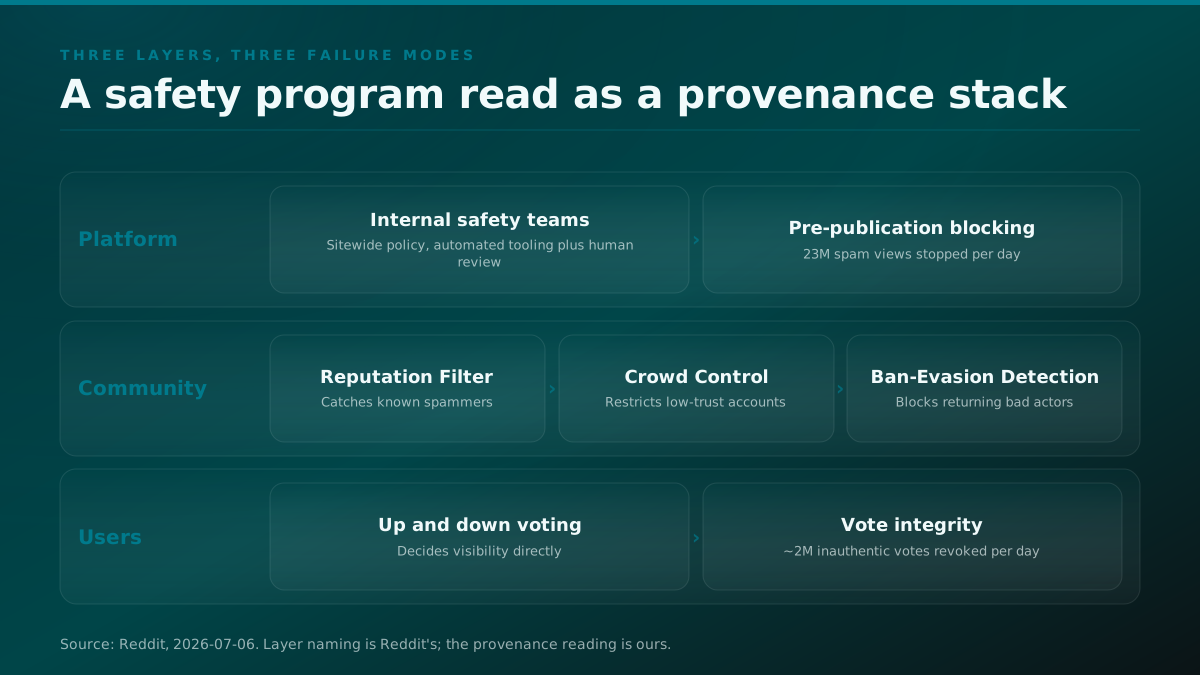
Described as a safety program, that is three teams doing overlapping work. Described as a trust architecture, it is something more specific: three independent filters with three different failure modes and no single point of capture.
An automated system can be probed and evaded at scale, but it is fast and it does not get tired. A human moderator is slow and inconsistent, but understands context an automated classifier cannot encode. A crowd is manipulable in principle, which is precisely why the second-largest number in the whole post is about revoking inauthentic votes, but at genuine scale it is expensive to fake.
Beating one layer is normal. Beating all three at once, repeatedly, is a different problem. That is what a retrieval system is implicitly relying on when it treats a heavily-discussed thread as more trustworthy than an anonymous page making the same claim.
Reddit did not describe it in these terms. We are.
The escalation nobody announced as an escalation
The July post also mentions, almost in passing, that accounts flagged as suspiciously automated will be asked to verify their humanity. It is one sentence in a document full of larger numbers, and it is the most structurally interesting thing in it.
Everything else in the enforcement stack is probabilistic. A classifier assigns a likelihood, a moderator makes a judgement, a crowd expresses a preference. A humanity check is different in kind: it converts an inference into an assertion attached to a specific account. That is a provenance primitive, not a filter.
A month later, the direction continued. Automated moderation with the power to remove posts and comments began rolling out to every newly created community, reported not as a platform announcement but as general news by outlets with no particular interest in content policy.
Two accounts, a combined 294,000 views on a story about moderation plumbing. That is not a metric about Reddit. It is a metric about how much attention the provenance of online text now attracts, and it is the same attention that makes a citation system's source choices worth arguing about at all.
Read the two moves together and a pattern shows up that neither announcement states. The enforcement work is moving from filtering content after it exists toward establishing the status of the account before it writes anything, and from human-supervised removal toward automated removal at the moment of creation. Both directions push the same way: earlier in the pipeline, and closer to a claim about origin rather than a claim about quality.
Origin is exactly what a citation system needs and mostly cannot get. A retrieval pass reading a page has no way to know whether the text in front of it was written by a practitioner with fifteen years of experience or generated in bulk to sell something. It can only read what survived, and infer from context. Every mechanism that makes survival correlate more tightly with genuine human origin makes that inference more reliable, whether or not anyone built it for that purpose.
Why attribution changes the economics
There is a reason to think the cost of citing a bad source is higher than the cost of ranking one, and it is worth making explicit because the whole argument leans on it.
Classic search sends a user to a page. The user arrives, sees the page, forms their own view, and the search engine's exposure is a click on a list. If the page turns out to be manipulated marketing dressed as advice, the reader can usually tell, and the failure is visibly the page's rather than the index's.
An answer engine does something else. It reads the page, extracts a claim, rewrites it in its own voice, and presents it as the answer, with the source named underneath. The reader never sees the original framing, never sees the surrounding page, and receives the claim already endorsed by the act of selection. If the underlying source was manufactured, the system has laundered it.
That asymmetry is not speculative. It follows from the interface. And it means the incentive to weight provenance more heavily is structural rather than a policy choice somebody might reverse, because the alternative is a product that confidently repeats whatever was best at pretending.
None of which proves any particular provider currently reads any particular platform's enforcement metrics. It explains why a provider would want to, which is a weaker claim, and the one we are actually making.
The obvious objection: this is search quality with new vocabulary
The strongest argument against everything above is that it describes nothing new. Search engines have penalised manipulation for twenty years. Platforms have fought spam for as long as they have existed. Nothing here is caused by AI, and dressing an old dynamic in new terminology is most of what the current wave of AEO commentary consists of.
We think that objection is about eighty percent correct, and saying so is more useful than defending the remaining twenty.
The eighty: there is genuinely no new mechanism. Google's own documentation is unambiguous that generative features run on the existing ranking and quality systems, with no special markup and no separate factor. Anyone selling a distinct AI-authenticity optimization is selling something that, by the provider's own account, does not exist. The correct response to most of this category is to keep doing the boring quality work.
The twenty that we think does change. First, attribution, for the reason above: being named in an answer is a different exposure from being ranked in a list. Second, compression. A results page shows ten sources and lets a reader triangulate; an answer typically names one to three. Winner-take-most selection raises the value of being the most clearly trustworthy source rather than merely a sufficiently good one. Third, the corpus itself is now contested in a way it was not, because generating plausible text at volume became nearly free, which is the change Reddit's own post opens by describing.
So the honest formulation is not that authenticity became a ranking factor. It is that an existing factor got more consequential at the same moment that faking it got cheaper. Both halves matter, and only the second one is new.
The five-second number is the one to watch
If you only take one figure from the announcement, it should not be the 23 million. Volume describes the size of the problem, and any large platform can report a large number.
The figure that changes what a machine finds is the latency: average detection to enforcement under five seconds on hate and violent content.
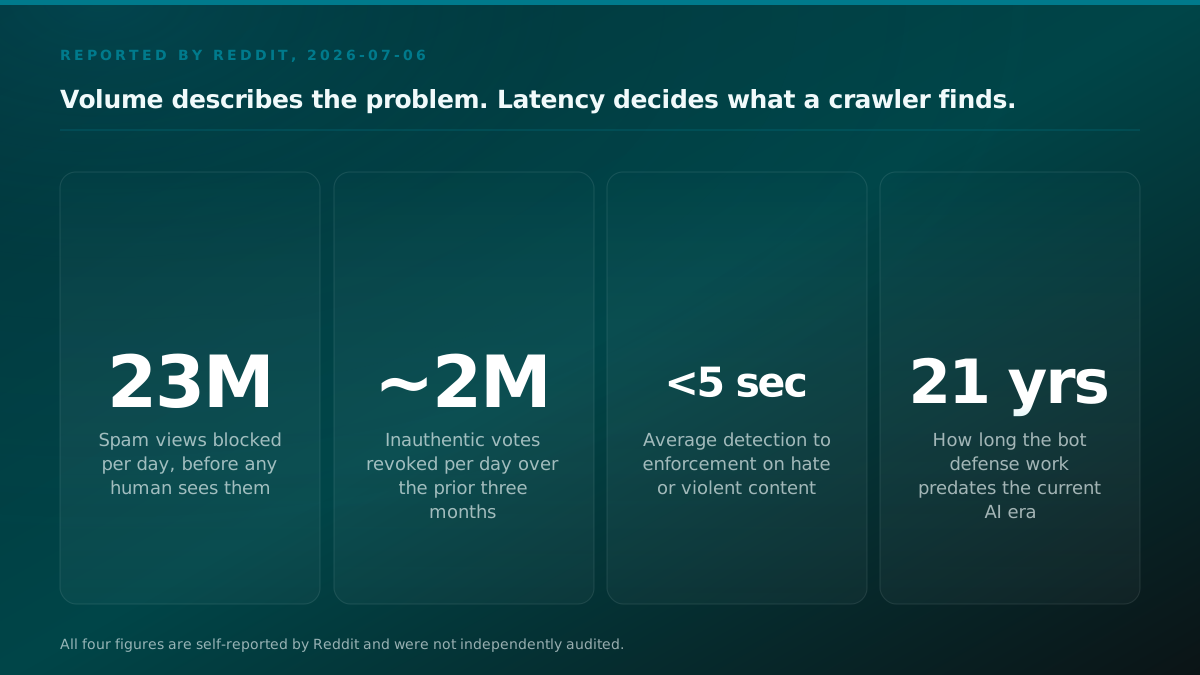
A crawler reads a page in whatever state that page is in at the moment it arrives. It does not wait for moderation to catch up, and it does not usually come back to check whether something was later removed. Content that survives for hours has a real chance of being indexed with the manipulation intact. Content that survives for four seconds mostly does not.
Enforcement speed, in other words, is the variable that decides whether the cleanup happened before or after the machine looked. The same logic is why false-positive precision matters here rather than being a footnote. Over-removal at scale would strip out exactly the awkward, specific, first-hand human answers that make the corpus worth quoting in the first place. A defense that cleaned the corpus by emptying it would win the spam metric and lose the thing being protected.
What actually transfers to your own site
Most of this does not port. You have no accounts to screen at creation, no vote graph to clean, and no volunteer moderator layer. Being honest about that is more useful than a listicle that pretends otherwise.
What transfers from a platform's defense stack to a normal website
| Reddit's mechanism | Transfers to your site? | What you can actually do |
|---|---|---|
| Signals read at account creation | No | You have no accounts to screen. This is platform-shaped and does not generalise. |
| Roughly 2 million inauthentic votes revoked daily | No | You have no vote graph. Nothing here is portable. |
| Volunteer moderators enforcing per-community rules | Partially | Named human review of what you publish, with the reviewer identifiable. |
| Enforcement before content reaches a reader | Yes | Do not publish the thin page and fix it later. A crawl may only ever see the first version. |
| Content that is specific rather than commodity | Yes | This is Google's own stated criterion, and it is the one lever on this list you fully control. |
Two rows do transfer, and neither is a technical change.
The first is enforcing quality before publication rather than after. This follows directly from the latency point. If a crawler reads a page in whatever state it finds it, then the thin first draft you intended to improve next week is a real artifact with a real chance of being the version that gets read. Reddit's own framing of this is that its most effective work happens before a post is ever seen by a human. The website equivalent is unglamorous: publish fewer pages, later.
The second is Google's own criterion, non-commodity content. This is the only item on the list you fully control and it is the one most often skipped in favour of markup changes that Google has explicitly said are not required. Content that could have been produced by a generative model is content a generative model has no reason to cite, because it can produce it itself. What it cannot produce is what you specifically measured, ran, priced, or got wrong.
That is the same reason we publish our own method for measuring answer engine optimization lift including the parts where our instrument is too weak, and why our AI citation measurement writing leads with a null result rather than a win.
Why nobody can prove this, including us
There is a version of this post that ends with a confident causal claim and a service pitch attached to it. We cannot write that version, and the reason is not modesty about the argument, it is our own measurement data, which shows the underlying instrument is far too noisy to support the claim we would need to make.
We ran a step-zero measurement: 12 commercially relevant queries, five identical repeats each, one model, one day. All 60 calls succeeded. Seven of the 12 questions changed their answer between repeats that were identical by construction. Not different phrasings. The same question, asked again, returning a different set of named brands.
We then ran a permutation test on the same query set: 20,000 random splits with no intervention applied at all. The null difference centred on zero, mean plus or minus 0.0016, with a standard deviation of 0.215. That standard deviation is the noise floor, and it is large.
The consequence is arithmetic. That design's minimum detectable lift is 51.1 percentage points, roughly four times too coarse for anything a real engagement moves. A 40-query by 40-sample design gets that floor down to 9.9 points. We published all of this, including the part where our own instrument was underpowered, on why a single AI visibility score is noise.
Apply that honestly to the present argument. If a single brand's citation outcome flips on identical repeats, then measuring whether a platform's enforcement changed its citation share would need a vastly larger design than anyone has published, plus a comparison against what would have happened anyway. Nobody has run it. We have not run it either.
So we are not claiming a measured effect. We are claiming that the incentive points one way, that the platforms are behaving as though it does, and that the first-party documentation from the largest search provider describes a mechanism in which it plausibly would.
The word that never appears in Reddit's own announcement is citation. That absence is worth more than a quote would have been, because it means the incentive is arriving without anyone having to be persuaded of it.
What would change our mind, written before anyone reads it
| Finding | What it does to this argument |
|---|---|
| A model provider publishes ranking documentation showing platform enforcement metrics are read directly as a feature | Strengthens it, and makes the indirect framing here unnecessarily cautious. |
| A controlled study finds citation share is flat against large changes in a platform's measured spam rate | Refutes the causal half. The observation that community platforms are heavily cited would survive; the join to enforcement would not. |
| Answer engines shift decisively toward licensed first-party data and away from open community corpora | Dates it. The trust currency would still exist, but the platforms holding it would be different ones. |
| Reddit's own numbers turn out to be measured against a moving definition of spam | Weakens the evidence without touching the mechanism. Every figure here is self-reported by an interested party, which the post says on its own. |
What this means if you are building for citation
The practical read, for anyone working on AI citations for a product rather than a platform, comes down to three things, none of which is a schema change and none of which requires believing the causal claim this post has deliberately refused to make. They hold even if the argument above turns out to be wrong.
Be somewhere with a functioning trust layer. If community platforms are carrying a disproportionate share of citations for exactly the intents where buyers ask "is this any good", then presence there is worth more than another page on your own domain saying you are good. That is also why Reddit and community marketing is a citation activity and not only an awareness one, and why doing it badly, in the way the enforcement systems above exist to catch, is now actively expensive rather than merely ineffective.
Publish the thing a model cannot generate. For most developer tools and APIs that means real numbers from real usage, real failure modes, real limits. Google's stated criterion and the practical citation criterion converge here: a passage gets quoted when it supports a specific claim that the model cannot assemble on its own.
Then measure it properly or do not claim it. Everything above is a direction, and directions are how you decide where to spend, not what to report. The moment you want to say a change worked, you need a control arm, and that is a different piece of work from any of this.
There is also a negative version of this list, and it is shorter and more important. Do not buy the thing that is explicitly documented as unnecessary. Google states there is no special markup, no AI text file, and no separate machine-readable artifact required to appear in Search. If a proposal's central deliverable is one of those, the provider's own documentation contradicts the pitch, and you can check that in about two minutes.
Do not manufacture the community presence either. The entire first half of this post is about a platform spending real engineering effort to detect exactly that behaviour, at a claimed 23 million blocked views a day, with account-level signals read at creation and roughly 2 million votes revoked daily. Coordinated posting designed to look organic is the specific adversary those systems were built for, and the failure mode is not merely that it stops working. It is that the account carrying your product's name gets caught by a system that is getting faster every quarter.
And do not treat any of this as a substitute for having something worth quoting. The mechanism described throughout decides which sources are eligible to be selected. It does not create a claim worth selecting. If the honest summary of your page is that it restates what is already widely known, no amount of provenance makes a model prefer it over its own ability to write the same thing.
How to check this yourself rather than believing us
Everything above is an argument rather than a measurement, so the genuinely useful thing to hand a reader is a way to test the parts that apply to them, using their own category and their own buyers, rather than a conclusion to accept on our authority. The exercise below takes an afternoon and needs no tooling.
Pick five questions where a buyer in your category decides something. Not brand questions, where your own site wins by default and the result tells you nothing. Decision questions: does this actually work, what breaks, what do people switch to.
Ask each one of a live answer engine, and write down not the summary but the SOURCES it named. Then ask the same five again the next day, unchanged, and write those down too.
Two things usually happen and both are informative. The first is that a meaningful share of the named sources are not vendor pages. If your results look anything like the seven-month study above, you will see community threads, encyclopedic entries and video alongside whatever companies are selling into the category. That tells you where the citation surface actually is for your buyers, which is rarely where the marketing budget is.
The second is that the source lists will not match between the two days. Ours did not. Seven of twelve questions changed answer between identical repeats in our own run, and that is the single most useful thing a reader can discover firsthand, because it inoculates against every dashboard that will later show them a number moving and imply it means something.
That exercise costs an afternoon and settles more than this post can. If it returns a stable, vendor-dominated source list for your category, then the argument here matters much less to you than we have suggested, and you should weight it accordingly.
What we are actually saying
Reddit published a safety document that never mentions AI search, and the numbers in it describe a platform investing heavily in being demonstrably human at exactly the moment being demonstrably human became commercially useful in a new way. We do not think that is a coincidence, and we cannot prove it is causal.
The distinction we would defend: authenticity enforcement is not a new ranking factor invented for the AI era. It is a twenty-year-old quality signal that suddenly acquired a consumer who reads your content out loud and attaches your name to the answer. Nothing about how to earn it changed. What changed is what happens after you earn it, and how much it costs when a manipulated source gets quoted with attribution.
There is a version of this we would happily be wrong about. If somebody publishes a controlled study showing citation share is flat against large swings in a platform's measured spam rate, the causal half of this argument goes away and we will say so here rather than quietly leaving the post up. The observation that community platforms carry a large share of citations would survive that result, because it was measured by somebody else and does not depend on our reasoning. The join between the two is ours, and it is the part that can be taken apart.
Until then, the practical position is unchanged and slightly boring. Publish things a model cannot write on its own, be present where the citations actually land, and refuse to report a number as a result until something was held back to compare it against.
If you want to know what the answer engines currently say about you, the useful first step is not a dashboard. It is reading the actual output for the handful of queries where a buyer decides.
Sources
Every number above, and where it came from. A figure without a row here is one we should not have printed.
- Reddit, "How We're Keeping Reddit Real and Safe in the AI Era"
- Published 2026-07-06. The primary source for every enforcement figure in this post, 23 million spam views blocked daily, roughly 2 million inauthentic votes revoked daily, detection to enforcement under five seconds, and the three-layer moderation model.
- Google Search Central, optimizing your website for generative AI features
- Google's own guidance. States that generative AI features on Search are rooted in core Search ranking and quality systems, that no special markup is required, and that content should be non-commodity rather than recycled.
- Conductor, "How AI Engines Choose and Cite Sources: A 7-Month Analysis"
- Seven engines, seven intent categories, September 2025 through March 2026, 1,056 data points. Found Reddit leading Support-intent citations for ChatGPT in five of seven months, with Wikipedia and YouTube leading elsewhere.
- r/coolguides, "A cool guide to where AI gets its information from"
- 17,279 upvotes, 1,027 comments. A general-audience subreddit, not a marketing one, showing that the question of where AI sources its answers has left the practitioner bubble entirely.
- r/SipsTea, "AI gets its facts from ... us?"
- 19,508 upvotes, 2,730 comments. The same realisation reaching a mass audience, framed as a surprise rather than as a marketing insight.
- Dexerto on Reddit's automated moderator rollout
- 1,664 favorites, 78 retweets, 166,436 views, 2026-08-05. Reports the moderation layer expanding again a month after the enforcement post, with automated removal available to every newly created subreddit.
- Polymarket on Reddit's automated moderators
- 615 favorites, 40 retweets, 128,327 views, 2026-08-05. A second independent account of the same rollout, evidence the enforcement story travels as general news rather than as platform PR.
- Our own step-zero measurement run
- 12 money queries times 5 identical repeats, one model, one day, 60 of 60 calls succeeded, 7 of 12 flipped outcome between identical repeats. Published with its numbers on this site.
- Our own permutation test
- 20,000 random splits of the same query set with no intervention applied. Null difference centred on zero, mean plus or minus 0.0016, standard deviation 0.215.
- r/GEO_FAQ, practitioner taxonomy of AI citation selection
- Ranks in the live top ten for "how do ai search engines choose sources." Names entity trust signals and multichannel corroboration as selection criteria, sourced to Google and OpenAI documentation. Low engagement, cited here as a competitive-set artifact rather than as demand evidence.
Questions this answers
- Does blocking spam actually help a platform get cited by AI?
- Indirectly and unproven. Google says its AI features run on core Search ranking and quality systems, and those systems already price manipulation. Cleaner content should score better there. No public dataset isolates enforcement's effect on citation share, so this is a documented direction rather than a measured result.
- How much spam does Reddit block per day?
- Reddit reported blocking 23 million spam views per day before they reach a user, catching roughly 25,000 new spammy posts and comments daily, and revoking nearly 2 million inauthentic votes per day. All figures are self-reported by Reddit in its 2026-07-06 post.
- Which sources do AI engines cite most?
- It varies by engine and by intent. A seven-month study across seven engines found Wikipedia leading for ChatGPT Search on several intents, YouTube leading for AI Overviews, Gemini and Perplexity, and Reddit leading Support-intent citations for ChatGPT in five of seven months.
- Is there special markup that makes AI engines cite my page?
- Google says no. Its guidance states there is no special schema.org markup required and no need to create new machine-readable files or AI text files to appear in Search. The stated criteria are non-commodity content, clear helpfulness, and a genuinely unique point of view.
- What can a normal website copy from a platform's authenticity stack?
- Two things. Enforce quality before publishing rather than after, because a crawl may only ever see the first version of a page. And publish specific, non-commodity content, which is Google's own stated criterion and the one fully within your control.
- Can anyone prove an AEO investment changed their AI citations?
- Only with a held-out control. Our own repeat testing found 7 of 12 identical queries changed answer between identical asks, and a 20,000-split permutation test on the same set produced a null centred on zero. Without a control arm, a single reading cannot separate work from drift.
Keep reading
AI citations
LLM SEO, what it actually is and what the work looks like
Google says its AI features run on the same ranking systems as Search, so the tactics are familiar. What changed is how you tell whether the work landed.
46 min read
AI citations
Best AI SEO Agency for Developer Tools and API Companies
A five-question checklist for vetting an AI SEO agency, built from what real developer-tool buyers report going wrong, not a ranked vendor list.
24 min read
AI citations
Does Google index Reddit comments? What actually counts
Reddit's robots.txt disallows every crawler, yet Google shows Reddit with full descriptions. Here is what is actually indexed, measured rather than assumed.
25 min read