Measuring ChatGPT Citations: Why an API Proxy Recovers Only a Quarter of Them
A 2026 study recovered just 28.3 percent of ChatGPT's real cited URLs through a Google and API proxy. Here is what AI visibility tools built that way miss.
Citon11 min read
Short answer
Can an AI visibility tool measure ChatGPT citations through a Google or API proxy?
Not accurately. An API proxy reads a different surface than the one ChatGPT cites from. A study posted on 2026-10-11 found that Google results combined with the OpenAI Responses API recover only 28.3 percent and 26.2 percent of ChatGPT's real cited URLs, rising to about half only at the hostname level. A tool built on that proxy is matching the exact pages ChatGPT names roughly a quarter of the time. A second problem compounds it: in our own run the same query asked twice changed its answer on 7 of 12 queries, so a single reading is one draw, not a score. Defensible measurement samples the production surface and treats every number as a distribution.
Paste the question a buyer would ask into ChatGPT and watch which sources it names. Then open your AI visibility tool and compare. For most tools the two will not match, because the tool is not reading the answer you just saw. It is reading a stand-in, usually a Google result set or an API endpoint, and a 2026 study has now put a number on how often the stand-in agrees with the real thing.
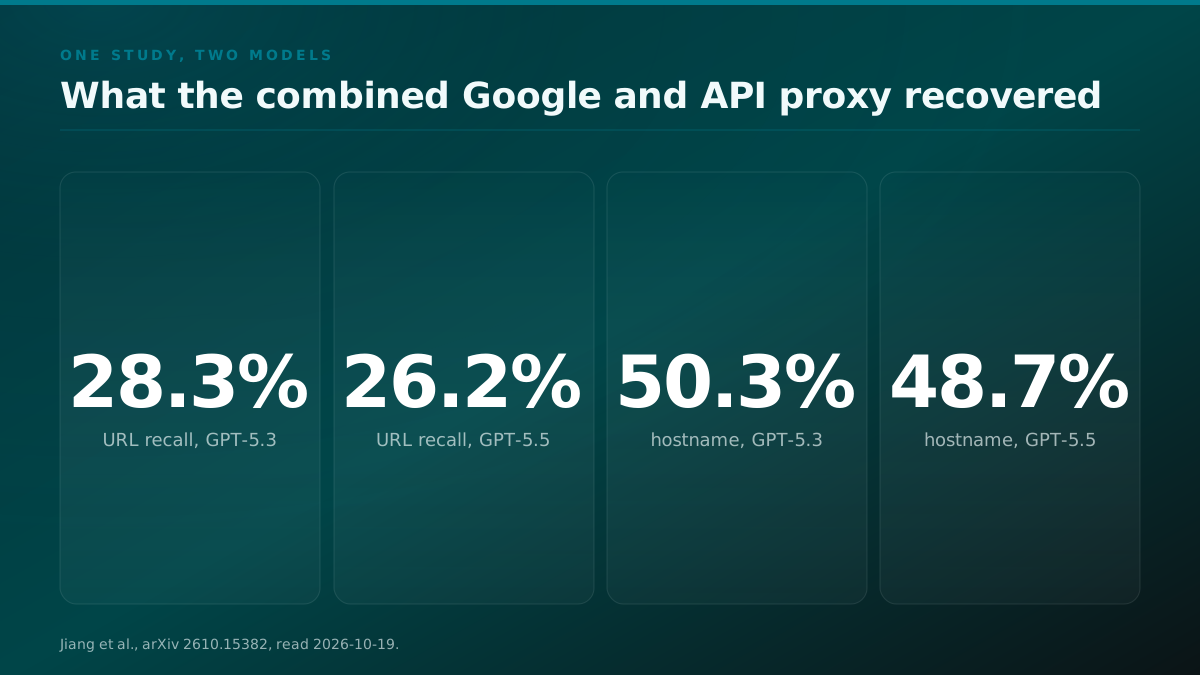
That study, Understanding ChatGPT Citations, posted on 2026-10-11, tried to recover the pages production ChatGPT cites using two external signals: Google Search results and the OpenAI Responses API. Combined, the two recovered 28.3 percent of the exact cited URLs for GPT-5.3 Instant and 26.2 percent for GPT-5.5 Instant. At the hostname level the match rose to about half, 50.3 percent and 48.7 percent. The authors are direct about what that means: external proxies recover the same hostnames more reliably than the same exact URLs.
This post is for teams buying or building an AI visibility tool for developer tools and APIs. It covers what the study measured, why a Google or API proxy misses most of what ChatGPT cites, a second problem that affects even a perfect reading, and what it takes to measure ChatGPT citations in a way you can defend to a skeptical buyer.
The short version
A study of production ChatGPT web search, posted 2026-10-11, tried to recover the pages ChatGPT cites using two external signals: Google results and the OpenAI Responses API. Combined, they matched only 28.3 percent of the exact cited URLs for one model and 26.2 percent for the next, and about half of the cited hostnames. An AI visibility tool that reads citations through that proxy is measuring a surface that agrees with the real one roughly a quarter of the time at the URL level. Ahrefs adds a second gap: across 66.6 million free responses, only 14.4 percent ran a web search at all. And in our own step-zero run, 7 of 12 queries flipped outcome across identical repeats, so one reading is one draw. The fix is to sample the production surface, repeat it, and report a difference against a held-out control rather than a single score.
At a glance
What the proxy recovers, level by level
| Match level | GPT-5.3 Instant | GPT-5.5 Instant | What it means for a tool |
|---|---|---|---|
| Exact cited URL | 28.3 percent | 26.2 percent | The page ChatGPT actually named is matched about a quarter of the time |
| Cited hostname | 50.3 percent | 48.7 percent | The right site is matched about half the time |
| Cited entity | 50.7 percent | 45.1 percent | The right brand or topic is matched about half the time |
What did the ChatGPT citations study actually find?
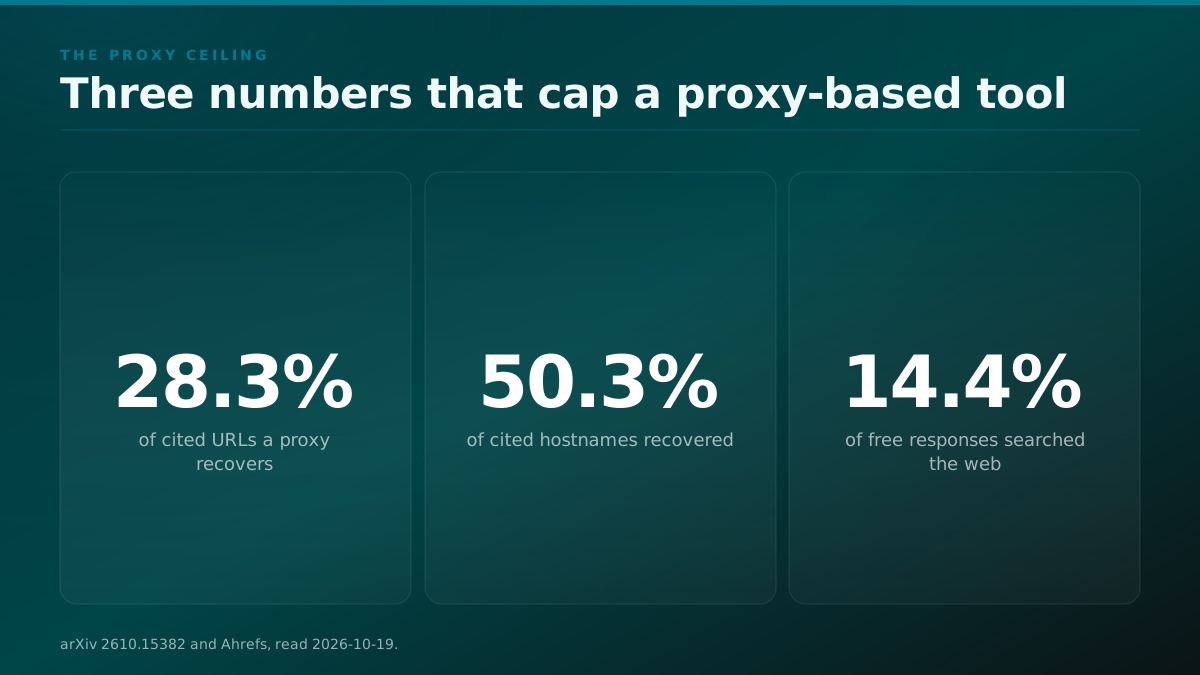
The study measured recovery, which is a plain question with an uncomfortable answer: if you only had Google results and the OpenAI Responses API, how many of ChatGPT's real citations could you reconstruct? For the exact URL the answer was 28.3 percent and 26.2 percent across two model generations, and for the hostname it was 50.3 percent and 48.7 percent. A supervised model that combined the two signals did better, clearing an AUC of 0.74 at every level, but that is a trained classifier, not the raw proxy a dashboard reads.
Those numbers describe the best case for a proxy, not the worst. The researchers used both Google Search and the Responses API together, where most tools lean on one. They ran it against production ChatGPT web search, the same surface a buyer sees. And they still recovered fewer than three in ten exact URLs. The paper itself, read 2026-10-19, frames this as a structural gap rather than a tuning problem: the proxy and the production answer are different surfaces that happen to overlap.
The reason the hostname figure is higher than the URL figure matters for how you read any tool. A proxy can often tell you the right site was involved while naming the wrong page on it. If your tool reports hostnames, it is working near its most reliable level. If it reports exact URLs or specific pages, it is working where the agreement is weakest.
How well two proxies recover ChatGPT's real citations
| Match level | GPT-5.3 Instant | GPT-5.5 Instant | Source |
|---|---|---|---|
| Exact cited URL | 28.3 percent | 26.2 percent | published |
| Cited hostname | 50.3 percent | 48.7 percent | published |
| Cited entity | 50.7 percent | 45.1 percent | published |
n = 2 · as of 2026-10-19
Method: Values are the recovery rates reported by Jiang et al., arXiv 2610.15382, for the union of Google Search and OpenAI Responses API candidates against production ChatGPT web search. We read the paper on 2026-10-19 and did not reproduce its runs. Re-read the source before relying on a cell.
One study, three match levels
How much of ChatGPT's citations a proxy recovers (GPT-5.3 Instant)
| Point | Value (pct) |
|---|---|
| Exact URL | 28 pct |
| Hostname | 50 pct |
| Entity | 51 pct |
A tool that reads ChatGPT citations through a Google result or an API endpoint is not watching ChatGPT answer. It is watching a stand-in, and the study put a number on how often the stand-in agrees.
Why does a Google or API proxy miss most ChatGPT citations?
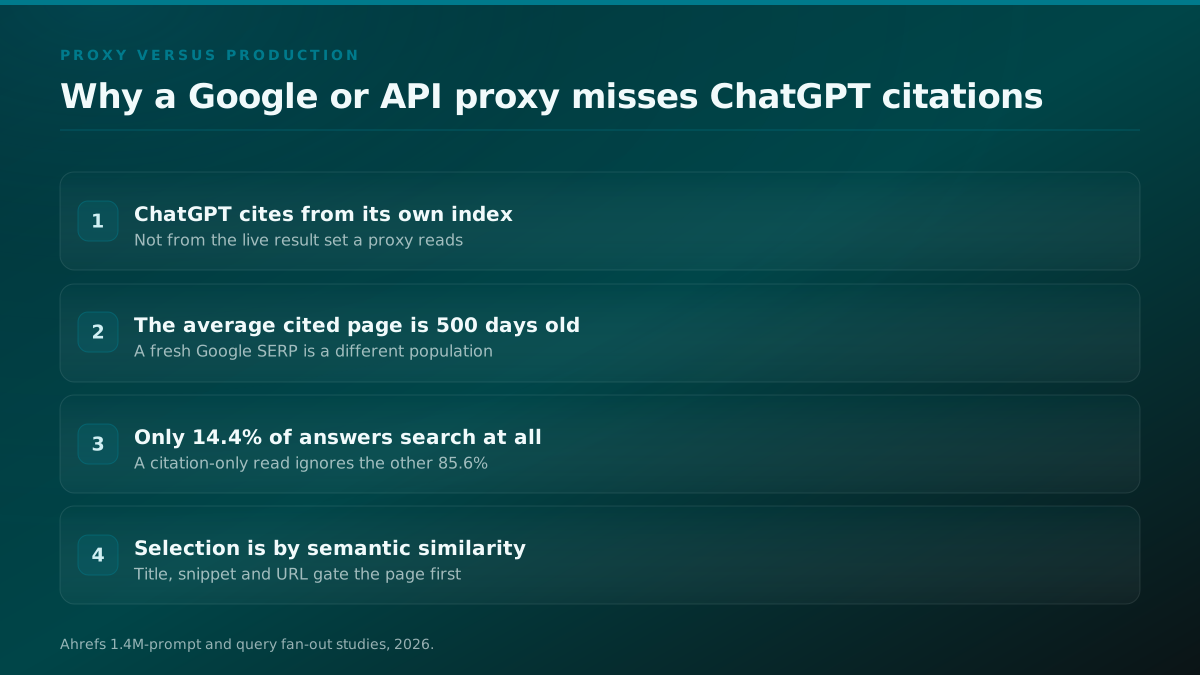
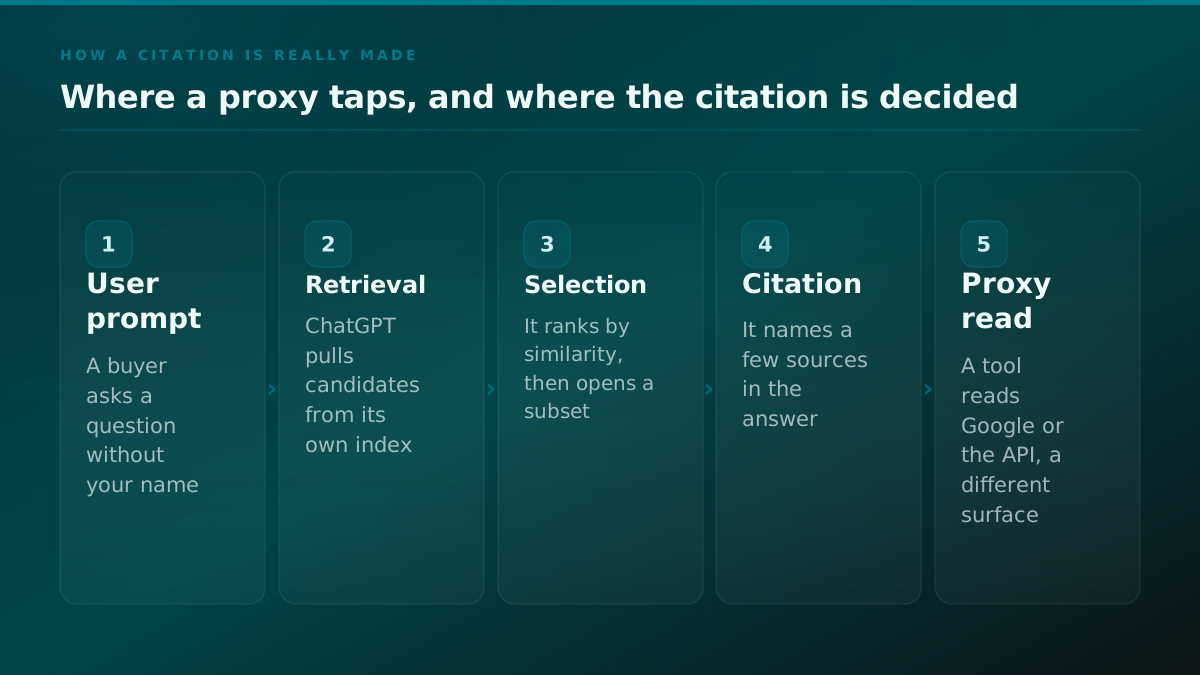
The proxy misses because ChatGPT does not cite from the surface the proxy reads. It cites from its own retrieval and its own index, selecting pages by semantic similarity to the query before it opens any of them. Ahrefs reached the same conclusion across 1.4 million prompts: ChatGPT favours its general search index, treats the title, snippet and URL as the first gate, and the average page it cites is about 500 days old. A live Google result set is a different population than a 500-day-old index, so the two will disagree by construction.
There is a second, blunter reason, and it is larger than the first. A citation only exists when ChatGPT ran a web search. Ahrefs analysed 66.6 million free, logged-out responses from August and September 2026 and found that only 14.4 percent of them searched the web at all. The other 85.6 percent answered from the model's own memory and named no sources. A tool that scores you on citations is scoring the minority of answers that produced one, and cannot see the majority where your brand was present or absent in the prose itself.
Put the two together and the proxy faces compounding losses. Of the answers that do search, it recovers the exact cited URL about a quarter of the time. Of all answers, most never cite anything. A single score built on that pipeline is a thin reading of a narrow slice, presented as a measure of the whole.
From the field
The proxy and the production answer are different surfaces
ChatGPT decides its citations inside its own pipeline, from candidates it retrieved and an index it already holds. A Google result set or an API endpoint is a separate surface that a tool can read cheaply. The study measured how often the two agree and found 28.3 percent at the URL level for GPT-5.3 and 26.2 percent for GPT-5.5, rising to about half at the hostname level. That gap is the ceiling on a proxy-based reading, before any sampling noise is added.
arXiv 2610.15382, read 2026-10-19
Worth knowing
Most answers never search, so a citation-only read is partial
A citation exists only when ChatGPT ran a web search and named a source. Ahrefs found that across 66.6 million free, logged-out responses in August and September 2026, only 14.4 percent triggered a search at all. A tool that scores you on citations alone is scoring you on the minority of answers that produced one, and is blind to the majority that answered from the model's own memory.
Ahrefs query fan-out study, read 2026-10-19
What is an AI visibility tool really counting?
An AI visibility tool that reads citations through a proxy is counting agreement between two surfaces, and the study says that agreement runs about 28.3 percent at the URL level and about half at the hostname level. It is not counting what ChatGPT cited. It is counting what a Google result set or the Responses API would have surfaced for the same query, which matches the real citation roughly a quarter of the time at the page level. That is not a defect in any one product. It is the ceiling the surface imposes on every product that reads it.
This is why two tools can disagree about the same brand on the same day. Each is sampling a different proxy, or the same proxy at a different moment, and both are a quarter-accurate stand-in for the answer a buyer actually saw. The honest version of the number is a confidence interval wide enough to swallow most week-over-week movement, which is a hard thing to put on a dashboard that wants to show a clean line going up. A practitioner thread from 2026-10-10 made the point from the other direction, arguing that a visibility report is a diagnostic tool, not proof, and that correlation between being cited and having traffic does not establish that one caused the other.
None of this means ChatGPT citations are unmeasurable. It means the measurement has to read the right surface and has to carry its own error bars. We keep a longer treatment of the tool landscape in our note on AI-citation measurement, and what counts, and a direct comparison of buying a tool against measured proof in an AI visibility tool versus an answer-engine agency.
The thing being sold
AI Visibility Score: 72 / 100
72
Headline score, one number
API proxy
Source of citations read
1
Repeats behind the number
None
Held-out control
- Reads citations from an API endpoint, not production ChatGPT
- One sample per query, so volatility is invisible
- No control group, so a market-wide move reads as your lift
- Trend line moves between identical runs
Two ways to measure the same thing
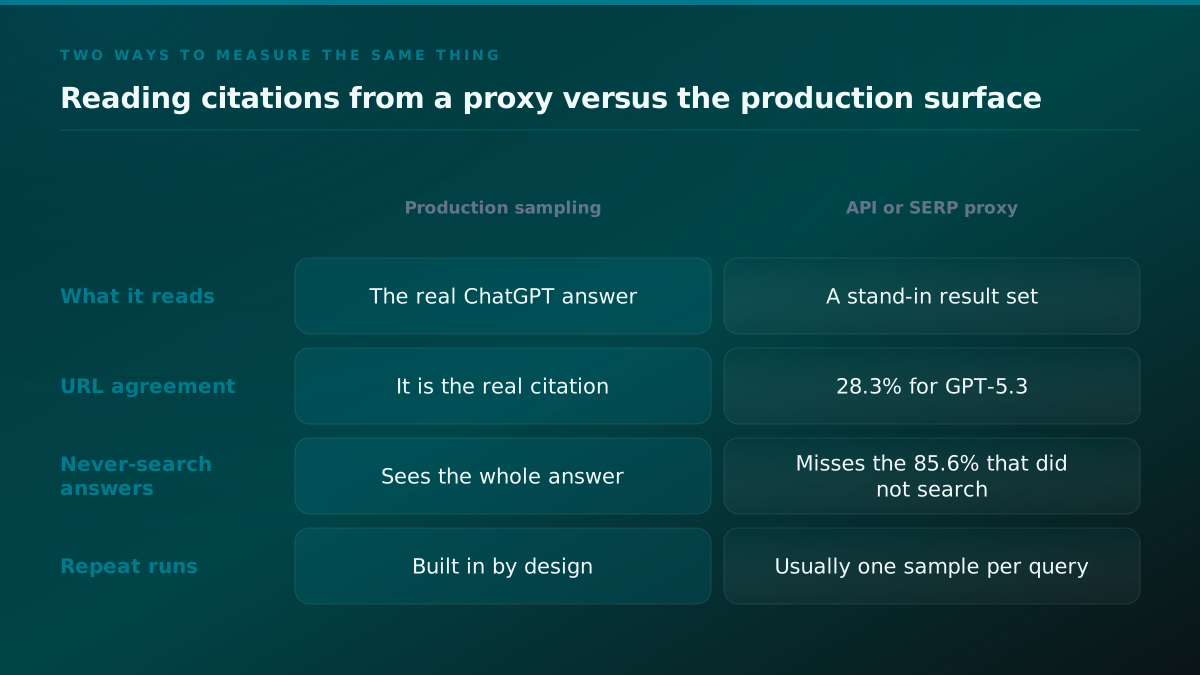
Reading ChatGPT citations through a proxy versus from the production surface
| Production-surface sampling | API or Google-SERP proxy | |
|---|---|---|
| What it reads | The answer ChatGPT actually returns to a user | A Google result set or an API endpoint that stands in for it |
| URL-level agreement with real citations | It is the real citation | 28.3 percent for GPT-5.3, 26.2 percent for GPT-5.5 |
| Handles answers that never search | Yes, it sees the whole answer | No, a citation-only read misses the 85.6 percent that did not search |
| Repeat runs | Built in, because volatility is the point | Usually one sample per query |
Two independent reasons a proxy undercounts ChatGPT citations
| Gap | Figure | Source | Effect on a single score | Source |
|---|---|---|---|---|
| Proxy misses the exact URL | 28.3 percent recovered | arXiv 2610.15382 | Three of four cited pages are the wrong page or absent | published |
| Most answers never search | 14.4 percent searched | Ahrefs, 66.6M responses | Citation-only reads ignore most of the surface | published |
| Same query disagrees with itself | 7 of 12 flipped | Citon step-zero run | One reading is one draw, not a level | measured |
People are selling optimization tricks before proving what actually earns citations.
The second problem: the same query answered twice disagrees
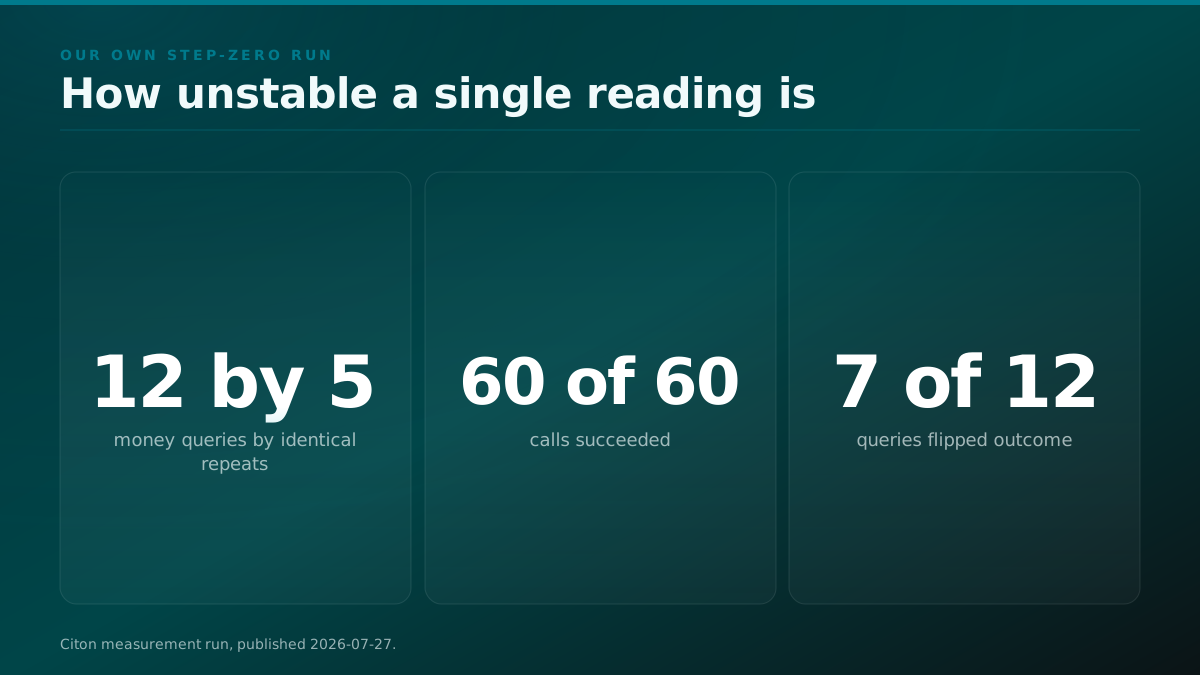
Even a perfect reading of the production surface runs into a second wall, which is that the surface itself is not stable. Ask ChatGPT the same money query twice and you can get two different answers, with two different sets of citations. We measured this in our own step-zero run, written up in why a single AI visibility score is noise: 12 money queries by 5 identical repeats on one model on one day, 60 of 60 calls succeeded, and 7 of the 12 queries flipped outcome across repeats that were identical by construction. That is a property of the system, not a vendor's bug.
If 7 of 12 queries change answer with no intervention at all, a single reading is one draw from a distribution, not a score. A tool that samples each query once and plots the result as a point is drawing a trend line through noise. The movement it shows between two Tuesdays can be entirely the run-to-run variance, with nothing underneath it. This is the same failure as the proxy gap, arriving from a different direction: the first adds error because the surface is wrong, the second adds error because the surface is unstable.
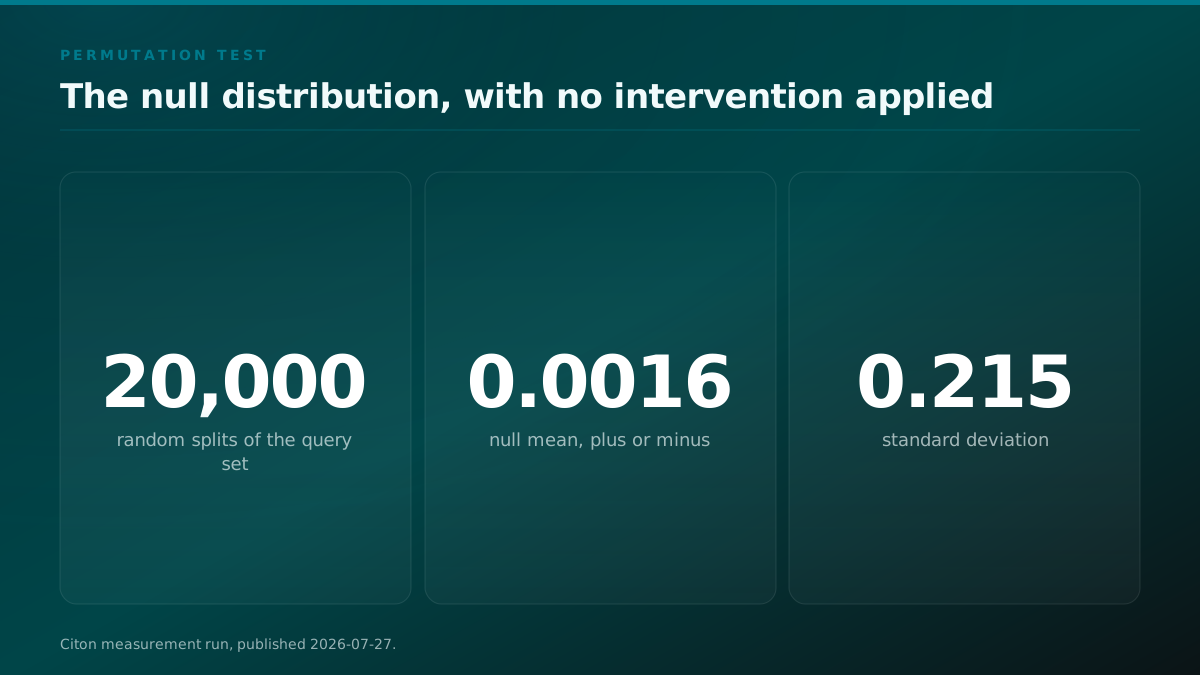
We also checked that the noise was symmetric rather than hiding a signal. Across 20,000 random splits of the same query set with no intervention applied, reported in that same AI visibility score analysis, the difference between the two halves centred on zero, mean plus or minus 0.0016 with a standard deviation of 0.215. Under that null the two arms are genuinely the same even while each one jumps around, which is exactly the condition that makes a before-and-after against a control recoverable and a single level meaningless.
Our own step-zero measurement of citation volatility
| Measurement | Result | What it means | Source |
|---|---|---|---|
| 12 money queries by 5 identical repeats, one model, one day | 7 of 12 queries flipped outcome, 60 of 60 calls succeeded | A single reading is one draw, not a stable score | measured |
| 20,000 random splits of the same query set, no intervention | Null difference centred on zero, mean plus or minus 0.0016, SD 0.215 | Under the null the two arms are the same, so a before-and-after against a control is recoverable | derived |
n = 60 · as of 2026-07-27
Method: Our own step-zero run and permutation test, published 2026-07-27 at /blog/measurement/why-a-single-ai-visibility-score-is-noise. First row: 12 money queries by 5 identical repeats on one model on one day, 60 calls, counting how many queries flipped outcome. Second row: 20,000 random splits of the same query set with no intervention, reporting the null difference between the two halves. This measures volatility and a null distribution, not a causal lift; the design is about four times too small to detect a realistic effect, which we state rather than imply a result we have not earned.
What does defensible measurement of ChatGPT citations require?
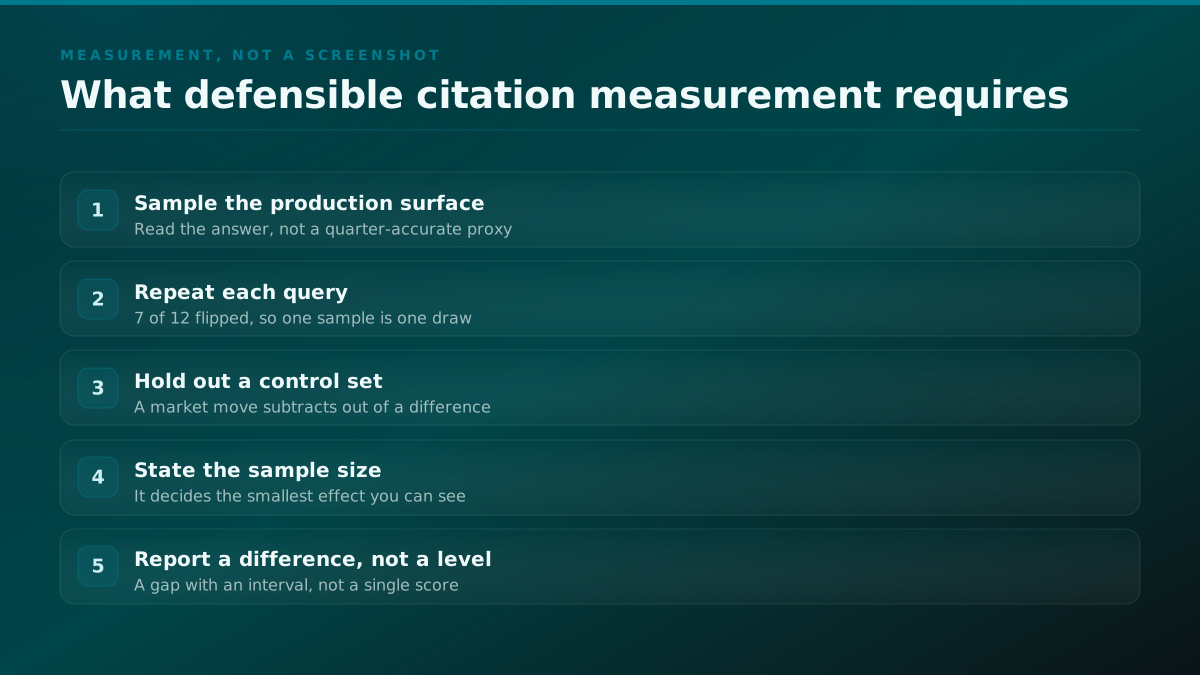
Defensible measurement requires four things a single score does not have: the production surface, repeats, a control, and a stated sample size. Read the answer ChatGPT returns to a user rather than a proxy that recovers the exact URL a quarter of the time. Repeat each query several times, because 7 of 12 flipped on us and yours will too. Hold out a comparable set of queries you leave unworked, so a model update or a market-wide shift moves both arms and subtracts out. And say how many calls sit behind the number, because that is what decides whether you can see a real effect or only a very large one.
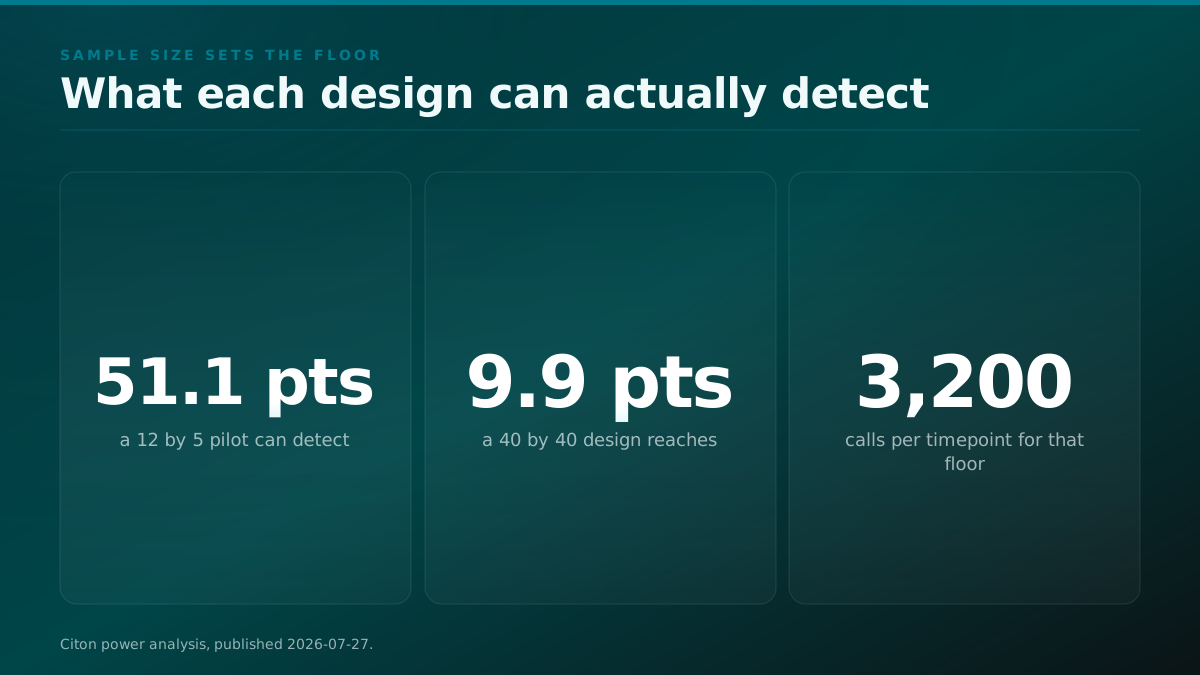
The sample size is not a detail. Our 12 by 5 pilot has a minimum detectable lift of 51.1 percentage points, which means it can only distinguish a move of fifty-one points or more from noise. A real engagement moves citation share by something closer to five to fifteen points, so a design that coarse would report almost every genuine win as nothing. Getting the floor down to 9.9 points takes 40 queries by 40 samples, roughly 3,200 calls per timepoint, and you pay that cost twice because you need a before and an after. We walk through that arithmetic in why a single AI visibility score is noise and the sampling design in our note on prompt tracking and sample size.
The shape that survives all of this is a difference, not a level. You are not reporting that a brand scored 72. You are reporting that the worked arm sat some measured number of points above the held-out arm, across a stated number of calls, with an interval around it. That is a claim a skeptical buyer can check, and it is the one thing a proxy-fed single score can never become.
STEPS
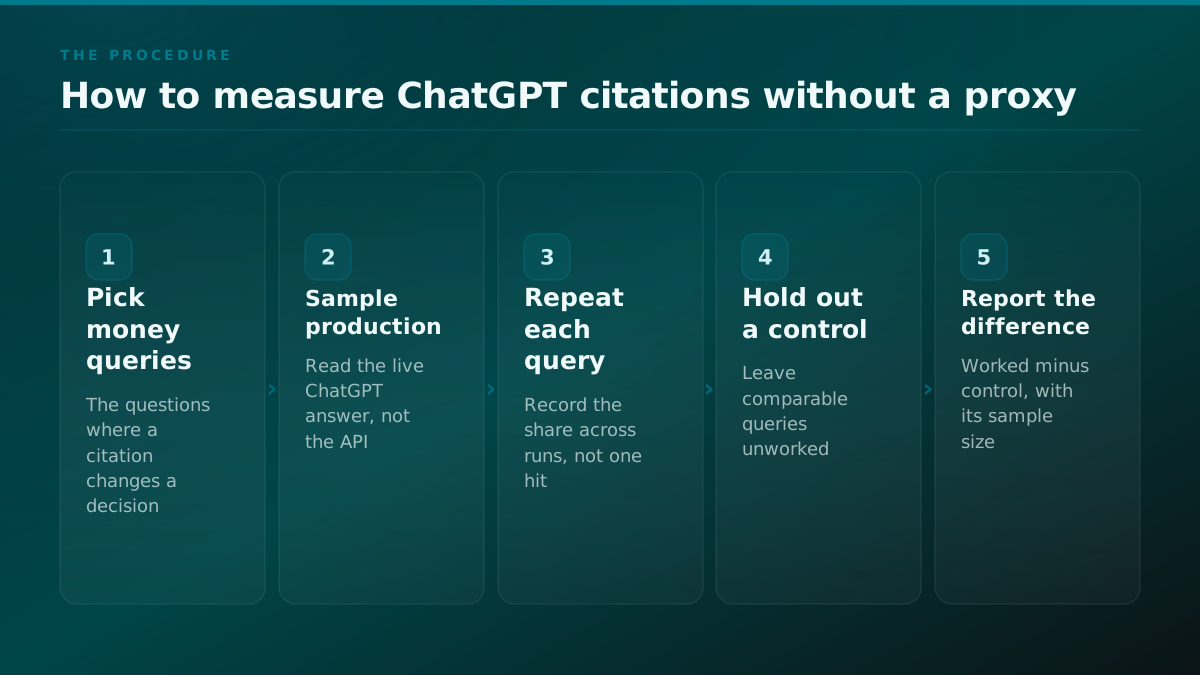
How to measure ChatGPT citations without a proxy
Pick a fixed set of money queries
First
Choose the questions a buyer actually asks, the ones where being cited changes a decision. Freeze the list so every run asks the same thing.
Sample the production surface
Second
Read the answer ChatGPT returns to a user, not a Google result or an API endpoint that recovers the exact URL about a quarter of the time.
Repeat each query several times
Third
The same query flipped outcome on 7 of our 12 queries across 5 identical repeats, so one sample is one draw. Record the share, not a single hit.
Hold out a control set
Fourth
Leave a comparable set of queries unworked. A market-wide shift moves both arms, and the difference is what isolates your effect from the noise.
Report a difference, with its sample size
Fifth
State the gap between the worked and held-out arms and the number of calls behind it. A 12 by 5 pilot sees only a 51.1 point move, a 40 by 40 design reaches 9.9 points.
A buyer's checklist for an AI visibility tool
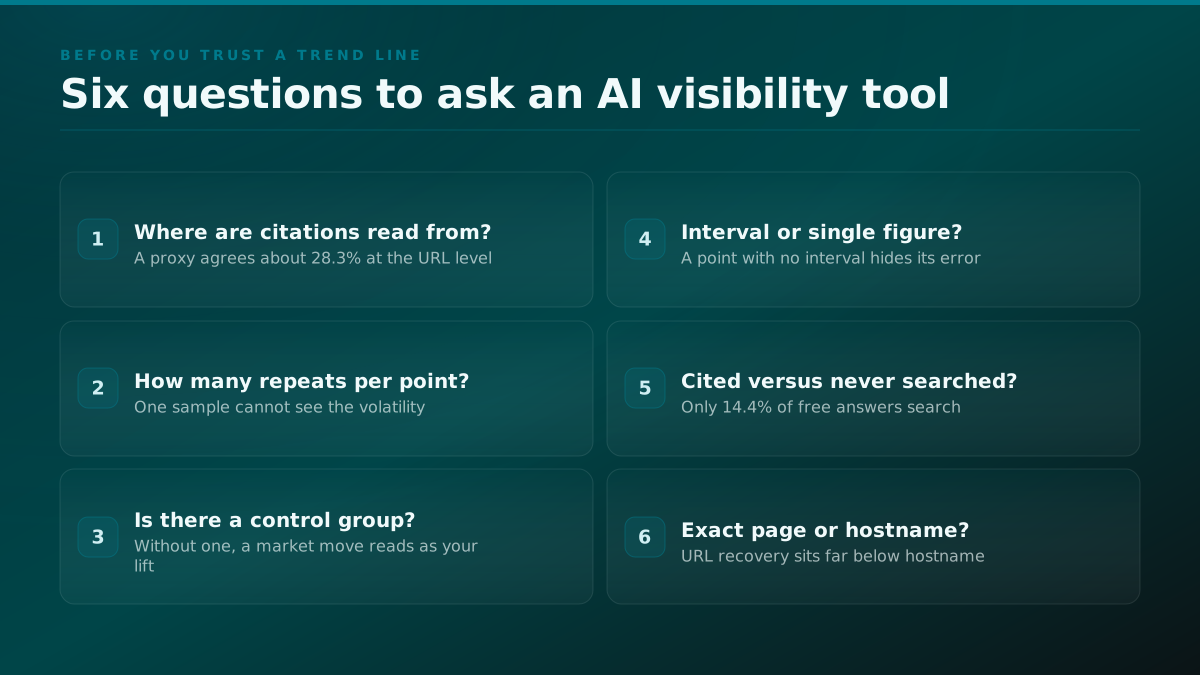
Before you trust a tool's trend line, ask six questions, and the first one settles most of the argument: where does it read citations from? If the answer is an API endpoint or a Google result set, you now know the agreement with real ChatGPT citations is about 28.3 percent at the URL level. Ask how many repeats sit behind each data point, because one sample per query cannot see the volatility that flipped 7 of our 12 queries. Ask whether there is a control group, because without one a market-wide move reads as your lift.
Then ask the three that expose how the number is framed. Ask whether the tool reports a confidence interval or a single figure, because a point with no interval is hiding its own error. Ask whether it distinguishes a cited answer from an answer that never searched, since only 14.4 percent of free responses search at all. And ask whether it can show you the exact pages cited or only a hostname, because the study puts URL-level recovery far below hostname-level. A tool that answers all six well is rare, and the ones that cannot answer them are selling a dashboard, not a measurement.
None of this requires you to distrust every number. It requires you to read each number at the size the method supports. A hostname-level, interval-bearing, control-backed difference is worth acting on. A single URL-level score from an unrepeated proxy run is worth about what its recovery rate suggests.
Where this sits in the work of getting cited
Measuring citations well is the instrument, not the work. The work is making your pages the ones an assistant reaches for when a buyer asks a question that does not contain your name, and then proving a change moved the answers. The measurement is what lets you tell a real win from run-to-run noise, which is why we treat it as the first deliverable rather than a report at the end.
What we sell is that measured chain for developer tools and APIs. Our answer engine optimization work reads citations from the production surface, repeats the queries, and measures a difference against a held-out set left unworked, and we write up how we measure the lift so the method is auditable before any number is. If you want the short version of why we refuse to hand you a single score, it is on this page.
Methodology: what we read and what we did not
Every recovery percentage in this post is the figure reported in Understanding ChatGPT Citations, arXiv 2610.15382, read on 2026-10-19. We did not reproduce its runs. The 14.4 percent search rate is from the Ahrefs query fan-out study of 66.6 million responses, and the citation-selection findings are from the Ahrefs 1.4 million prompt study, both read the same day.
The volatility and null figures are our own, published on 2026-07-27 with their full method. They are a 12 by 5 step-zero run and a 20,000-split permutation test, one model, one day. We state plainly what they are not: there is no completed causal-lift result here, the design is about four times too small to detect a realistic effect, and nothing in this post claims an intervention raised anyone's citations. The point is narrower and firmer. A proxy agrees with real ChatGPT citations about a quarter of the time, a single run is one draw, and a number without a surface, a repeat and a control is not yet a measurement.
Sources
Every number above, and where it came from. A figure without a row here is one we should not have printed.
- Jiang et al., Understanding ChatGPT Citations (arXiv 2610.15382)
- Study of production ChatGPT web search across model generations, posted 2026-10-11. Reports that Google Search and the OpenAI Responses API, combined, recover 28.3 percent and 26.2 percent of cited URLs for GPT-5.3 and GPT-5.5 Instant, and 50.3 percent and 48.7 percent of cited hostnames. A supervised model combining the signals reaches AUC above 0.74 at all three levels. Read 2026-10-19.
- Ahrefs, How often does ChatGPT search the web (query fan-out study)
- Analysis of 66.6 million free, logged-out ChatGPT responses from August and September 2026. Found that only 14.4 percent of them triggered a web search. Published 2026-10-12, read 2026-10-19.
- Ahrefs, Why ChatGPT cites one page over another
- Analysis of 1.4 million ChatGPT prompts. Reports that ChatGPT favours its own general search index, selects by semantic similarity, and that the average cited page is about 500 days old. Read 2026-10-19.
- Citon, Why a single AI visibility score is noise
- Our own step-zero measurement run and permutation test, published 2026-07-27. 12 money queries by 5 identical repeats on one model on one day, 60 of 60 calls succeeded, 7 of 12 flipped outcome. A 20,000-split permutation test put the null difference at mean plus or minus 0.0016, standard deviation 0.215.
- OpenAI, Responses API reference
- First-party documentation for the Responses API, the server-side endpoint that returns web search candidates. It is one of the two proxies the study tested against production ChatGPT. Read 2026-10-19.
Questions about measuring ChatGPT citations
- Can an AI visibility tool measure ChatGPT citations through a Google or API proxy?
- Not accurately. A 2026 study found that Google results combined with the OpenAI Responses API recover only 28.3 percent of ChatGPT's real cited URLs for one model and 26.2 percent for the next, rising to about half at the hostname level. A tool built on that proxy agrees with the exact pages ChatGPT names roughly a quarter of the time.
- Why does a proxy miss so many ChatGPT citations?
- Because ChatGPT decides citations inside its own pipeline, favouring its own index and selecting by semantic similarity, as [Ahrefs found across 1.4 million prompts](https://ahrefs.com/blog/why-chatgpt-cites-pages/). A Google result set or an API endpoint is a different surface, so they agree on the exact URL only about a quarter of the time per [the 2026 production-search study](https://arxiv.org/abs/2610.15382).
- How often does ChatGPT even search the web?
- Rarely, on free logged-out use. Ahrefs analysed 66.6 million responses from August and September 2026 and found that only 14.4 percent triggered a web search. A citation exists only when a search happened, so a citation-only score ignores the majority of answers that came from the model's own memory.
- Why does the same query give a different AI visibility result each time?
- Because the output is not deterministic. In our own step-zero run, 12 queries repeated 5 times each produced 7 that flipped outcome across identical repeats, as published in [why a single AI visibility score is noise](https://citon.ai/blog/measurement/why-a-single-ai-visibility-score-is-noise). A single reading is one draw from a distribution, not a fixed score.
- What does defensible measurement of ChatGPT citations require?
- Sample the production surface rather than a proxy, repeat each query so volatility is visible, hold out a control set so a market move does not read as your lift, and report a difference with its sample size. A 12 by 5 pilot can only detect a 51.1 point move, while a 40 by 40 design reaches 9.9 points.
- Is a single AI visibility score ever useful?
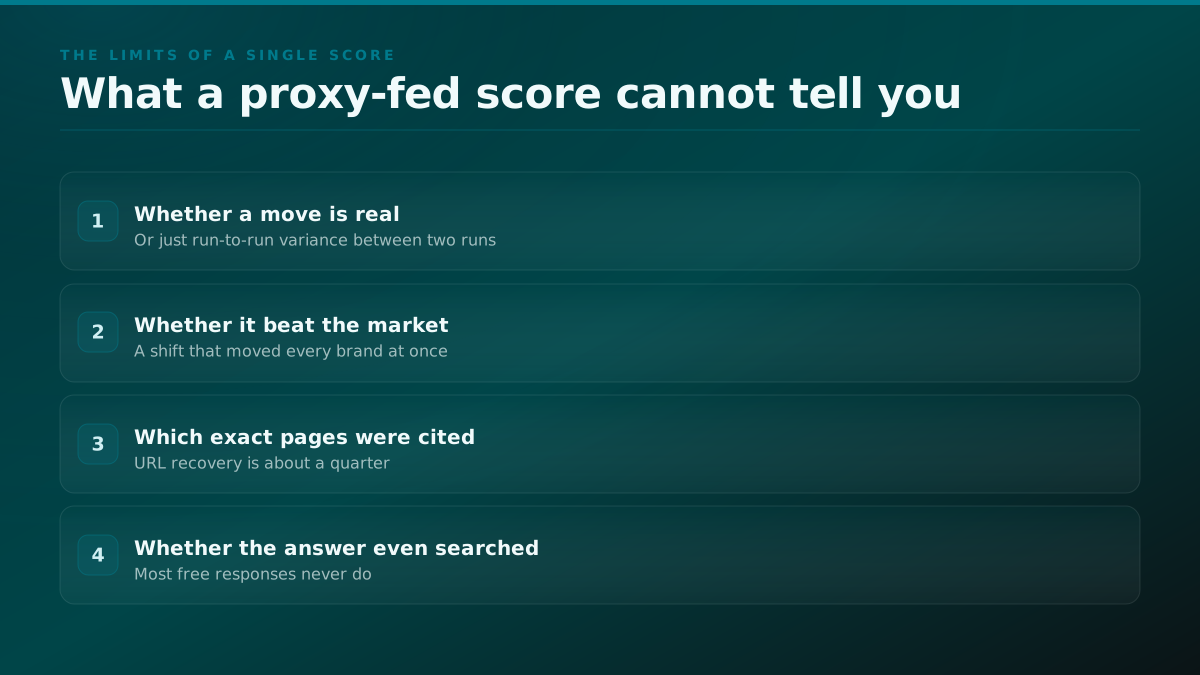
- As a rough diagnostic, yes, but not as proof. It cannot tell you whether a change is real, whether it beat a market-wide shift, or which exact pages were cited. Treat it as a prompt to measure properly, not as evidence that a brand is winning or losing.
Keep reading
AI citations
AI Overview Optimization: What Actually Changes
Google ranks first for "AI Overview optimization" and says no special optimization exists. What the docs state, what the studies measured, what nobody tested.
42 min read
AI citations
Perplexity SEO: How Perplexity Picks the Sources It Cites
Perplexity has published its retrieval pipeline, crawler rules and source review. The ten pages ranking for "perplexity seo" quote none of it. This one does.
46 min read
AI citations
Does llms.txt actually move AI citations, and how would you tell
Every page ranking for this term explains what llms.txt is. None answers whether it changes anything. What 40 sites deploy, and the test that would tell.
43 min read