Does llms.txt actually move AI citations, and how would you tell
Every page ranking for this term explains what llms.txt is. None answers whether it changes anything. What 40 sites deploy, and the test that would tell.
Citon43 min read
Short answer
Does llms.txt improve AI citations?
Nobody has published a controlled result showing that adding an llms.txt changed whether an AI assistant cites you, and that includes us. Four different claims get called "does llms.txt work": the file is fetchable, a crawler requests it, a model uses it to choose what to read, and adding it changed a citation outcome. Only the first two have been measured by anyone, and the two best server-log readings disagree, one reporting 97 percent of files never read across 137,000 sites and one reporting heavy use across more than a million bot hits on a single property. Both can be true. Deploying the file is cheap and low risk, so ship it if you want it, but treat it as an unproven experiment rather than a requirement, and if you want an answer rather than a belief, hold half your pages back and compare the difference against the distribution your own label shuffles produce.
Search for llms.txt and you get ten pages that tell you what it is. The specification, a Reddit thread, four tool vendors, a docs platform, a trade-press write-up and a video. Two of those pages put the real question in their own titles, some version of "and should you use it", and then answer a different one underneath. Nobody is being dishonest. They answer the definitional question because it is the one that can be answered.
The question a person actually types into a search box before a planning meeting is whether putting this file on their site will change what an AI assistant says about them. That question has no published answer. Not a contested answer, not a weak answer, no answer, and that includes from us.
This post is about why, what is actually deployed right now, and what a test that could settle it would have to look like. We did the measurable part ourselves. On 2026-09-02 we fetched forty named developer tool and SaaS documentation sites and recorded what each one serves to a machine: whether an llms.txt exists and returns real text, whether an llms-full.txt exists, whether a per page markdown mirror is reachable, whether an OpenAPI spec sits at the conventional path, what robots.txt says to four named AI user agents, and whether the documentation renders without JavaScript. Thirty four of the forty serve an llms.txt. That is the deployment picture and it is a fact. It is not, and this is the whole point, an answer to the question in the title.
The short version
Four separate claims get called "does llms.txt work" and only the first two have been measured by anyone. Of 40 documentation sites we fetched live, 34 serve an llms.txt and 25 serve a per page markdown mirror, so the file is now the norm rather than the edge. The two best server-log readings disagree and both are probably right about different populations. Google says you do not need it. Deploy it if you want, it is cheap and low risk, but the reason nobody can tell you whether it works is that measuring it needs a held out arm, and the design most teams would run could not detect a real effect at all.
Before any of the detail, one framing that makes the rest of the argument tractable.
Four claims wear the same question
"Does llms.txt work" is four different claims stacked on top of each other, and they need four different instruments. Almost every argument about this file is two people defending different rungs of the same ladder.
The file exists and is fetchable. One HTTP request per site settles it. This is the rung we measured, and it is the easiest to get wrong in a boring way, because a host that answers a missing path with its HTML error page at status 200 will pass any check that reads the status code alone.
A crawler requests it. Server logs filtered by user agent settle it, over a window long enough to mean something. Two people have published readings of this and they disagree by a wide margin, which turns out to be the most interesting fact on the whole term.
A model uses it to decide what to read. Nothing you can observe from outside settles this. It needs either a disclosure from the provider or a controlled probe that varies the file and holds everything else still. Google has published that it does not treat the file specially, which is a partial answer for one surface.
Adding it changed a citation outcome. This needs a frozen query set, a held out arm, a fixed window and a null distribution built from your own data. Nobody has published one. Every confident sentence you have read about llms.txt is either about one of the first two rungs or is a claim about the fourth with the evidence of the first.
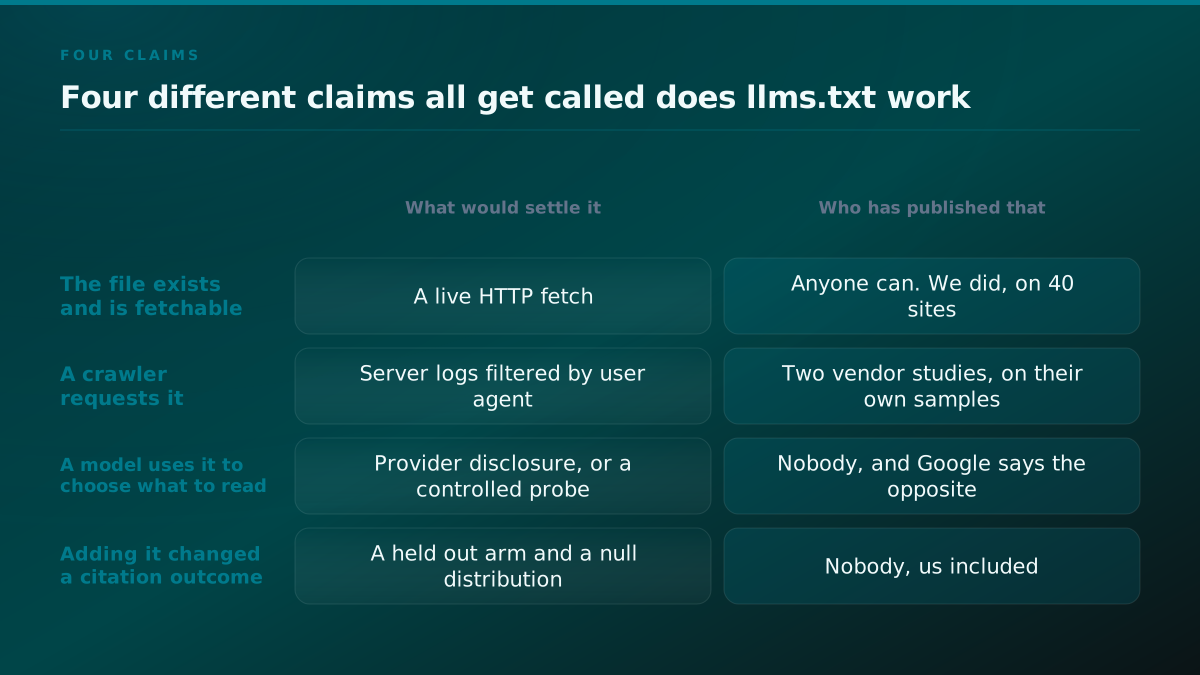
The reason this matters operationally, rather than as a taxonomy exercise, is that the four rungs move independently. A file can be fetched thousands of times and change nothing. A site can have no file at all and be cited constantly, because it is cited through a forum thread and a comparison page it does not control. Collapsing four observations into one yes or no is how a team spends a quarter on the wrong rung.
Four claims that all get called does llms.txt work
| The claim | What would settle it | Who has published that | Source |
|---|---|---|---|
| The file exists and is fetchable | One live HTTP request per site, checking the content type and not only the status code. | Anyone can. We did, across 40 sites, and 34 of them serve one. | measured |
| An AI crawler requests it | Server logs filtered by user agent, over a window long enough to matter. | Two third-party studies, on their own samples, reaching opposite conclusions. | published |
| A model uses it to decide what to read | Provider disclosure, or a controlled probe that varies only the file. | Nobody. Google has published that it does not treat the file specially. | published |
| Adding it changed a citation outcome | A frozen query set, a held out arm, a fixed window and a null distribution. | Nobody, and that includes us. | unknown |
n = 40 · as of 2026-09-02
Method: Row 1 is measured: a live curl of /llms.txt on each of 40 named sites on 2026-09-02, classified by content type rather than by status alone. Rows 2 and 3 are published, meaning somebody else measured or asserted them and we are reporting it. Row 4 is unknown because no such result exists anywhere we could find, which is a claim about the literature and is falsified the moment somebody publishes one with a held out arm.
At a glance
What is deployed today, and what nobody has established
| The question | The answer we can support | What it rests on |
|---|---|---|
| Is llms.txt widely deployed? | Yes. 34 of 40 documentation sites we fetched serve one, and 25 also serve a per page markdown mirror. | Our own live probe on 2026-09-02, with four declared controls that all fired. |
| Do AI crawlers request it? | Sometimes, and the published readings disagree by a wide margin about how often. | Two third-party server-log studies pointing opposite ways, neither of them ours. |
| Does it change what a model cites? | Unknown. Nobody has published a controlled result, us included. | The absence of any held-out-arm study anywhere in the ranking set. |
| Should you ship one? | Probably yes, because it is cheap and carries no known downside, but ship it as an experiment rather than as a fix. | Cost of deployment against the honest state of the evidence. |
What do forty documentation sites actually serve?
We wanted the deployment picture before touching the argument, because most of the writing on this term reasons about a hypothetical site rather than about the ones that actually exist. So we went and looked at forty of them on one day, and recorded six things about each.
The method, in full, so you can repeat it or break it. Forty named developer tool and SaaS documentation properties, chosen because they are the sites a developer or an assistant is most likely to land on: infrastructure and platform vendors, database and observability companies, model providers, and the documentation-heavy end of the API market. For each one, six live HTTP requests with curl on 2026-09-02, between 18
and 18 UTC, five concurrent workers, three retries per request, gzip decoded, sending an ordinary desktop browser user agent. We recorded the status code, the content type, the byte size and the body, and classified each result rather than trusting the status alone.Four controls were declared before the run, each naming the result it had to return, because a sweep with no control that has to fire is not a sweep. A synthetic path on a real host had to come back absent, and it did, at 404. A file we knew existed had to come back present, and it did, at 8,839 bytes. A client rendered page had to come back as JavaScript-only, and it did, returning 10 characters of visible text with no script executed. A server rendered page had to come back server rendered, and it did, at 8,644 characters. All four fired, which is the only reason any count below is worth reading.
Here is what came back.
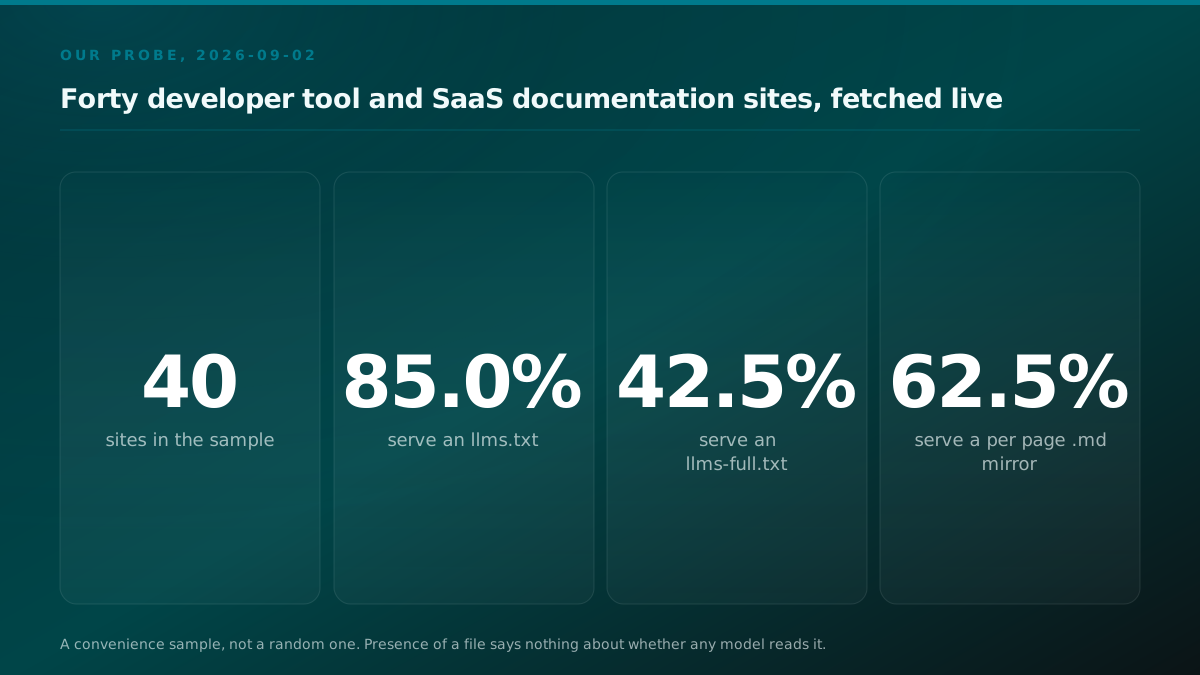
Thirty four of the forty serve an llms.txt that returns real plain text, which is 85.0 percent. Twenty five serve a per page markdown mirror reachable by appending .md to the documentation URL, 62.5 percent. Seventeen serve an llms-full.txt, 42.5 percent. Eight expose an openapi.json at the conventional path off the documentation root, 20.0 percent. Thirty seven serve a readable robots.txt.
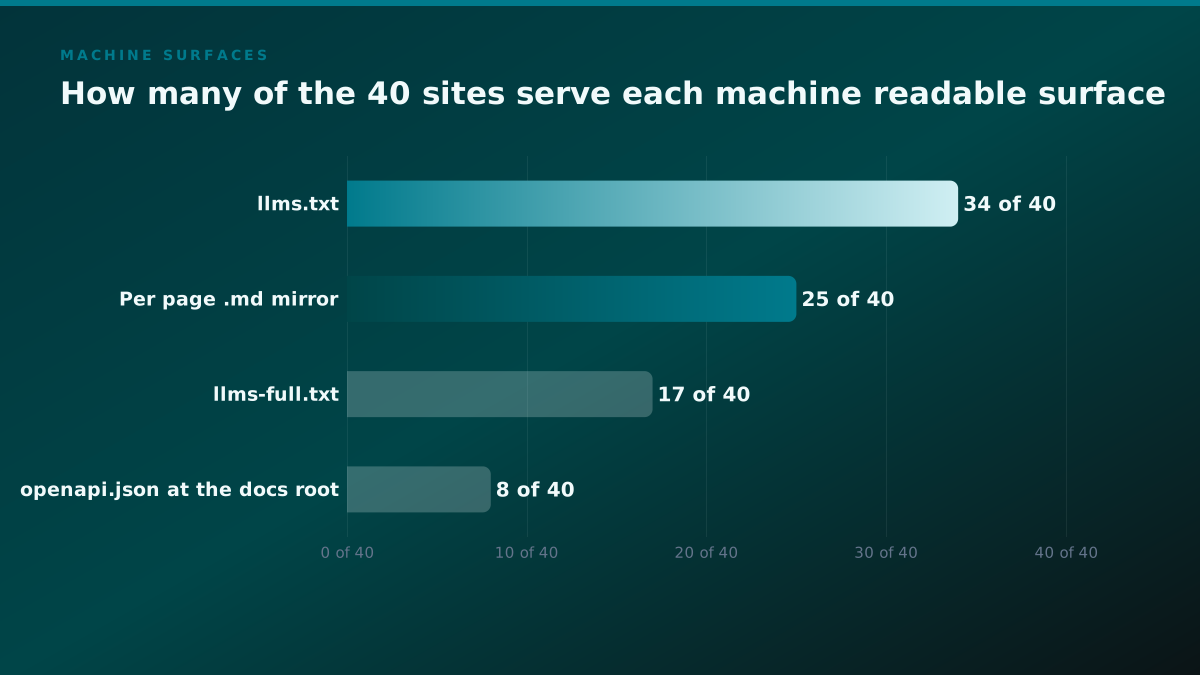
The shape of that result is the finding, more than any individual number. The index file is now the norm at this end of the market rather than an experiment somebody is trying. If your reason for hesitating is that shipping one would look eccentric, that reason expired. Four in five of the documentation sites a developer reads every day already have one.
What 40 documentation sites actually serve, fetched live
| Surface | Sites carrying it | Share of the sample | What the count does not mean | Source |
|---|---|---|---|---|
| llms.txt returning real plain text | 34 of 40 | 85.0 percent | That any model requested it, which this probe cannot see. | measured |
| A per page markdown mirror at .md | 25 of 40 | 62.5 percent | That the mirror carries the same content as the HTML page. | measured |
| llms-full.txt | 17 of 40 | 42.5 percent | That the full text is current. It is a second file that can drift. | measured |
| openapi.json at the conventional docs root | 8 of 40 | 20.0 percent | That the other 32 have no spec. Many serve one from a path we did not guess. | measured |
| A readable robots.txt | 37 of 40 | 92.5 percent | That the three without one block anything. Two returned 404 and one served HTML. | measured |
| Docs page readable with no JavaScript | 38 of 38 fetchable | 100 percent | Anything about the two we could not fetch, one 404 and one 403. | measured |
n = 40 · as of 2026-09-02
Method: Forty named developer tool and SaaS documentation sites, fetched with curl on 2026-09-02 between 18:30 and 18:33 UTC, five concurrent workers, three retries per request, gzip decoded. A transport failure is recorded as unknown and never as absence, which matters because the first version of this probe recorded four connection failures as missing files and under-counted llms.txt at 31 of 40. Four controls were declared before the run and all four fired: a synthetic path returned absent, a known file returned present, a client rendered page returned 10 characters of text, and a server rendered page returned 8,644. What would falsify the headline figure is re-running the same list and finding a materially different count, which anyone can do because the site list and the script are both published with this post.
Two of the forty answered a machine path with HTML at status 200. That is the soft 404 shape and it is worse than a plain 404, because a fetcher that checks only the status code records it as a hit, stores an HTML error page as if it were content, and reports a healthy deployment forever. We caught it by recording the content type and by testing whether the body started with an angle bracket. A monitoring setup that pings the URL and alerts on non-200 would have been green on both of those sites indefinitely.
The record
One row per site, and the fields that stopped us being wrong
40
Sites probed
6
Requests per site
4
Controls declared
4 of 4
Controls that fired
- Content type recorded, not just the status code
- Transport failure recorded as unknown, never as absence
- Three retries per request before giving up
- Per-user-agent robots verdict, with group inheritance resolved
- A control that had to return absent, and one that had to return js-only
- Any observation of what a model did with the fileThere is none. This probe reads configuration over HTTP. It cannot see a retrieval, a ranking or a citation, and a column implying otherwise would be the overclaim the post argues against.
Our own error, since it is the more useful half
The first run of this probe was wrong, and the way it was wrong is the reason the second run has retries in it.
Four sites returned a connection failure on the llms.txt request. Curl could not complete the request, reported a status of zero, and the classifier turned that into "absent". The headline came out at 31 of 40 rather than 34. Three of those four, checked by hand afterwards, serve a perfectly real llms.txt: one at 578 bytes, one at 12,552, one at 17,674. The fourth genuinely returns 404.
A failed request and a missing file produce identical output unless you separate them deliberately, and the error ran in the direction that made our number more interesting. A lower deployment figure is a better story. That is exactly the direction a measurement error is hardest to notice, and it is why the probe now retries three times with backoff and records a transport failure as unknown rather than as absence.
What this sample cannot tell you
It is a convenience sample and not a random one, and every limit that follows from that is real.
It cannot tell you what share of the web carries an llms.txt. Forty sites chosen because they are prominent documentation properties will over-report any practice that early adopters adopt first, and this is exactly such a practice. The 85.0 percent describes the leading edge of documentation engineering, not the web, and the gap between those two is enormous.
It cannot tell you whether any model requested any of these files. The probe reads configuration over HTTP. It has no access to anyone's server logs and it cannot see a retrieval.
It cannot tell you whether the mirror carries the same content as the page it mirrors. We checked that a markdown response came back. We did not diff it against the HTML, and a practitioner who scanned 300 sites reports that three of the seven markdown variants he found dropped body content the HTML carried, all three on the same platform.
It cannot tell you anything about the two sites we could not fetch. One documentation entry point returned 404, which probably means the URL moved rather than that the site is broken. One returned 403 to our user agent, which is a block and is recorded as unknown rather than folded into either column.
What would falsify the headline figure is straightforward: re-run the same list and get a materially different count. The site list, the script and the raw results are published with this post's research dossier, so that is a check anyone can run rather than a claim you have to take.
Is an llms.txt one thing, or several?
The thirty four files we found are not the same kind of thing, and treating them as a single category is a large part of why the evidence about them looks so contradictory. The size spread alone should stop anyone reasoning about llms.txt as though it were one artefact.
The smallest was 342 bytes. The largest was 2,329,071 bytes, which is over two megabytes. Thirteen of the thirty four came in under 5 KB, eighteen sat between 5 KB and 50 KB, and three were over 50 KB.
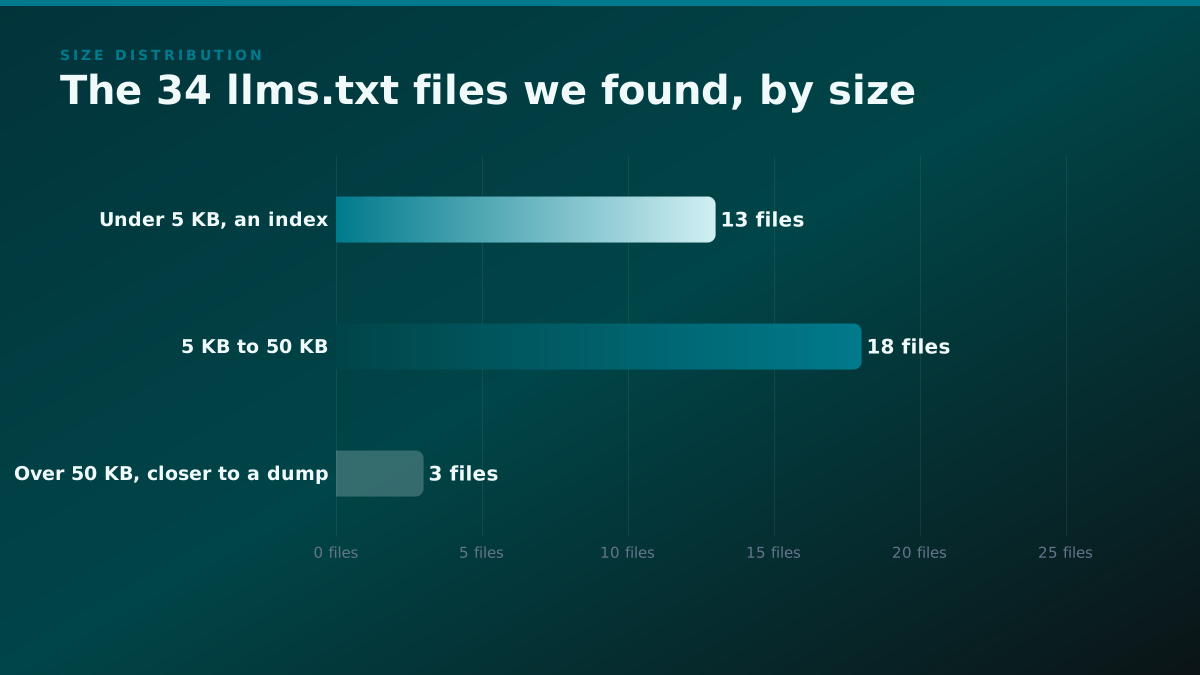
A 342 byte file is a signpost. It names a handful of entry points and expects the reader to follow links. A two megabyte file is a corpus dump, and whatever a model does with it, it is not the same operation. If a study reports that llms.txt files are rarely read, and a second study reports that they are used heavily, the possibility that they were looking at different artefacts wearing the same filename deserves a hearing before either is called wrong.
There is a second version of the same split. Seventeen sites also serve an llms-full.txt, which inlines the content rather than linking to it. So on those sites there are two machine surfaces with overlapping jobs, and two files means two chances to drift out of sync with the pages they describe. Nothing in the specification says which one a reader should prefer, and nothing on the sites we probed indicated a preference either.
Nobody serves the mirror without the index
One number from the probe surprised us enough that we went back and re-checked the parsing before believing it, and it survived that re-check. Twenty five of the forty serve both files, and the pattern underneath that count is stricter than we expected.
Twenty five sites serve both an llms.txt and a per page markdown mirror. Nine serve the index alone. Six serve neither. And zero, out of forty, serve a markdown mirror without also serving an index.
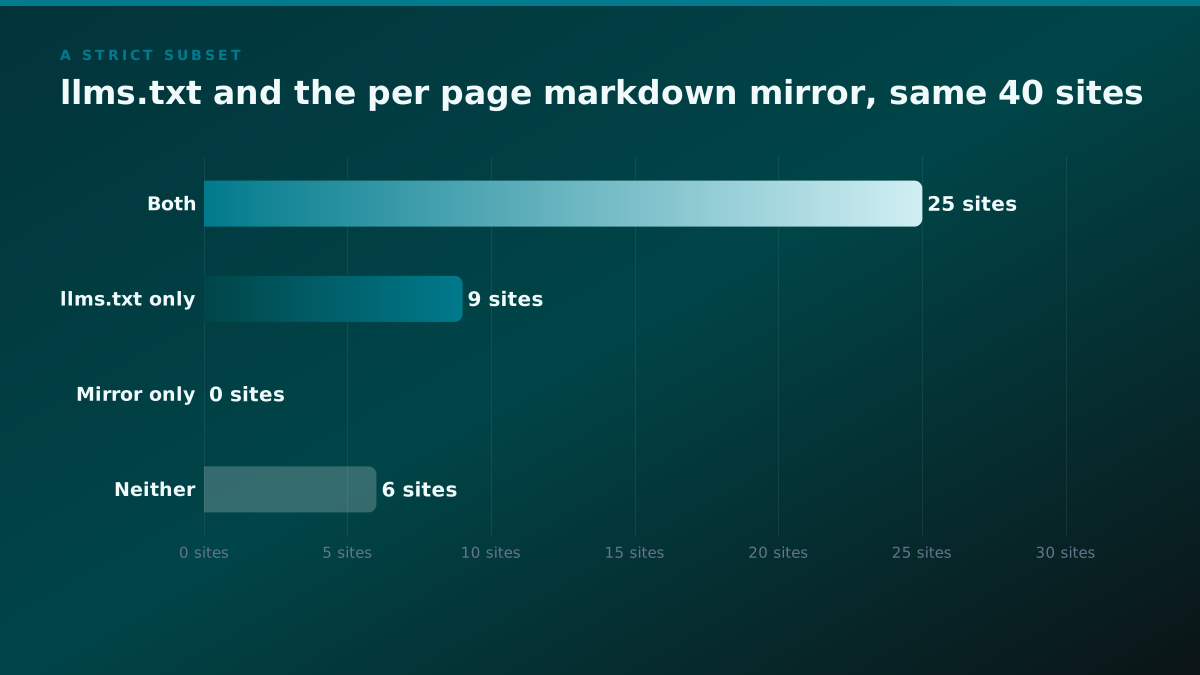
That is a strict subset, and on a sample of forty it is unlikely to be coincidence. Whatever teams believe about these two surfaces, they adopt them in one order, and the index comes first. Two readings are available and we cannot separate them with this data. Either teams treat the index as the entry point and the mirror as an enhancement on top of it, or, more prosaically, the documentation platforms that generate one generate both and the ordering is a product decision made by four or five vendors rather than by forty teams.
The second reading is worth taking seriously, because it would mean a large part of what looks like industry consensus about machine readable documentation is a default in somebody's build pipeline. If that is what is happening, then counting deployments measures platform market share more than it measures belief, which is a caution that applies to our own 85.0 percent as much as to anyone else's number.
If you are shipping one, what goes in it
The specification leaves the contents largely to you, and the size spread we measured shows teams have taken very different views of what that means. Since the evidence does not settle the question, here is the reasoning we would use, presented as reasoning rather than as a finding.
Write it for the reader that has a budget. Whatever fetches this file is going to keep a slice of what it gets and discard the rest, so an index that lists two hundred pages in no particular order spends its whole allowance on an inventory. The thirteen files under 5 KB in our sample are doing something defensible: naming a small number of entry points and letting links do the rest.
Order it by what a stranger needs first. Quickstart, authentication, the two or three endpoints that carry most of the usage, then errors. Not your navigation order, which is organised by product area because that is how your team thinks, and not alphabetically, which encodes nothing.
Annotate each link with one line about what is on the page. This is the part that gets skipped and it is the part that does the work, because it is what lets a reader decide whether to spend a fetch. A bare list of forty URLs and titles is a sitemap wearing a different filename, and you already have a sitemap.
Include the error strings. This is the least common suggestion here and we think it is the most valuable, because a developer who hits an error pastes it into an assistant before opening any documentation. A page that names the literal error text, and an index entry that names it too, is reachable by the query people actually run. Nothing in the specification asks for this and nothing prevents it.
Leave out the marketing pages. A pricing page in an index intended for a machine reading your documentation is a fetch spent on something that does not answer a technical question, and if the reader is a coding agent it is worse than neutral.
Then date it and put a refresh on a schedule, because the stale index is the failure mode that grows on its own while the file keeps returning 200 perfectly.
None of that is validated. It is derived from what the file has to survive rather than from any measurement of what a model does, and we are labelling it that way rather than presenting a set of preferences as a result. If somebody publishes a controlled comparison of index structures, we will take their answer over this reasoning without hesitation.
Do AI crawlers actually read llms.txt?
Sometimes, and the two best published readings disagree with each other by a wide margin. Here is the most useful pair of facts on this entire term, and no page currently ranking for it puts the two of them side by side, which is why the question feels unsettled.
In June, an analysis of the Ahrefs llms.txt study across 137,000 sites reported that 97 percent of llms.txt files are never read. It added two details that matter more than the headline. Zero AI bots go looking for llms.txt files that do not exist, meaning nothing is probing for the file speculatively. And 12 percent of the requests that do arrive come from tools studying the format rather than from anything consuming it, which means a naive log count over-reports real usage by roughly an eighth before you start.
In August, an operator published the opposite reading from his own logs. More than a million AI bot hits across thirty days on a property that shows up in AI answers, and his summary was that OpenAI and Anthropic used llms.txt heavily to answer users, index pages and train models. He added that markdown pages were crawled about half the time and that the bots still used HTML, which is a useful corrective in its own right.
Two server-log readings. Both first-hand. Both from people with no obvious reason to misreport. Opposite conclusions.
The reconciliation is not that one of them is wrong, and this is the paragraph we think is missing from the public conversation. A 137,000-site population assembled from a crawl is dominated by its middle: sites that publish an llms.txt because a plugin generated one, that no assistant was ever going to fetch, that rank for nothing an assistant answers. Of course 97 percent of those are never read. A single property that already surfaces in AI answers and publishes machine readable content is the far tail of that same distribution. It is not a counterexample to the study. It is the two percent, describing itself.
Two people read their own server logs and reached opposite conclusions about the same file. Neither is lying. They sampled different worlds, and the argument has been running ever since without anybody saying so.
Which means the honest answer to "do AI crawlers read llms.txt" is conditional rather than universal, and the condition is about you rather than about the file. If assistants already reach your site, they may well request the file. If they do not reach your site, the file changes nothing, because nothing goes looking for it. The Ahrefs finding that zero bots probe for files that do not exist is the load-bearing sentence there, and it is the one that gets quoted least.
Three published readings of whether anything requests the file
| Who | What they measured | What they found | What it does not establish | Source |
|---|---|---|---|---|
| Ahrefs, 137,000 sites | Server-side requests for llms.txt across a large crawl-derived population. | 97 percent of files never read. Zero AI bots go looking for files that do not exist. 12 percent of requests come from tools studying the format rather than consuming it. | That the file is useless on a site that AI answers already reach. A large sample is dominated by its middle. | published |
| One operator, more than 1 million bot hits in 30 days | His own server logs on a property that ranks in AI answers. | OpenAI and Anthropic used llms.txt heavily. Markdown pages crawled about half the time, with bots still using HTML. | Anything general. It is one property, and it is the tail of the distribution above rather than a refutation of it. | published |
| Mintlify, a four arm comparison | 404s encountered by Claude Code and Codex navigating the same content served four ways. | HTML only finished last, with 15 to 30 times more 404s than markdown plus an llms.txt index. | Anything about citations. This is a navigation result, and the party running it sells the product it favours. | published |
as of 2026-09-02
Method: All three rows are other people's measurements, read from their own public reports on 2026-09-02 and tagged published for that reason. We did not re-run any of them and we are not asserting any of the three numbers as verified. What we do assert is the reconciliation in the fourth column, which is an argument about sampling rather than a measurement, and it is falsified if someone shows the two log studies drew from comparable populations.
That has an uncomfortable implication for the way the file is usually sold. It is offered as a way to get discovered. The evidence, such as it is, points the other way: it is a way for something that already finds you to find you more efficiently. Those are different products and they belong to different stages of a programme.
The strongest evidence for the file measured something else
There is exactly one genuine experiment in public on this question, and it deserves better treatment than either the sceptics or the advocates currently give it. It is a real four-arm comparison with a stated outcome measure, and the outcome it measured is not the one people quote it for.
A documentation platform served the same content four ways: raw HTML, plain markdown, markdown with an llms.txt index, and markdown with the llms.txt inlined on every page. Then they had Claude Code and Codex navigate that documentation and counted every 404 each agent hit before it found the answer. HTML alone finished last by a wide margin, with 15 to 30 times more 404s than markdown plus an llms.txt index.
Take that seriously. It is a four-arm comparison with a stated outcome measure and a directional result, which puts it ahead of every opinion published on this term including, until we ran our probe, ours. Two boundaries have to travel with it, and neither is a reason to dismiss it.
The party who ran it sells the product the result favours. That is disclosed rather than disqualifying, and the correct response is to weight it as an interested party's result and to want a replication, not to throw it away.
The second boundary is the one that gets lost, and it is the more important. The outcome measured is 404s encountered by a coding agent navigating documentation. That is a NAVIGATION result. It says an agent that is already on your documentation site, already trying to find a specific page, wastes fewer requests when a machine readable index exists. It says nothing whatsoever about whether an answer engine cites you when a buyer asks a question somewhere else entirely. Reading "15 to 30 times fewer 404s" as evidence that llms.txt raises citations substitutes one question for another, and the substitution is invisible because both questions sound like "does it help".
The distinction between what ranks and what a model actually pulls is not hypothetical. Our own reading of citation sources found the overlap far smaller than teams assume.
Page one ranking
What the model read
 reddit.com
 g2.com
 news.ycombinator.com
Rank 1 appears in 0 of the 3 pages read
Does Google use llms.txt?
Google has published that you do not need it, and that is the single most load-bearing counter-argument on this term. It appears in Google's own documentation, under a heading that says what you do not need to do, and the boundaries around that sentence matter as much as the sentence.
Google's own AI optimization guide puts it plainly: you do not need to create new machine readable files, AI text files, markup, or Markdown to appear in generative AI search. It adds that Google may discover, crawl and index many kinds of files in addition to HTML, and that this does not mean the file is treated in a special way.
From the field
The platform owner has published that you do not need it
Google's AI optimization guide lists llms.txt under a heading called what you do not need to do, in these words: you do not need to create new machine readable files, AI text files, markup, or Markdown to appear in generative AI search. It adds that Google may discover, crawl and index many kinds of files, and that this does not mean the file is treated in a special way. Read the boundary as carefully as the claim. It is a statement about Google Search and its generative features. It is not a statement about ChatGPT, Claude or Perplexity, and it is not a statement about a coding agent reading your documentation from a checkout.
That guidance surfaced in a technical SEO thread that ran to 211 upvotes and 106 comments, which is a fair indication of how much of the practitioner conversation it settled and how much it did not.
Now read the edges, because they are as informative as the claim.
It is a statement about Google Search and its generative features. It is not a statement about ChatGPT, about Claude, about Perplexity, or about any assistant that is not Google. Four surfaces, one of which has published a position. Treating that one position as settling all four is the mirror image of the vendor overclaim, and it is a mistake we see made by people who consider themselves sceptics.
It is also not a statement about coding agents. An agent working inside a repository, resolving a package name and going looking for a reference page, is a different reader running a different retrieval, and Google's guidance about its own search index has no bearing on it. That is precisely the reader the four-arm navigation experiment above was testing.
And a smaller point that is easy to miss: the sceptical position was itself tested rather than assumed. A practitioner probed whether Google's "ignores" was a hard rule and found that Google knows about these files, reads and displays information from them, and can cite them in responses, while concluding that none of this looked useful for ranking. That is the correct shape of a rebuttal. It separates "the file is fetched and can surface" from "the file helps you rank", concedes the second and establishes the first, and it does not turn a fetch into a lift.
The file that actually decides is the one nobody wrote
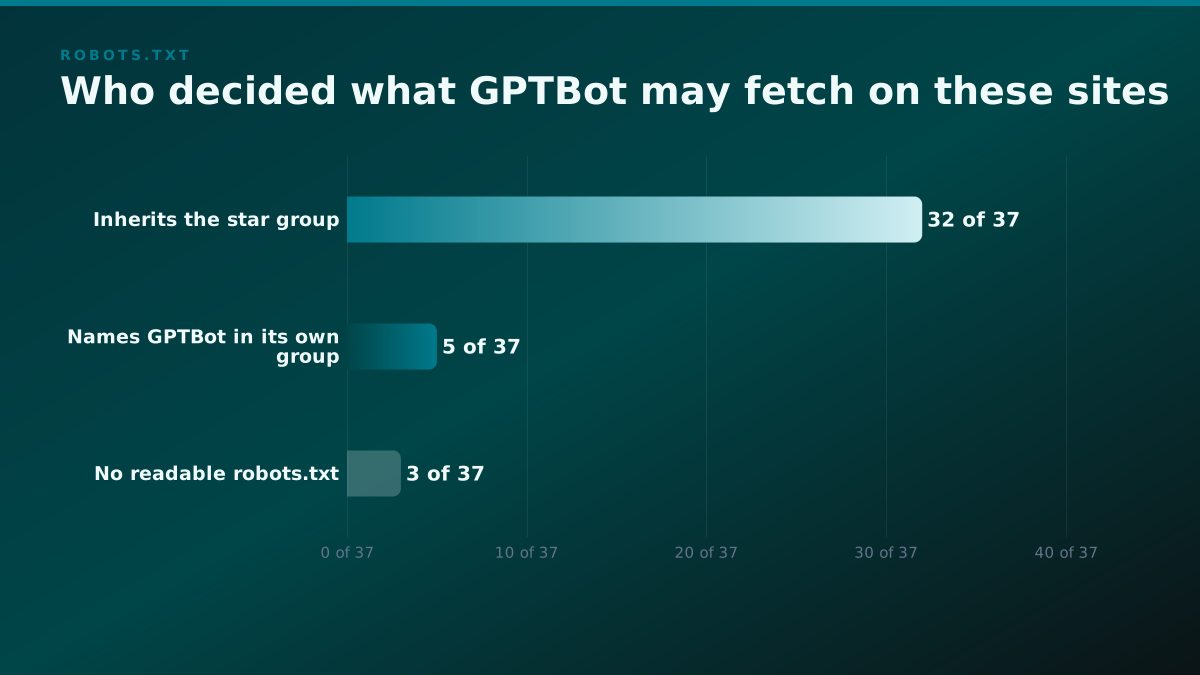
While everyone argues about the suggestion file, the permission file sits quietly deciding whether any of it is reachable at all, and on most of the sites we probed nobody has touched that file with these crawlers in mind. Thirty two of thirty seven are running an inherited answer.
Of the thirty seven sites in our sample with a readable robots.txt, five name GPTBot in a group of its own. Four name ClaudeBot. Four name PerplexityBot. Three name Google-Extended. Everybody else inherits whatever the star group says, and the star group on a documentation site was written years ago for search crawlers.
Who actually decided what the AI crawlers may fetch
| User agent | Named in its own robots group | Left to the star group | Blocked outright | Source |
|---|---|---|---|---|
| GPTBot | 5 of 37 | 32 of 37 | 1 of 37 | measured |
| ClaudeBot | 4 of 37 | 33 of 37 | 1 of 37 | measured |
| PerplexityBot | 4 of 37 | 33 of 37 | 0 of 37 | measured |
| Google-Extended | 3 of 37 | 34 of 37 | 0 of 37 | measured |
n = 37 · as of 2026-09-02
Method: Denominator is 37, the sites in the sample whose robots.txt was readable, not 40. Each file was parsed into user-agent groups, a bot's own group taken where present and the star group applied otherwise, which is how the major crawlers document their own behaviour. What would falsify it: a parser that groups differently, so the raw robots bodies are worth re-reading if the split matters to you. Note one site named GPTBot and ClaudeBot and blocked both while leaving PerplexityBot and Google-Extended to inherit an allow, which is two policies rather than one.
Thirty two of thirty seven let a rule written before these agents existed decide what those agents may fetch. That is not a criticism, and in most cases the inherited answer happens to be permissive, so nothing breaks. It is a description of where the decision actually got made, which is not where anyone thinks it did.
One site in the sample makes the asymmetry visible. It names GPTBot and ClaudeBot and blocks both, while leaving PerplexityBot and Google-Extended to inherit an allow from the star group. Read that as a policy and it is incoherent: two of the four AI crawlers are refused and two are welcomed, with no principle separating them. Read it as history and it makes sense, because two bots were named at some point and the other two arrived later. Either way, that site is running two policies and one of them was never chosen.
The practical version of this is short. Robots.txt is four decisions, not one, and until you write four lines you have made none of them. Decide separately for GPTBot, ClaudeBot, PerplexityBot and Google-Extended, and know that Google-Extended is the Gemini opt out and does not affect Google Search, which is the single most common misunderstanding in this area.
There is one more asymmetry worth stating plainly. A robots block beats an llms.txt listing every time. If you list a page in your index and a rule elsewhere refuses the crawler, the page is not fetched and nothing about the listing changes that. Permission is upstream of preference, and a team that spends a week curating an index while a WAF rule quietly returns 403 to two of the four agents has optimised the wrong layer.
How does an llms.txt fail while still returning 200?
It fails in four ways that a status code cannot see, which matters because a status code is the check almost everyone runs. Each of these returns a perfectly healthy 200 while delivering nothing useful, and two of the four showed up in our own sample.
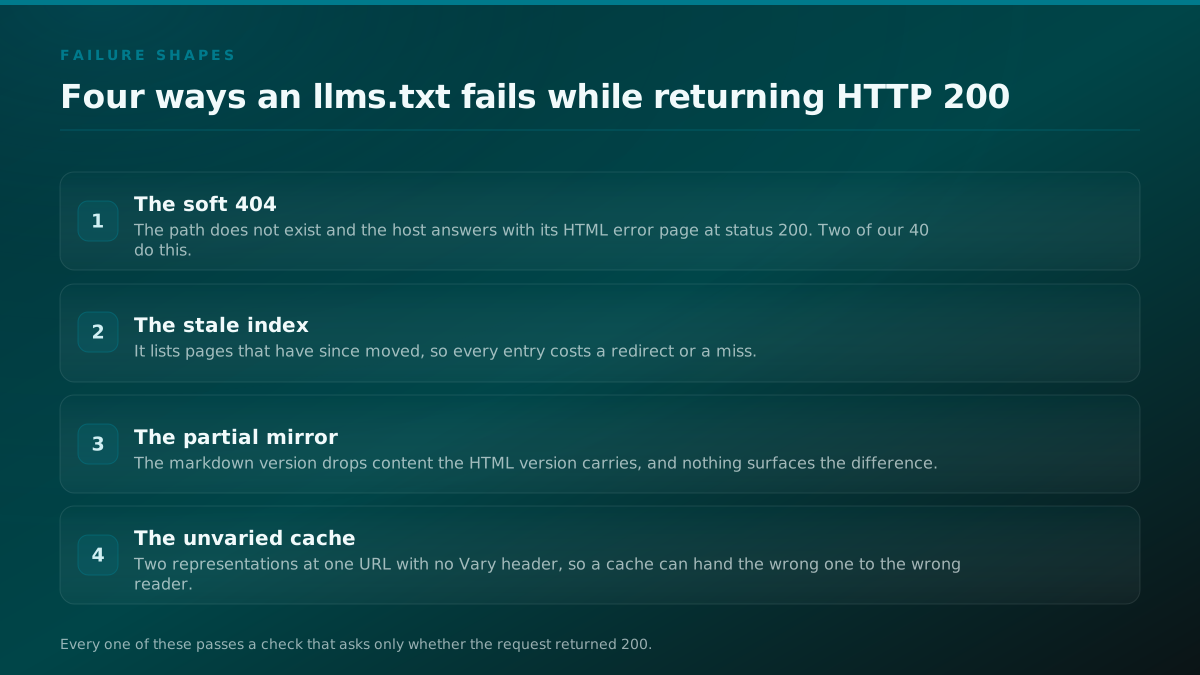
The soft 404. The path does not exist and the host answers with its own HTML error page at status 200. We found this on two of our forty. A fetcher reads a 200, stores the error page, and reports a healthy deployment. The fix costs nothing: check the content type, or check whether the body starts with an angle bracket, rather than checking the status alone.
The stale index. The file lists pages that have since moved. Every entry now costs a redirect or a miss, which is the opposite of the efficiency the file exists to provide. This is the failure that grows with time and it is invisible from the outside, because the index itself keeps returning 200 perfectly.
The partial mirror. The markdown version drops content the HTML version carries. A practitioner who scanned 300 sites found three of the seven markdown variants he identified dropped body content, all three on one platform, and nothing in either representation surfaces the difference. A reader taking the mirror gets a quietly reduced page and has no way to know.
The unvaried cache. Two representations served at one URL with no Vary header, so a cache in front of the site can hand the wrong version to the wrong visitor. The same scan found six of seven markdown variants missing that header. This one is a correctness bug rather than a documentation problem, and it is the sort of thing that produces a support ticket nobody can reproduce.
None of these is exotic and none of them is caught by a monitor that pings a URL and alerts on non-200. If you ship an index and a mirror, the check worth building is a weekly pass that resolves every link in the index, compares each markdown response against its HTML counterpart by word count, and asserts a text content type on both.
Five links between your file and a citation
The reason this argument never resolves is that the two sides are standing at different points along a chain of five steps, and almost nobody names the chain out loud. A claim about the first link and a claim about the last link sound identical and are not.
The chain
Five links between your llms.txt and a citation a reader can see
- FetchedA crawler requests the file at all. Visible in your server logs and nowhere else.
- ParsedThe links inside resolve. A stale entry costs a redirect or a miss.
- RetrievedOne of those pages is actually pulled for this particular question.
- UsedThe answer leans on that page rather than listing it decoratively.
- AttributedYour domain appears in a source list the reader can see.
- FetchedParsedlink 1
- ParsedRetrievedlink 2
- RetrievedUsedlink 3
- UsedAttributedlink 4
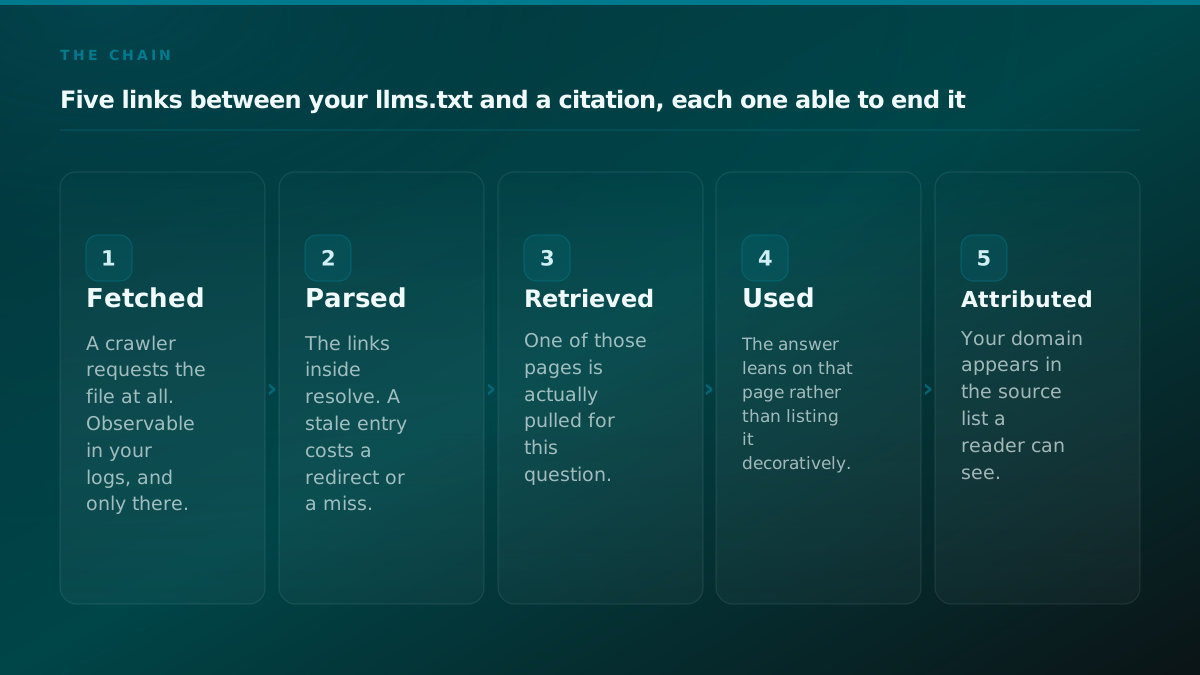
Fetched. Something requests the file. Observable in your access logs and observable nowhere else. This is the rung the two log studies argue about.
Parsed. The links inside resolve to real pages. A stale entry breaks here, silently, and the file keeps returning 200 while doing so.
Retrieved. One of those pages is actually pulled for the specific question a buyer asked. Nothing about listing a page compels a retrieval on any particular query.
Used. The answer leans on that page rather than listing it beside five others. The gap between a decorative citation and a load-bearing one is real and almost nothing measures it.
Attributed. Your domain shows up in a source list a reader can see and click.
Published work on llms.txt stops at the first link, or occasionally at the third. The claim people want to make is about the fifth. That distance, four links wide, is the entire disagreement, and it is why two people can both be honest and both be certain and still contradict each other.
It is also worth being clear about what governs the middle of that chain, because it is not the index file. A page gets cited when it is retrievable, extractable, verifiable and consistent, and an index file touches the first of those four and none of the others.
Four files that get argued about as if they were one
A great deal of the confusion here is nomenclature. Four files come up in the same conversation, and they do different jobs for different readers with different consequences when they are wrong.
Comparison
Four files that get discussed as if they were one
| llms.txt | robots.txt | sitemap.xml | AGENTS.md | |
|---|---|---|---|---|
| What it is for | Suggests which pages are worth reading, in a curated order. | States who may fetch what. It is permission, not preference. | Enumerates every URL you want discovered. | Instructs a coding agent working inside your repository. |
| Who honours it | Unclear, and the published readings disagree. | Every major crawler, by long convention. | Search crawlers, documented by the search engines themselves. | The agent, reading from the checkout rather than over HTTP. |
| What breaks if it is wrong | Wasted fetches, or nothing at all. | You block a reader you wanted, silently. | Slower discovery of pages you care about. | The agent makes the wrong change to your code. |
| Is it a standard | A proposal. Not adopted by the largest search engine. | Yes, and it has been for decades. | Yes, and search engines document how they read it. | Converging, and actively contested in public. |
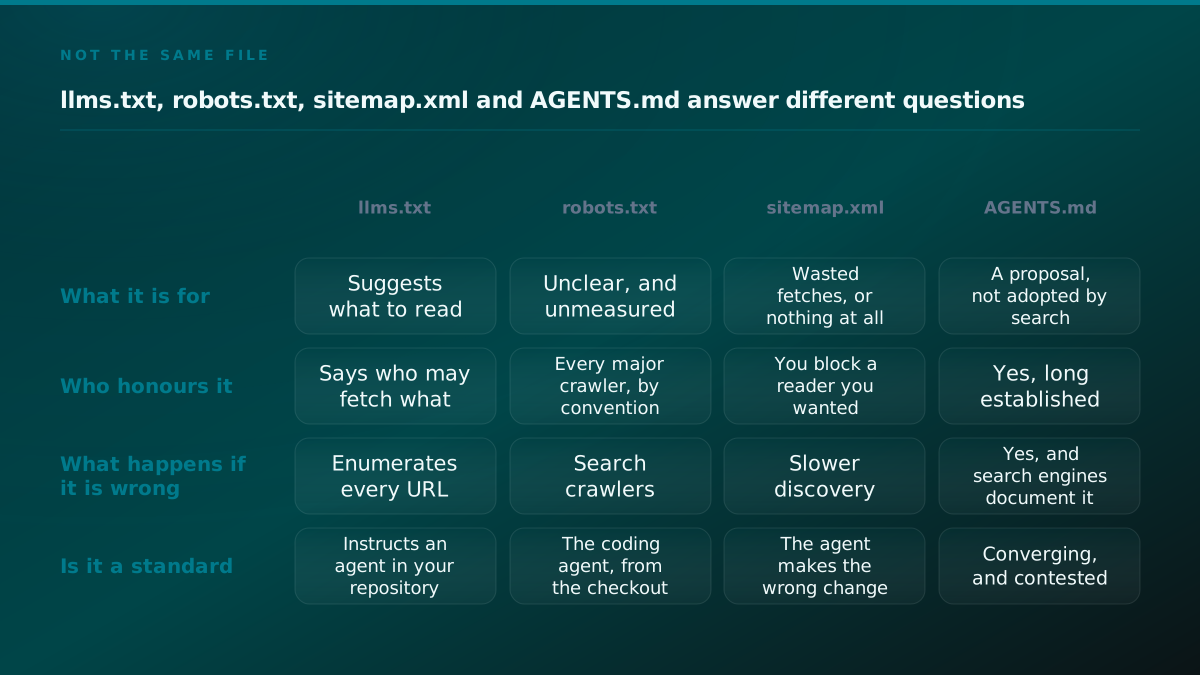
Robots.txt is permission. Every major crawler has honoured it for decades and the failure mode is that you block a reader you wanted. Sitemap.xml is enumeration, the search engines document how they read it, and the failure mode is slower discovery. AGENTS.md instructs a coding agent working inside your repository, it is read from a checkout rather than over HTTP, and the failure mode is that the agent makes the wrong change to your code. Llms.txt is preference, its adoption by any reader is unclear, and the failure mode is wasted fetches or nothing at all.
Three of those four are settled and documented by the parties who read them. The fourth is the one everybody argues about, and the argument is possible precisely because nobody who reads it has documented what they do with it.
Worth reading the llms.txt specification itself before repeating anything about it, because a surprising share of the claims attributed to it are not in it. It defines a file format and its intent. It does not promise a citation outcome, and it does not claim adoption it has not got. The trade press write-up of the proposal is similarly careful, describing it as proposed rather than as standard. Most of the overclaiming happened downstream of both.
What coding agents actually read, which is somewhere else
If your reason for shipping an llms.txt is that coding agents will use it to find your reference pages, there is one behavioural study on that question and it points somewhere you may not expect.
An empirical study of how coding agents read documentation instrumented 557 agentic coding sessions, yielding 94,813 development events including 3,033 documentation interactions, alongside 33,097 agentic pull requests and 690,260 classified file-level change records. Instruction files and the agents' own working notes accounted for 60.5 percent of all documentation interactions. Classical technical documentation accounted for 10.6 percent. API references accounted for 1.3 percent.
From the field
The one behavioural study of agent documentation reads points somewhere else entirely
A study of 557 agentic coding sessions and 33,097 agentic pull requests found that instruction files and the agent's own working notes account for 60.5 percent of documentation interactions, classical technical documentation for 10.6 percent, and API references for 1.3 percent. If your reason for shipping an llms.txt is that coding agents will use it to find your reference pages, that study is the closest thing to evidence on the question and it points at a file in the repository rather than at a file on your docs domain.
Read those three numbers in order. The artefact getting nearly two thirds of the attention is a file in the repository, written by or for the agent, that has nothing to do with your documentation domain. The reference page you spent a quarter improving is the last of the three by a factor of eight.
The study also reports that the assumed loop of read the docs, then write the code, barely appears. The adjacent transition probability between a documentation consultation and a code edit is 0.002, and no explicit documentation-based validation sequence was observed at all. Consultation was self-initiated 70.2 percent of the time rather than triggered by a failure, and among pull requests that changed both code and documentation, code was touched first 4.7 times more often.
None of that says your documentation is worthless. It says that the specific story used to justify machine readable documentation files, in which an agent consults your reference before writing against your API, is not what these traces show. If you want the version of this question that applies to a human buyer rather than a coding agent, we have written separately about LLM SEO, what it is and what the work looks like and about the questions developer tool buyers ask AI.
Does llms.txt improve AI citations in ChatGPT, Claude and Gemini, and how would you tell?
Nobody has published a controlled result for any of the three engines, so the honest answer is that nobody knows, including us. Everything above is context. What follows is the answer to the title, and that answer is a test design rather than a number, because the number does not exist yet.
Start from the version most teams run, so it is clear what is wrong with it. You add an llms.txt on a Tuesday. Three weeks later somebody asks whether it worked. You open a tracker, look at a visibility score for the month before and the month after, see it up four points, and the answer becomes yes. That procedure is worthless, and it is worthless for two independent reasons that compound.
Reason one, identical questions disagree with themselves
The first reason has nothing to do with your llms.txt and everything to do with the instrument.
We ran the cheapest possible version of this check on our own work. Twelve money queries, five identical repeats each, one model, one day, nothing changed between runs. Sixty calls, all sixty succeeded. Seven of the twelve queries changed outcome between identical asks. Not between Tuesday and Friday. Between two asks a few seconds apart using the same words.
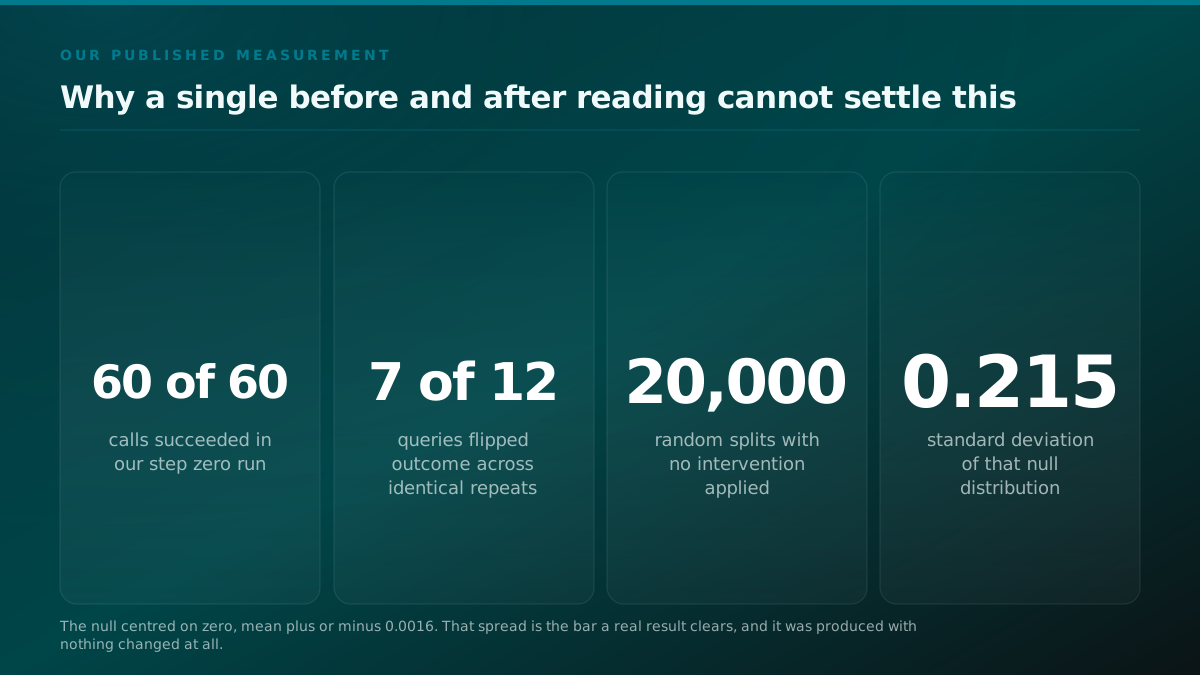
That is an instability rate of 58.3 percent, and it is the number that makes a single before-and-after reading meaningless. If more than half your queries disagree with themselves under repetition with nothing changed, then a reading taken once before a docs change and once after is two draws from a noisy distribution, and the difference between them is mostly the width of that distribution.
We then built the null. Twenty thousand random splits of that same query set, with no intervention applied at all, recomputing the arm difference under each fake assignment. The null centred on zero, mean plus or minus 0.0016, standard deviation 0.215.
The zero mean is the design's kill test and it passed: an instrument that manufactures a difference out of nothing would not centre there. The 0.215 is the bar. It is how big a difference looks when nobody did anything, which is the number a real result has to clear, and doubling it gives a conventional threshold around 0.43. We have written the long version of this argument in why a single AI visibility score is noise, and the full procedure in how to track AI visibility, the procedure and the proof.
Apply that to the llms.txt question directly. A four point move on a monthly visibility score, with one reading on each side, is comfortably inside a distribution that a set with our instability produces while sitting completely still. It is not weak evidence. It is not evidence.
one money query, nothing changed between runs
7 of 12 queries moved outcome across identical repeats in our own step zero run, 60 of 60 calls successful. One read is not a reading.
Reason two, your design probably could not have seen it anyway
The second reason is worse, because it is invisible and it fires even when the first reason is handled.
Suppose you do everything right. You freeze a query set, you hold half back, you run a proper comparison, and you get a null result. It is tempting to report that as evidence llms.txt does nothing. Before you do, ask whether the design you ran could have detected a real effect if one had been there.
Statistical power
Smallest lift a design of this size could detect
| Point | Value (percentage points) |
|---|---|
| 12 queries by 5 samples | 51.1 percentage points |
| 20 by 20 | 21.4 percentage points |
| 30 by 30 | 11.4 percentage points |
| 40 by 40 | 9.9 percentage points |
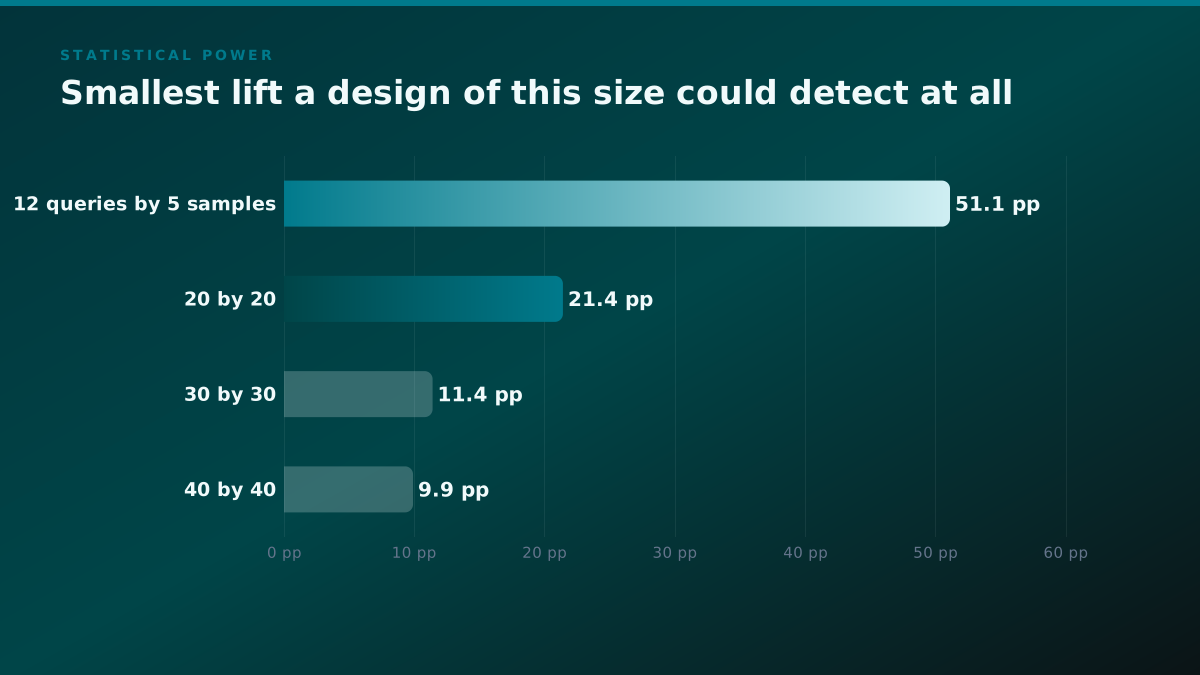
Computed from the variance in our own step-zero run, a design of 12 queries by 5 samples has a minimum detectable lift of 51.1 percentage points. Twenty by twenty reaches 21.4. Thirty by thirty reaches 11.4. Forty by forty reaches 9.9.
The smallest lift a two-arm design of each size could detect at all
| Design | Calls per reading | Minimum detectable lift | What a null result from it means | Source |
|---|---|---|---|---|
| 12 queries by 5 samples | 60 | 51.1 percentage points | Nothing. Only an enormous effect was ever visible. | measured |
| 20 by 20 | 400 | 21.4 percentage points | Still inconclusive against any realistic llms.txt effect. | derived |
| 30 by 30 | 900 | 11.4 percentage points | Borderline. Would detect a large effect and miss a moderate one. | derived |
| 40 by 40 | 1,600 | 9.9 percentage points | A null here starts to carry information. | derived |
n = 60 · as of 2026-09-02
Method: The 12 by 5 design is measured and ours: it ran, 60 of 60 calls succeeded, and the variance in that run is what every other row is computed from. The calls column is arithmetic. The lift floors are derived from that measured variance rather than taken from a vendor table. Falsify it by measuring a lower instability rate on your own query set, which moves every floor down. We publish no causal lift figure from any of these designs because the pilot could not have measured one.
Now put a plausible effect size next to that ladder. If llms.txt does anything for citations, it is not going to move citation share by fifty percentage points. A generous guess is single digits to low double digits, and that is a guess rather than a measurement. Which means every design on that ladder except the last one is structurally incapable of seeing it, and a null from any of them is inconclusive rather than negative.
This is the trap that makes the whole topic feel unresolvable. Teams run underpowered tests, get nulls, and conclude the file does nothing. Vendors run uncontrolled tests, get movement, and conclude the file works. Both groups are reading noise, in opposite directions, with equal confidence. The sample-size arithmetic behind those floors is worth reading in full, and we have written it up separately in prompt tracking and the sample size it needs.
Note the shape of our own honesty here. We publish no causal lift figure for llms.txt, and we are not able to, because the pilot design we have run is roughly four times underpowered against the design that would reach 9.9 points. Publishing a lift off it would be publishing a number the design could not have produced.
1 repeat per query, so no query has an error bar at all
5 repeats per query, so each query carries its own error bar
20 calls either way
Same spend, same week, same engine. Only the second allocation can tell a move from noise, and our own step zero run is the reason: 12 queries asked 5 times each, 7 of them changed outcome with nothing altered between runs.
The design that could come back negative
Here is what a test worth running looks like. None of it is novel statistics. It is the ordinary apparatus of a controlled measurement, applied to a file.
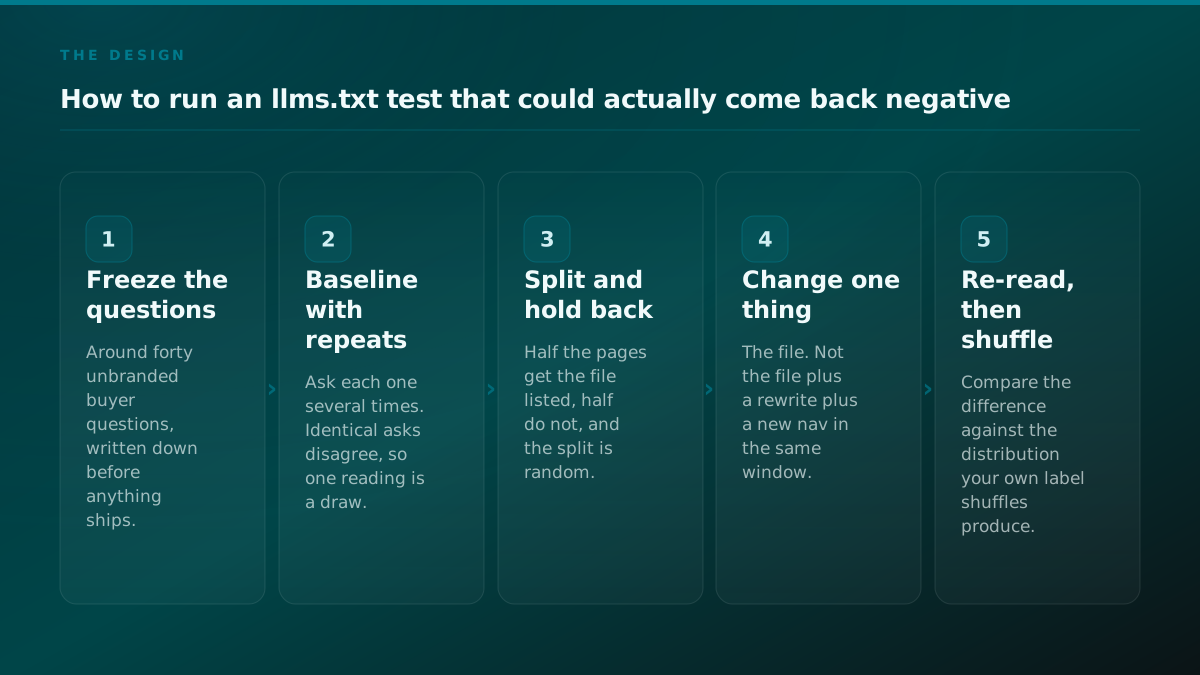
Freeze the question set first. Around forty unbranded buyer questions, written down before anything ships and not edited afterwards. Never questions carrying your own brand name, because those are already won and cannot move. Never questions you picked after seeing which ones looked promising.
Baseline with repeats, not once. Ask every question several times. Five is a floor rather than a target at an instability rate like ours. The point of the repeats is that they turn each query into a proportion with a denominator instead of a boolean, and a proportion is the only thing you can put an error bar on.
Split the pages, at random, and hold half back. Half your documentation pages get listed in the index. Half get nothing, for the entire window. This is the step everybody skips and it is the step that does all the work, because it subtracts whatever the system did on its own during those weeks. Without it you are comparing your work against the calendar.
Change one thing. The index. Not the index plus a documentation rewrite plus a new navigation in the same window. Two changes in one window buy you one uninterpretable result, and the temptation to ship them together is strongest exactly when the window is expensive.
Re-read, then shuffle the labels. Compute the difference between arms. Then discard the arm labels, reassign them at random at the query level, recompute the difference, and repeat a few thousand times. Where your observed difference sits inside that distribution is the answer. Not whether it cleared a threshold somebody else chose.
Four checks before you believe your own reading. Did the instrument stay identical across the window, same wording, same repeat count, same engine, same model version string. Did the arms fail equally, because an asymmetric shock voids the comparison. Is the difference outside your own shuffled null. And could the design have seen a smaller effect, because if it could not, a null is inconclusive rather than negative.
STEPS
The order to do this in, if you are doing it at all
First, check the page renders without JavaScript
Ten minutes
If the text is not in the HTML, nothing downstream matters. All 38 fetchable pages in our sample passed this, so it is probably already true for you, and it takes one curl to know rather than assume.
Second, read robots.txt as four decisions
Twenty minutes
GPTBot, ClaudeBot, PerplexityBot and Google-Extended. On 32 of the 37 readable files in our sample, all four are decided by a star group nobody wrote with them in mind.
Third, ship the llms.txt
An afternoon
It is cheap, it is low risk, and 34 of 40 of your peers already have one. Ship it as an experiment with a stated stopping point rather than as a fix.
Fourth, check your logs rather than your dashboard
Ongoing
Filter by user agent and count requests for the file. This is the only link in the chain you can observe directly, and it is the one almost nobody looks at.
Last, if you want an answer, hold half back
One quarter
A frozen query set, a random split, one change in the window, and a null built from your own label shuffles. Anything less produces a story rather than a result.
If that sounds like a lot of apparatus for one file, it is, and that is the honest reason nobody has published this result. It requires deliberately not listing half your pages for a quarter, which is hard to defend internally and harder to keep when the quarter goes badly. That difficulty is the whole explanation for the evidence gap. It is not that the question is hard to think about. It is that the answer costs a quarter of restraint. This is the same discipline behind measuring answer engine optimization lift, and it is the part of the work that does not demo.
What the test costs, in calls rather than in feelings
Since the honest recommendation involves a quarter, it is worth pricing so the decision is a real one.
Take the design that could actually see a plausible effect: 40 queries by 40 samples, one engine. That is 1,600 calls per reading. Three baseline readings before anything ships gives 4,800. Twelve weekly readings across a ninety day window gives 19,200. Total 24,000 calls on one engine, and engines multiply before anything else does, so covering two doubles it to 48,000.
Those are metered calls landing on somebody's card, plus the storage, plus a scheduler somebody maintains when a provider changes a response shape. That is the real reason this result has not been published by anyone, and it is a better explanation than assuming the field is careless.
It also tells you when not to run it. If the decision behind the question is worth less than a quarter of measurement and the 24,000 to 48,000 metered calls above, do not run the arm. Ship the file, watch the logs, and hold the question open honestly rather than manufacturing an answer with a design that cannot produce one. Half-running this test is worse than skipping it, because it produces a number that looks like evidence and is not.
And one boundary on the arithmetic itself: those figures are derived from a stated design rather than measured on a running programme. Multiply them out yourself before quoting them. Converting calls to money depends on your provider and your model, and we are deliberately not asserting a single dollar figure here that would be wrong for most readers.
A reading here is inside the shuffles. Indistinguishable from having done nothing.
A reading out here clears its own noise. This is what a result looks like.
Our own run: 20,000 random splits of the same query set with no intervention applied, difference between halves centred on zero, mean plus or minus 0.0016, standard deviation 0.215. The mean being zero is what proves the design is unbiased. The spread is what your result has to clear.
How to grade the next claim you are shown
You will be shown llms.txt results by vendors and by consultants, and you now have enough to grade any of them without running a single call yourself. Five questions do almost all of the work, and the fourth one decides most cases on its own.
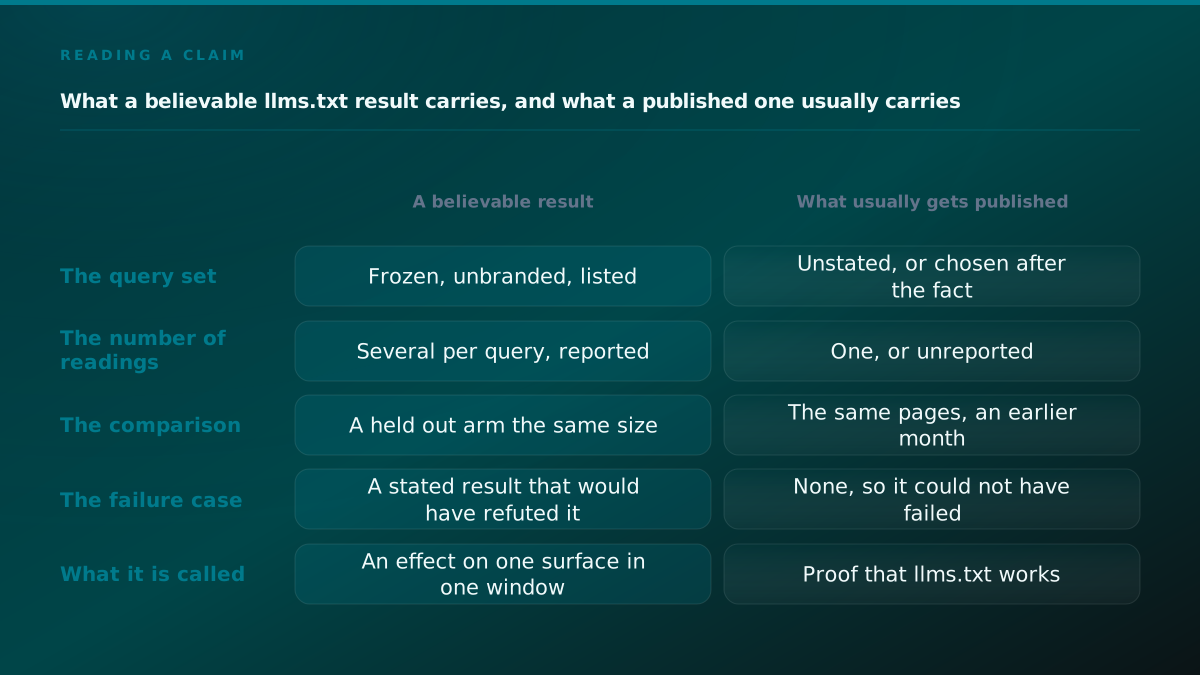
How to grade the next llms.txt claim you are shown
| What to look for | A believable result carries | What is usually published instead | Source |
|---|---|---|---|
| The query set | Frozen before the change, unbranded, and listed so you can read it. | Unstated, or visibly chosen after the outcome was known. | derived |
| Readings per query | Several, with the repeat count reported. | One, or the count is not mentioned at all. | derived |
| The comparison | A held out arm of comparable size that got no change. | The same pages, an earlier month, and a calendar in between. | derived |
| The failure case | A stated result that would have refuted the claim, written before the run. | None, so the test could not have come back negative. | derived |
| What it is called | An effect on one surface in one window. | Proof that llms.txt works. | derived |
as of 2026-09-02
Method: Derived from the four ways we have watched an AI visibility claim fall apart, each row stating its own failing result so it functions as a check rather than as reassurance. Falsify the list by naming a sixth column that a claim can be wrong in that none of these five catches, which is exactly how the list grew to five.
Five things to look for. Was the query set frozen before the change, unbranded, and published so you can read it, or is it unstated. Were there several readings per query with the repeat count reported, or one. Was the comparison a held out arm of comparable size, or the same pages in an earlier month. Was there a stated result that would have refuted the claim, written before the run. And what is the thing being called: an effect on one surface in one window, or proof that llms.txt works.
The fourth is the one that decides it. A test with no failing result defined in advance was never a test. There is a good public argument on exactly this point, made by showing that the evidence offered for llms.txt survives intact if you swap the filename for a nonsense one. That is a falsification test rather than an opinion, and an argument that cannot fail is not an argument. We take the same side on method while declining the conclusion, because "the evidence is bad" and "the file is worthless" are different claims and only the first is established.
Five things an llms.txt cannot do
Whatever it does, these are outside its reach, and confusing any of them for its job is how a team ends up disappointed by a file that was never going to help.
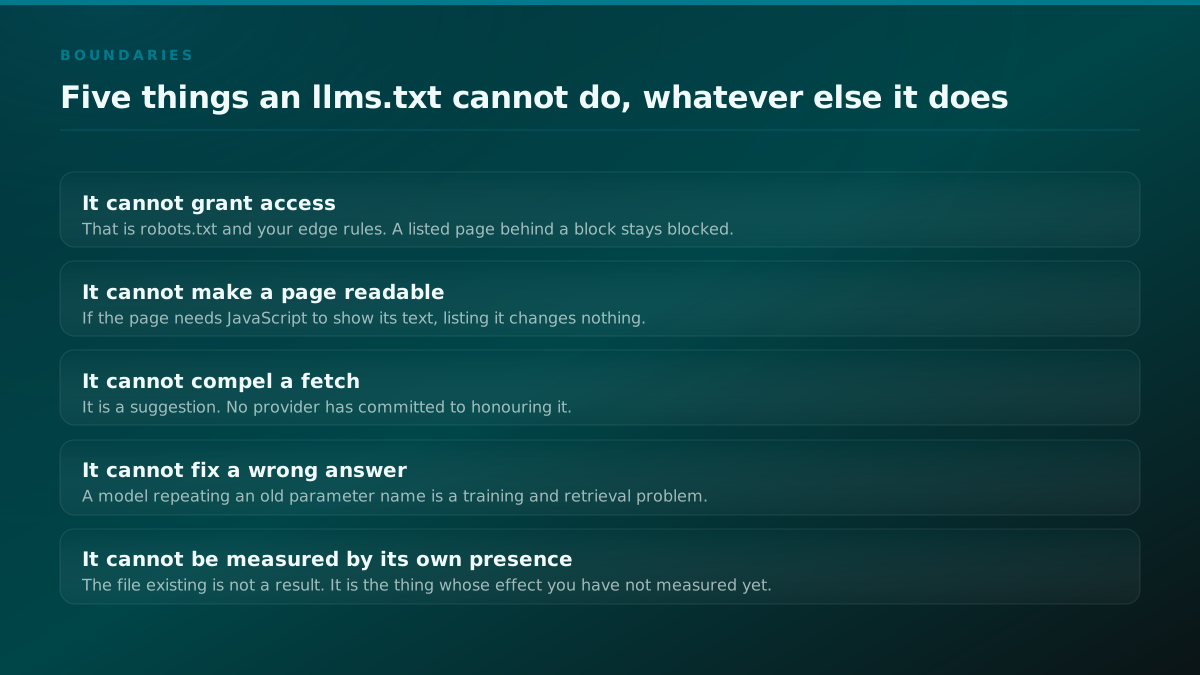
It cannot grant access. That is robots.txt, your CDN bot rules and your WAF. A listed page behind a block stays blocked, and the listing does not argue with the block.
It cannot make a page readable. If the text only appears after JavaScript runs, listing the URL changes nothing about what a non-rendering fetcher receives.
It cannot compel a fetch. It is a suggestion. No provider has committed to honouring it, and the Ahrefs finding that nothing probes for files that do not exist means it is not even a discovery mechanism for a site nothing already visits.
It cannot fix a wrong answer. A model repeating a parameter name you removed two versions ago is a training and retrieval problem. Adding a file that lists your pages does not reach into model weights and does not force a fresh retrieval on any particular question. If your problem is stale answers about your API, the relevant lever is content freshness and third-party corroboration, and we have looked at how quickly cited sources turn over in half of AI citations are under 13 weeks old.
It cannot be measured by its own presence. The file existing is not a result. It is the thing whose effect you have not measured yet. This is the most expensive of the five, because it is the one that closes the ticket.
The rendering question, since it always comes up
Every discussion of machine readable documentation eventually reaches somebody saying that AI crawlers do not execute JavaScript, so a client-rendered documentation site is invisible. That is true as a statement about crawlers. On this end of the market it appears to be a solved problem, which was the most surprising result in our probe.
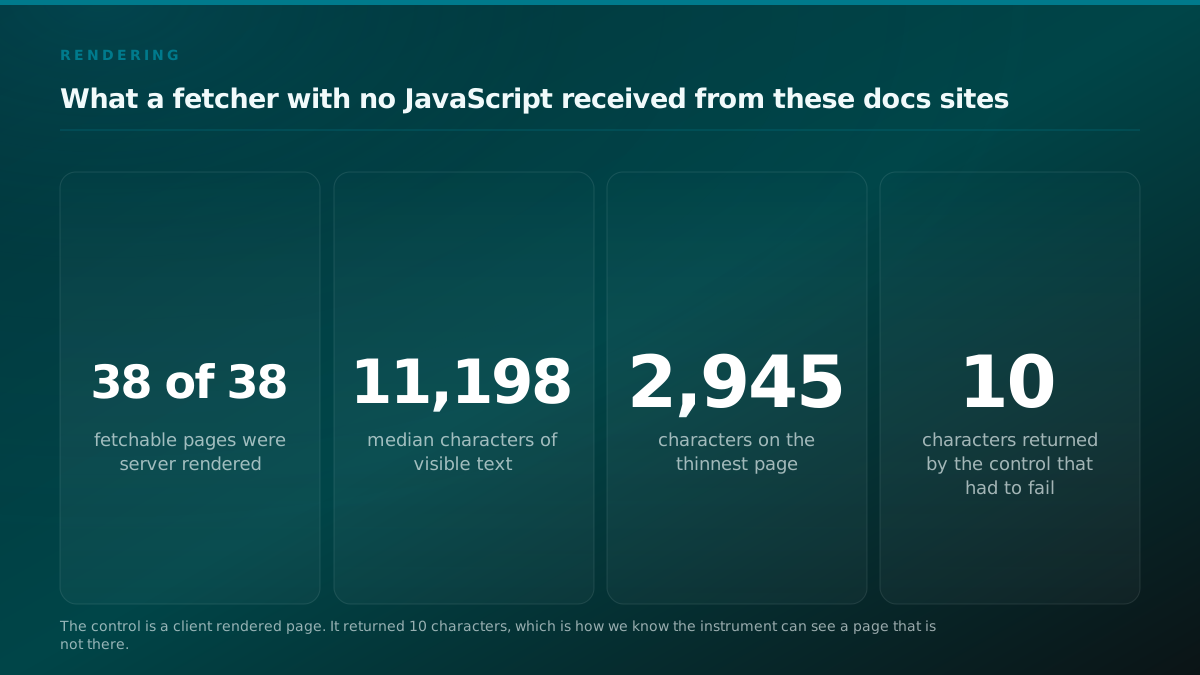
Thirty eight of the forty documentation entry points were fetchable, and 38 of 38 returned their content in the HTML with no JavaScript executed. Median visible text was 11,198 characters. The thinnest page returned 2,945 characters and the richest returned 77,152. Not one came back as a shell.
A uniform result across every member of a set is usually the instrument rather than the finding, so this one needed a control before we would report it. The control was a client-rendered application fetched by the same code path, which returned 10 characters of visible text. The check could have failed and did not. Two sites are excluded rather than counted: one documentation URL returned 404, and one returned 403 to our user agent, which is a block rather than an absence.
The practical reading is that if you are a documentation-heavy company on a mainstream documentation platform, you have probably already cleared this bar without deciding to, because the platforms pre-render. It still takes one curl to know rather than assume, and it is upstream of everything else in this post, because a page a fetcher cannot read is not helped by being listed in an index.
Where an llms.txt programme goes wrong
Pulling every failure mode in this post into one place, each paired with the specific step that would have caught it before it cost anything. Three of the eight were observed directly in our own forty-site probe, and two more come from another practitioner's scan.
Where an llms.txt programme actually goes wrong, and the step that prevents it
| Failure | Prevented at | Source |
|---|---|---|
| The file 404s and the host answers with HTML at status 200 | The content type check, not the status check | measured |
| The index lists pages that have since moved | The link resolution pass, run on a schedule | derived |
| The markdown mirror drops content the HTML carries | A content parity check between the two representations | published |
| Two representations at one URL with no Vary header | The cache configuration, before the mirror ships | published |
| A listed page sits behind a rule that blocks the crawler | Reading robots.txt as four decisions rather than one | measured |
| The page needs JavaScript to show its text | The server rendering check, which is upstream of everything here | measured |
| The before and after moved and nobody can say why | The held out arm | derived |
| A null result is reported as evidence the file does nothing | The power arithmetic | derived |
as of 2026-09-02
Method: Rows 1, 5 and 6 are measured in our own 40-site probe: two sites served HTML at 200 on a machine path, one site blocks two named crawlers while allowing two others by inheritance, and 38 of 38 fetchable pages were server rendered. Rows 3 and 4 are published, reported by a practitioner who scanned 300 sites and found six of seven markdown variants missing a Vary header and three dropping body content. The rest are derived from the design. Falsify the list by hitting a failure none of the eight describes.
The pattern across all eight is that the early ones are cheap to prevent and invisible to detect, while the late ones are expensive to prevent and obvious once you know. The soft 404 costs one line in a health check and will otherwise sit there for a year. The held out arm costs a quarter of restraint and cannot be added afterwards, because you cannot retroactively not-change half your pages.
So should you ship an llms.txt?
Probably yes, as a cheap experiment rather than as a fix, and here is the recommendation broken into five parts with a confidence level attached to each rather than smoothed into one confident voice. The ordering matters more than any single item.
Ship the file. High confidence, low stakes. It costs an afternoon, 34 of the 40 documentation sites we probed already carry one, no published evidence suggests harm, and the downside if it does nothing is an afternoon. Ship it with a stated stopping point rather than as a fix, and do not let its presence close a ticket about AI visibility.
Serve a markdown mirror if your platform does it for free. Medium confidence. The one real navigation experiment favours it, the party running that experiment sells the product, and 25 of our 40 already do it. If it is a checkbox, tick it. If it is a month of engineering, that month has better uses.
Read your robots.txt as four decisions today. High confidence, and this is the one we would actually prioritise. Thirty two of thirty seven sites are letting a rule written for search crawlers decide for four AI agents. Twenty minutes of work, and unlike the index file it has a known mechanism and a known failure mode.
Look at your access logs monthly. High confidence. Filter by user agent, count requests for the file, and you have observed the one link in the chain that is directly observable. Almost nobody does this and it is nearly free.
Run the held out arm if the decision is worth a quarter. This is the only option that can come back negative, and it is the only one that produces a number rather than a belief. It is also genuinely expensive in organisational patience rather than in money.
01 / Ship it and stop thinking about it
- Stands out
- It costs an afternoon, it carries no known downside, and 85 percent of the documentation sites we probed already have one. If you are wrong, you have wasted an afternoon.
- Best for
- Teams who want the box ticked and would rather spend the argument budget somewhere that has evidence behind it.
- Falls short
- You learn nothing. In a year you will still not know whether it did anything, and you will still be having this conversation.
02 / Ship it and watch the logs
- Stands out
- The one link in the chain you can observe directly is whether anything requests the file. Filtering your access logs by user agent costs almost nothing and answers a real question.
- Best for
- Teams with access to their own server logs and someone willing to look at them once a month.
- Falls short
- A fetch is not a citation. This tells you the file is being read and says nothing about whether reading it changed an answer.
03 / Run the held out arm
- Stands out
- The only option that can come back negative, which is the only reason to run anything. It also produces the number the other two cannot.
- Best for
- Teams with a real spending decision behind the question and a quarter to spend on it.
- Falls short
- It means deliberately not listing half your pages for a full window, which is hard to defend internally and harder to keep when a quarter goes badly.
What we would not do is spend an argument on this file. It is cheap and unproven, which is a perfectly ordinary place for a piece of infrastructure to sit while the evidence catches up. The failure is not shipping it or skipping it. The failure is calling a deployment a result, and then building a quarter of work on top of a number nobody measured.
Cheap and unproven is a perfectly respectable place for a piece of infrastructure to sit. It only becomes a problem when somebody sells it as cheap and proven.
If you want the causal answer rather than the deployment picture, that is the work behind answer engine optimization as we run it, and it starts with a frozen query set rather than with a file.
What this post does not show
The limits of everything above, stated plainly, because a post whose central argument is that other people overclaim owes the reader its own boundary in the same detail. There are four of them and each one narrows a claim made earlier.
Scope
What this post can support, and what it cannot
| A vendor claim | This post | Still unanswered by either | |
|---|---|---|---|
| Is the file deployed | Rarely stated as a number. | Yes. 34 of 40 sites we fetched, on a named list, on a stated date. | What share of the whole web carries one, which needs a random sample. |
| Do crawlers fetch it | Usually yes, from one sample. | Reported both ways, from two studies that are not ours. | Which of the two populations yours resembles. |
| Does it change a citation | Frequently implied. | No. Nobody has published that, us included. | The same question, until somebody runs a held out arm. |
| Should you ship it | Yes, and here is the product. | Probably, as a cheap experiment with a stated stopping point. | Whether the effort would have been worth more spent elsewhere. |
Our probe measures configuration and nothing else. Forty sites, one day, six requests each. It cannot see a retrieval, a ranking or a citation. Every number in it describes what a server returned to curl on 2026-09-02, and any sentence in this post that goes further than that is reasoning rather than measurement, labelled as such.
The sample is a convenience sample. It over-reports adoption relative to the web because it is drawn from prominent documentation properties, and the direction of that bias is known even though its size is not.
We have no causal result. Not for llms.txt, not for anything else. Our instrument passed its kill test and our pilot was underpowered, and both of those facts are published rather than implied.
The two log studies we cite are somebody else's, tagged published throughout, and we did not re-run either of them. Our reconciliation of them is an argument about sampling, not a measurement, and it is falsified if somebody demonstrates the two populations were comparable.
And the honest state of the question, one week before this was written, was put better by a practitioner than by any vendor page ranking for the term. He had read everything published on it, could not answer it, and named the exact observation that would settle it for him.
That is the reader this post is written for, and the answer he deserves is not a confident yes or a confident no. It is that the question is answerable, that answering it costs a quarter of restraint, and that until someone spends that quarter the correct posture is to ship the cheap thing and stop calling it evidence.
Sources
Every number above, and where it came from. A figure without a row here is one we should not have printed.
- Our own live deployment probe of 40 documentation sites
- Forty named developer tool and SaaS documentation sites fetched with curl on 2026-09-02, recording llms.txt, llms-full.txt, a per page markdown mirror, a conventional OpenAPI path, robots.txt rules for four named AI user agents, and whether the docs page was server rendered. Four controls declared before the run, all four fired. This is ours and it is the only first-party measurement in the post.
- Our own step-zero repeat run
- 12 money queries, 5 identical repeats each, one model, one day. 60 of 60 calls succeeded and 7 of the 12 changed outcome between identical asks. This is why a single before and after reading cannot settle an llms.txt question.
- Our own 20,000-split permutation test
- 20,000 random splits of the same query set with no intervention applied. The null centred on zero, mean plus or minus 0.0016, standard deviation 0.215. That spread is the bar any llms.txt result would have to clear.
- Google's own AI optimization guide
- Lists llms.txt under what you do not need to do for generative AI search. The single most load-bearing counter-argument on this term, and it is published by one of the four surfaces the practice targets.
- The Ahrefs 137,000-site llms.txt study
- Reports that 97 percent of llms.txt files are never read, that zero AI bots go looking for files that do not exist, and that 12 percent of the requests that do arrive come from tools studying the format rather than consuming it. Somebody else's measurement, tagged published throughout.
- The llms.txt proposal itself
- The specification. Defines the file format and its intent, and makes no claim about citation outcomes, which is worth noting because most of the argument attributed to it is not in it.
- An empirical study of how coding agents read documentation
- arXiv 2608.20195. 557 agentic coding sessions and 33,097 agentic pull requests. Instruction files and working notes account for 60.5 percent of documentation interactions against 1.3 percent for API references. Read directly rather than through a summary of it.
Questions people actually ask about llms.txt
- Does llms.txt actually improve AI citations?
- Nobody has published a controlled result showing that it does, and that includes us. A controlled result needs a frozen query set, a held out arm and a null distribution, and no such study exists on this file. What is established is that the file is cheap to deploy and carries no known downside, which is a different sentence entirely.
- How many sites actually have an llms.txt?
- On our own sample, most of them. We fetched 40 named developer tool and SaaS documentation sites on 2026-09-02 and 34 served a real llms.txt, which is 85 percent. That is a convenience sample rather than a random one, so it describes the leading edge of documentation practice and not the web.
- Does Google use llms.txt?
- Google has published that you do not need to create machine readable files, AI text files, markup or Markdown to appear in generative AI search, and that discovering such a file does not mean it is treated specially. That statement covers Google Search. It says nothing about ChatGPT, Claude, Perplexity or coding agents.
- What is the difference between llms.txt and robots.txt?
- They answer different questions. Robots.txt states who may fetch what, it is permission rather than preference, and every major crawler has honoured it for decades. An llms.txt suggests which pages are worth reading. If a page listed in your llms.txt sits behind a robots block, the block wins every time.
- What is the difference between llms.txt and llms-full.txt?
- The first is an index of links, the second inlines the whole content. On our 40 site sample, 34 served an index and only 17 served the full text, so the index is roughly twice as common. Two files means two chances to drift out of sync with the pages they describe.
- How do I test whether llms.txt is doing anything?
- Start with your access logs rather than a dashboard. Filter by user agent and count requests for the file over a month, because that is the one link in the chain you can observe directly. Everything past a fetch, meaning retrieval and citation, needs a held out arm to answer honestly.
- Why do studies disagree about whether AI bots read llms.txt?
- Because they sampled different populations. A 137,000 site crawl is dominated by sites nothing was ever going to fetch, so a 97 percent never read figure is unsurprising. One operator with over a million bot hits on a property that already ranks in AI answers is the tail of that same distribution.
- Is llms.txt an official standard?
- It is a proposal rather than an adopted standard. The specification defines a file format and its intent, and it deliberately makes no claim about citation outcomes. Most of the argument attributed to it in vendor blogs is not actually in it, which is worth checking yourself before you repeat any of it.
- Should I ship an llms.txt or not?
- Probably yes, treated as a cheap experiment rather than as a fix. It costs an afternoon, 34 of the 40 documentation sites we probed already carry one, and no published evidence suggests harm. Ship it with a stated stopping point, then look at your logs, and do not call a deployment a result.
- How many queries would I need to prove llms.txt worked?
- More than most teams run. Computed from the variance in our own step zero run, a design of 12 queries by 5 samples has a minimum detectable lift of 51.1 percentage points, 20 by 20 reaches 21.4, and 40 by 40 reaches 9.9. Only the largest could see a realistic effect.
- Does a markdown mirror of each page matter more than llms.txt?
- Possibly, and the deployment pattern hints at it. Across our 40 sites, 25 served a per page markdown mirror and every single one of those also served an llms.txt, while nine served the index alone. No site served a mirror without an index, so teams appear to add the index first.
- Will llms.txt fix an assistant giving wrong instructions for my API?
- No, and this is the most common wrong reason to ship one. A model repeating a parameter name you removed two versions ago is a training and retrieval problem. Adding a file that lists your pages does not reach into a model's weights or force a fresh retrieval on any particular question.
Keep reading
AI citations
LLM SEO, what it actually is and what the work looks like
Google says its AI features run on the same ranking systems as Search, so the tactics are familiar. What changed is how you tell whether the work landed.
46 min read
AI citations
Reddit is cited by AI. That is not a reason to buy upvotes.
Published Reddit citation shares run from 2% to 46.7%, and one study puts Reddit at 67.8% of every URL ChatGPT retrieves and then declines to cite.
23 min read
AI citations
What Is Answer Engine Optimization? How AI Picks Sources
What answer engine optimization means, how AI assistants decide what to cite, and what our own measurement work says about proving it caused a citation gain.
23 min read