AirOps Alternatives: Content-AEO vs Pure Measurement
Nine real AirOps alternatives, split into content production and pure measurement, plus the buyer split most vendor comparison pages miss entirely.
Citon25 min read
Short answer
What are the best AirOps alternatives?
The AirOps alternatives real buyers actually name split into three groups. On the content-production side: Writesonic, ContentPen, ContentMonk, Orchly, SlateHQ, Moonlit, and Aiken House. On the pure-measurement side: Profound and Promptwatch, the exact tool a real Reddit thread names after ruling AirOps out. And for a technical team willing to self-host: N8N, wired to whatever LLM the team wants. AirOps itself bundles content production with a lighter tracked-prompts view starting on its free Solo plan, which is exactly why the two switching threads behind this post split into different complaints, one about the content workflow, one about tracking depth. Picking a replacement without first deciding which job you actually needed AirOps to do is how a team ends up switching twice.
A search for "airops alternatives" turns up a page mostly written by the alternatives themselves. Orchly ranks with its own AirOps-alternatives page, several more content tools run the same play under a different name, and the one weak, non-vendor result in the top ten is a Reddit thread. That thread is where the real signal sits, and it says something the vendor pages do not, that the actual complaint behind an AirOps switch is not one complaint. It is two, and they point at different replacements.
In r/seogrowth , a buyer describes moving off AirOps to a smaller tool called trywonda.com, citing cost and unused features. In r/GrowthHacking , a different buyer nearly picks AirOps to replace a tracking platform they were leaving, then backs off after reading reviews that made clear it is not built for that job the same way a dedicated tracker is. Same tool, two different disappointments, because AirOps genuinely sells two different jobs from one product, and most people evaluating it only notice the half they went looking for.
This comparison sorts the real alternatives into the two lanes AirOps itself straddles, content production and tracked-prompt measurement, names what each actually costs where that is published, and is honest about the one thing search volume alone will not tell you: 90 searches a month is a small, real number, not a big one, and the reason this topic is still worth a straight answer is the quality of the switching evidence behind it, not its size.
It is worth being direct about what a comparison like this one can and cannot do. There is no independent benchmark scoring these tools against each other on output quality or tracking accuracy, because that would require testing every content template and every tracked-prompt result against a ground truth no outside party can fully see. What follows instead is a comparison of what each tool is actually built to do, what it costs where that is disclosed, and which lane it sits in, built from what real buyers report rather than from a vendor's own feature grid.
At a glance
Nine AirOps alternatives, split by which job they actually do
| Tool | Which lane it is actually in |
|---|---|
| Writesonic | Content-production plus its own tracked-prompt AI-search dashboard, the closest direct AirOps overlap. |
| ContentPen | AI content production and refresh, narrower scope than AirOps' full workflow suite. |
| ContentMonk | AI content production aimed at SEO teams, positioned as a lighter, cheaper AirOps substitute. |
| Orchly | AI content and AEO workflow tool, ranks directly for "AirOps alternatives" itself. |
| SlateHQ | Content operations and AI-search workflow tool, smaller team-focused positioning. |
| Moonlit | AI content production platform, appears in the same switching conversations as AirOps. |
| Aiken House | AI content and GEO-focused workflow tool, ranks directly for "AirOps alternatives" itself. |
| Profound | Pure tracked-prompt measurement, no content production, the tool a real buyer was leaving when AirOps came up as an option. |
| Promptwatch | Pure tracked-prompt measurement, named directly by a real buyer as where they landed after ruling out AirOps. |
| N8N | Self-hosted workflow automation, the DIY route a real buyer took after AirOps' setup and support friction. |
Why teams go looking for an AirOps alternative
The two Reddit threads cited throughout this post are not the same complaint wearing different words. One is about the workflow, one is about the number, and treating them as interchangeable is the fastest way to pick the wrong replacement.
The r/seogrowth thread is a workflow complaint, from a real 50-employee startup trying to automate SEO and content with limited headcount. The original post is upfront that AirOps "is not cheap and looks like it's going to take some time to properly onboard the team to," and the poster's own edit, added after running demos, names the tool they picked instead: trywonda.com, "like AirOps but they give you a fully managed white glove service with customized workflows for content generation, refresh and monitoring." That is not a cheaper-and-simpler downgrade, it is a trade toward less setup burden and more hand-holding, the opposite tradeoff from the one a self-serve tool like ContentPen or ContentMonk offers. A separate top-level reply in the same thread, from a different buyer who used AirOps early on, describes a harder edge to the same workflow complaint: setup was not straightforward for a non-technical team, real support required upgrading plans, and AirOps later removed the ability to export workflows between projects. That buyer moved to N8N, a self-hosted workflow-automation tool, and reports it working well for new-content and refresh workflows once a technical teammate set it up, at meaningfully lower cost than a managed tool. Twenty comments on a post that started with only three upvotes is itself a small tell, a low-visibility thread that still pulled real, substantive engagement rather than one that got upvoted for reach and then went quiet.
The r/GrowthHacking thread is the opposite complaint, aimed at the other half of the product, and it names its tools specifically rather than describing them generically. The poster is leaving Profound, by name, over unhelpful support despite paying for its top subscription tier, and says directly: "I wanted to go with Airops at first but I saw several bad reviews, so now I'm leaning towards something like Promptwatch." The post closes by asking for "bonus points if it has content generation too, not just tracking," which is the two-lane split this entire comparison is built around, stated by a real buyer in one sentence before this post existed to name it. The buyer correctly identified that AirOps was the wrong shape for a pure-measurement need, even though AirOps genuinely does have a tracking feature, and Promptwatch, the tool they landed on instead, is a dedicated AI-answer tracking product built primarily for that one job. Twenty-five comments on a twelve-upvote post is a similar shape to the first thread, real back-and-forth rather than a drive-by complaint.
After going through different product demos, we decided to go with trywonda.com, it's like AirOps but they give you a fully managed white glove service with customized workflows for content generation, refresh and monitoring.
Reading both threads together is more useful than reading either alone. A comparison page that treats "AirOps alternatives" as one list, ranked by whichever metric the page author picked, is answering a question neither of these real buyers actually asked. Both of them needed to know which job AirOps was failing at before a replacement tool made any sense, and neither vendor listicle currently ranking for this search makes that split explicit. That gap is exactly what this comparison is built to close, not by adding a bigger or more exhaustive tool list, but by sorting the names that do keep coming up, seven from the live SERP plus two named directly by real buyers, into the two jobs they actually solve.
AirOps already does two jobs, which is the root of the confusion
AirOps' own pricing page settles the ambiguity plainly: it is not a content tool with a small tracking bonus feature, and it is not a tracking tool with content generation bolted on. It bills both as first-class, and reading the plan structure top to bottom makes that shape obvious in a way a feature-list marketing page usually does not.
From the field
AirOps already does two jobs, which is why its alternatives split into two lists
AirOps' own pricing page shows tracked prompts and pages as a line item starting on its free Solo tier, alongside AI content production, brand kits, and CMS integrations. That is not a small tracking add-on, it scales from 100 tracked prompts on Solo to 250 on Pro with multi-engine coverage across Google, Perplexity, OpenAI, and Google AI Studio. A buyer reading only the content-production marketing and missing this half is comparing AirOps against the wrong set of alternatives, and a buyer reading only the tracking half is doing the same thing in reverse. The r/GrowthHacking thread cited above shows exactly this confusion in real time, a buyer nearly picking AirOps to replace a dedicated tracking platform before catching that it is not built the same way.
The two jobs a "content-AEO platform" gets sold as one product
| Job | What it actually does | Tools built primarily for this job |
|---|---|---|
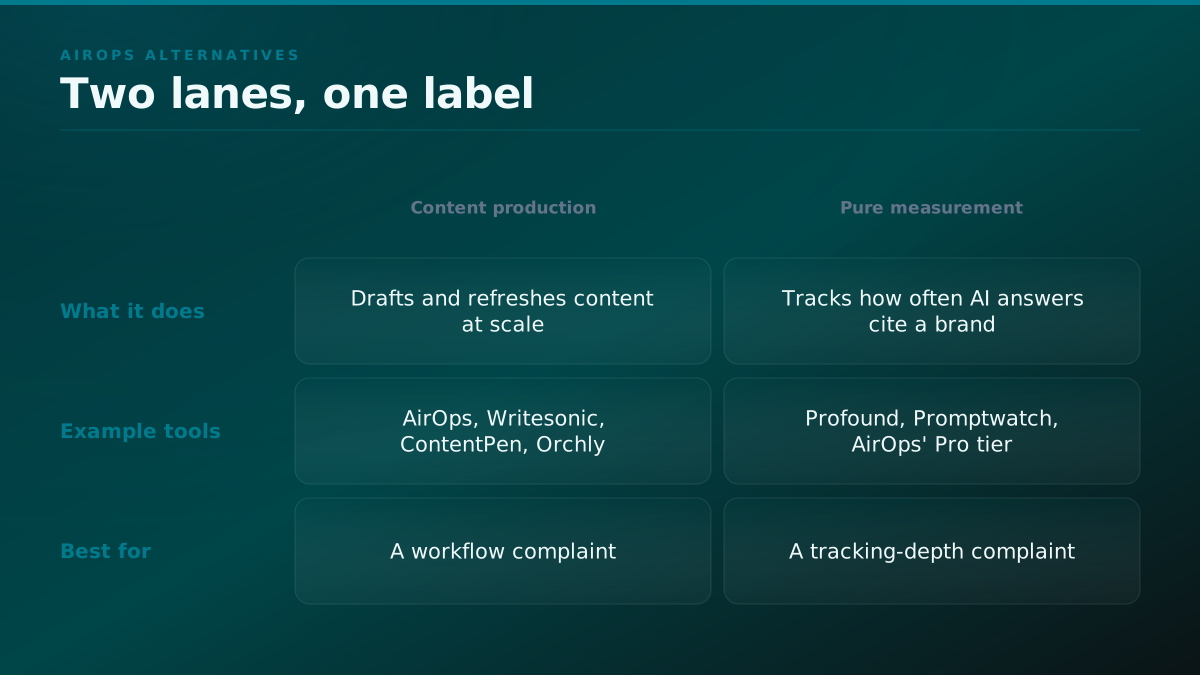
| Content production | Drafts, refreshes, and publishes content at scale, often with SEO or AEO-shaped templates. | AirOps, Writesonic, ContentPen, ContentMonk, Orchly, SlateHQ, Moonlit |
| Citation measurement | Repeatedly runs a fixed prompt set against AI answer engines and reports how often a brand gets named. | Profound, Peec AI, AthenaHQ, Otterly.AI |
The Insights plan, free, is essentially the entry point to the content and brand-kit side: one user, basic templates, one brand kit, five knowledge base sources, community support, 30-plus AI models, 10-plus data providers, and 10-plus CMS integrations. Nothing in that tier mentions tracked prompts at all, which is presumably why a buyer who signs up through the Insights door and never looks past it walks away thinking AirOps is purely a content tool.
The Solo plan, also free, is where the tracking side becomes explicit for the first time: 100 tracked prompts and pages, ChatGPT insights specifically, monthly opportunity reports, alongside 20,000 tasks for content production and three knowledge bases. A buyer landing on Solo instead of Insights sees both halves of the product on the same screen, which is probably the more accurate first impression of what AirOps actually is.
What AirOps itself actually charges, by plan
| Plan | Price | Tracked prompts and pages | Content production |
|---|---|---|---|
| Insights | Free, 1 user | Not included | Basic templates, 1 brand kit, 5 knowledge base sources |
| Solo | Free | 100, ChatGPT insights only, monthly opportunity reports | 20,000 tasks a month, 1 brand kit, 3 knowledge bases |
| Pro | Custom-quoted | 250, multi-engine (Google, Perplexity, OpenAI, Google AI Studio), weekly reports | 75,000 tasks a month, unlimited seats |
| Pages | Custom-quoted | AI search visibility insights included | Everything in Solo, plus unlimited users and content refresh tooling |
| Enterprise | Custom, contact sales | Custom limits, unlimited knowledge bases and brand kits | Dedicated account manager, 1:1 onboarding, unlimited seats |
By the time a buyer reaches the Pro plan, custom-quoted rather than published, the tracking side has grown to 250 tracked prompts and pages with multi-engine coverage across Google, Perplexity, OpenAI, and Google AI Studio, weekly opportunity reports instead of monthly, and 75,000 content-production tasks with unlimited seats. The Pages plan sits alongside Pro rather than above it, built around unlimited users and content refresh tooling specifically, still carrying the AI search visibility insights feature but framed for a team whose primary need is publishing volume. Enterprise, the top tier, adds a dedicated account manager, 1
onboarding, and custom limits across every dimension, the standard shape of a top-tier B2B SaaS plan sold entirely through a sales conversation.That is a genuinely bundled product, not a content tool with an afterthought feature. Which is exactly why the switching threads split the way they do. A team unhappy with the content-production side is not describing the same product experience as a team unhappy with the tracking side, even though both are describing AirOps, and a vendor's own marketing copy, built to sound comprehensive rather than to explain which buyer actually needs which half, does not make that distinction for anyone reading it cold.
Nine real alternatives, sorted by lane
Vendor listicles for this search term mostly skip the lane question entirely and list every tool that shows up in a related search, content and tracking mixed together with no framing for which job each one solves. Sorting by lane first makes the comparison actually usable, and it is the one thing none of the current top-ranking pages for this exact search do.
Writesonic. The closest direct overlap with AirOps' bundled shape, and the one alternative on this list that also does both jobs rather than specializing in one. Writesonic's own pricing page lists a Starter tier at 79 USD a month on annual billing, tracking 50 prompts and 50 answers daily across ChatGPT, Gemini, and Google AI Overviews, alongside 15 AI articles a month and 10 site audits covering up to 100 pages each. The Basic tier, at 199 USD a month, roughly doubles most of those limits and adds a second user. The Growth tier, at 399 USD a month, adds sentiment analysis and a five-action trial of its Action Center for automated on-page and off-page changes, positioned as the most-popular tier on the pricing page itself. Enterprise, custom-quoted, adds coverage across all ten of Writesonic's tracked AI platforms rather than the three named on the lower tiers, plus SOC 2 Type II and HIPAA compliance for teams with procurement requirements AirOps' own pricing page does not address at all. For a team leaving AirOps because it wants the same two-job shape but different pricing, depth, or a different feature emphasis, Writesonic is the most direct comparison to run side by side, and it is the one alternative on this list where a real, published price ladder makes that comparison possible without a sales call first.
ContentPen. A narrower AI content-production tool, without AirOps' bundled tracking feature. For the buyer whose r/seogrowth complaint was specifically about the content workflow and who has no interest in a tracked-prompt view at all, dropping the tracking half entirely and picking a tool built only for content production is a reasonable simplification rather than a downgrade. The tradeoff is the one this whole comparison keeps returning to: a narrower tool does one job without the overhead of a second one nobody in that specific team was using, but it also means starting from zero if a tracking need shows up later rather than simply upgrading a plan tier the way an AirOps or Writesonic customer would. It ranks in the live top ten for "airops alternatives," which puts it directly in front of a buyer already typing this exact search rather than relying on a broader category term to surface it.
ContentMonk. Positioned as a lighter, SEO-team-focused content tool, another content-only option in the same shape as ContentPen. Teams choosing between the two are usually trading small differences in template library, integration depth, and price rather than a structural difference in what the product does, which makes the actual decision closer to a trial-and-feel comparison than a feature-grid one. Neither ContentPen nor ContentMonk publishes a starting price, so budgeting for either one means requesting a quote before the comparison against AirOps' free tiers is even apples to apples. Both also rank in the live top ten for this exact search term, which is worth naming plainly: a page that describes itself as an independent "AirOps alternatives" resource while also being one of the alternatives being ranked is not a neutral comparison, whatever its own framing claims.
Orchly. The one alternative on this list that ranks directly in the live search results for "airops alternatives" itself, meaning it is positioning itself explicitly against AirOps rather than being pulled in by a broader category search. Orchly covers content and AEO workflow together, closer to AirOps' own bundled shape than ContentPen or ContentMonk, though without AirOps' specific multi-engine tracked-prompt depth on the Pro tier. Its direct positioning against AirOps is itself a signal worth noting, a vendor betting its own SEO strategy on capturing exactly the switching intent this post's own primary keyword represents, the same reason it currently outranks every independent source for this search except the one Reddit thread.
SlateHQ. A content-operations tool aimed at a smaller team's workflow rather than an enterprise content pipeline. The positioning leans toward simplicity over feature breadth, a reasonable fit for a team whose AirOps complaint was that the fuller feature set felt like more product than they needed, the mirror image of a team that outgrew a lighter tool and moved up to AirOps in the first place. A team evaluating SlateHQ should go in expecting a smaller feature surface by design, not as a limitation to work around.
Moonlit. An AI content-production platform that appears in the same switching conversations as AirOps without a single dominant differentiator in the public record. Worth a direct trial comparison against whichever content-only alternative a team is otherwise leaning toward, since the meaningful differences at this end of the category tend to show up in day-to-day workflow feel rather than a feature grid, the kind of difference a pricing page or a comparison table cannot fully capture no matter how carefully it is built.
Aiken House. The smallest and least-documented name in this comparison, also ranking in the live top ten for "airops alternatives." Its public footprint is thinner than the six names above, which is itself useful information for a buyer doing due diligence: a tool with a sparse public record is a real risk factor independent of whatever its landing page claims, and it belongs on a shortlist for a trial rather than a decision made from marketing copy alone.
Profound. Not a content tool at all, and included here specifically because of the r/GrowthHacking thread, which shows a real buyer leaving Profound itself over support, considering AirOps as the replacement, and rejecting it on reviews before landing on a third option. Profound is the tool the thread's own OP was moving away from, not toward, and it is included here because that thread is the single clearest piece of evidence that a pure-measurement tool and AirOps sit in the same buyer consideration set. Profound is built around repeated-prompt tracking with competitor share-of-voice and no content-production feature at all. Its own published pricing starts around 500 USD a month for a single-brand plan, well above every content-focused alternative here, which is the direct cost of trading a bundled feature for a purpose-built one.
Promptwatch. The tool the r/GrowthHacking poster actually named as where they were leaning after ruling out both Profound and AirOps, "I wanted to go with Airops at first but I saw several bad reviews, so now I'm leaning towards something like Promptwatch." It sits in the same pure-measurement lane as Profound, tracking how often a brand gets named across AI answer engines, and its appearance in this specific thread is the most direct evidence in this entire comparison that a real buyer treats AirOps and a dedicated tracker as substitutes for the same underlying need, even though the two products are built differently.
N8N. Not a content-AEO tool at all in the sense the other names here are, and included specifically because a real buyer in the r/seogrowth thread named it as what worked after AirOps' setup friction and support gating pushed them off it. N8N is a general workflow-automation platform, self-hosted, that a technical teammate can wire into whatever content-generation and refresh logic a team wants, using its own LLM connections rather than a purpose-built content-AEO interface. The tradeoff is explicit in that buyer's own account: real technical setup cost upfront, and a real cost advantage afterward from self-hosting rather than paying a managed-tool markup. This is the DIY end of the spectrum this comparison covers, worth naming because it is where a technical team with in-house workflow-automation capacity ends up, not because it competes feature-for-feature with a purpose-built tool like AirOps or Writesonic.
Nine AirOps alternatives compared
| Tool | Starting price | Lane | Best for |
|---|---|---|---|
| AirOps (for reference) | Free Insights and Solo tiers; Pro, Pages, and Enterprise custom-quoted | Both, content production plus a lighter tracked-prompt view | A team that wants both jobs from one vendor and does not need deep measurement rigor on either side. |
| Writesonic | 79 USD a month (Starter, annual billing) | Both, content production plus its own AI-search tracking dashboard | A team leaving AirOps for the same two-job shape at a different price point and feature mix. |
| ContentPen | Custom-quoted, not published | Content production | A team whose AirOps complaint was about the writing workflow specifically, not the tracking feature. |
| ContentMonk | Custom-quoted, not published | Content production | A team that wants a lighter, cheaper content tool and does not use AirOps' tracking side at all. |
| Orchly | Custom-quoted, not published | Content and AEO workflow | A team already comparing AirOps-shaped tools directly, since this is the one alternative that ranks for the exact search. |
| SlateHQ | Custom-quoted, not published | Content operations | A smaller team that wants a lighter operations layer without AirOps' full feature surface. |
| Moonlit | Custom-quoted, not published | Content production | A team named in the same switching conversations as AirOps, worth a direct trial comparison. |
| Aiken House | Custom-quoted, not published | Content and GEO workflow | A team doing broad due diligence on every tool ranking for this exact search, worth a trial rather than a decision from marketing copy alone. |
| Promptwatch | Custom-quoted, not published | Pure tracked-prompt measurement | A team whose real complaint is tracking depth, the tool a real buyer landed on after ruling out AirOps. |
| N8N | Free (self-hosted), infrastructure and setup cost instead of a subscription | DIY workflow automation | A technical team with in-house automation capacity that wants to avoid a managed-tool markup entirely. |
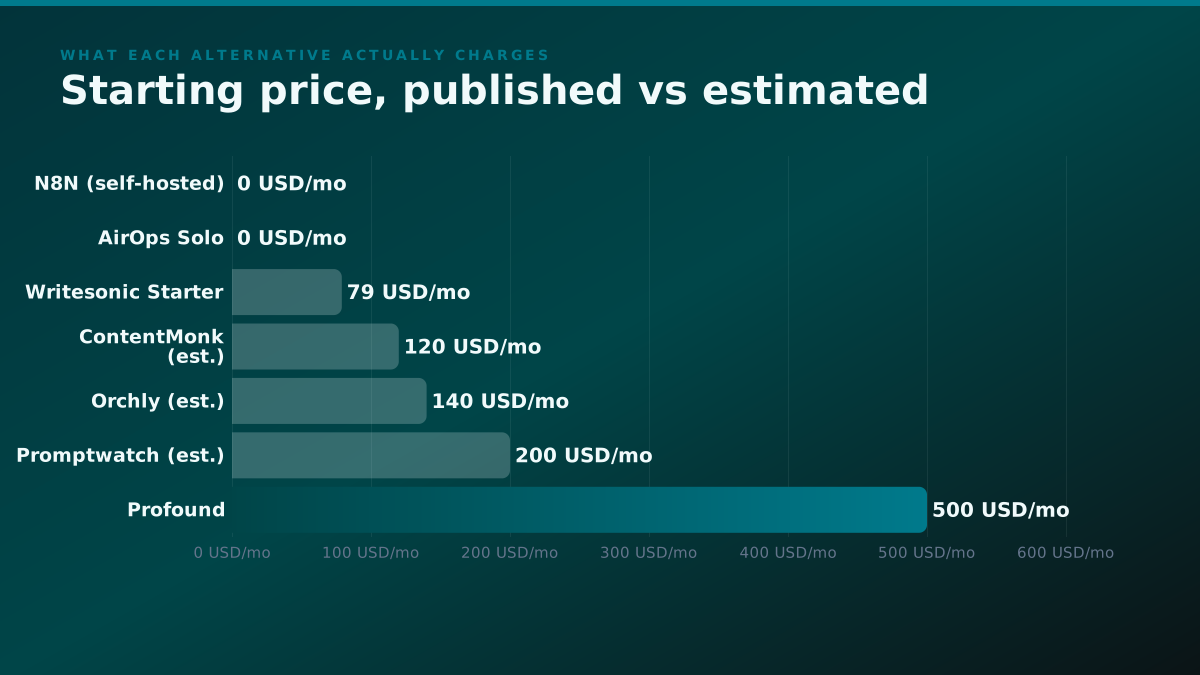
Reading the pricing column across all nine, a pattern shows up that the individual vendor pages do not surface: only Writesonic and AirOps itself publish a self-serve starting price for this category's fuller feature set, N8N is free by virtue of being self-hosted rather than sold, and every other name here, ContentPen, ContentMonk, Orchly, SlateHQ, Moonlit, Aiken House, and Promptwatch, sells through a demo or sales call. That is not unusual for B2B SaaS at this price tier, but it does mean the "starting price" comparison most listicles present with confident specific numbers is, for seven of nine tools, an estimate dressed as a quote. This comparison states that plainly in the table's own footnote rather than let a specific-looking figure pass as a confirmed one, and it is the same discipline this site applies to every comparison it publishes, whether the subject is a content tool, a measurement platform, or an agency.
What actually ranks for "airops alternatives" right now
Nine of the ten live results for this exact search are either AirOps itself, one of its direct competitors, or a review aggregator. One is a Reddit thread.
That is a narrower ratio than most comparison searches in this category. The competitors ranking here, Orchly, ContentMonk, ContentPen, SlateHQ, Moonlit, Aiken House, and Writesonic, are not incidentally showing up through a broader category search, they are each running their own "AirOps alternatives" page specifically, competing for the exact buyer intent this post targets. G2 sits in the results as the one third-party aggregator, a genuinely useful second layer of unsponsored opinion for a category where seven of the other nine results have an obvious reason to rank a specific tool favorably. Reddit is the only result written by neither a vendor nor an aggregator, and it is the source this comparison leans on most heavily for exactly that reason.
Google's AI Overview also fires on this query, in every one of five separate trials run against it, with a median of nine references shown when it does fire. Nine is a wide answer box by the standard of a niche B2B comparison term, meaning a page that earns a citation here shares the spotlight with roughly eight other sources rather than standing alone, and a search this specific rewarding that many simultaneous citations is itself a sign the underlying question does not yet have one settled, widely-cited answer. A structured, sourced comparison built around what real buyers say rather than around a single vendor's own framing of its competitive set is a closer fit for that kind of answer box than another entry in the same self-interested listicle format already crowding the organic results.
What switching actually costs, beyond the subscription price
The number on a pricing page is rarely the real cost of a switch, and the two Reddit threads cited throughout this post both describe costs that never appear on any vendor's comparison table.
The r/seogrowth buyer's stated reason for leaving, paying for unused features, is itself a cost most pricing comparisons miss: a 20,000-task content-production allowance on a plan a team only uses for tracking, or a 250-tracked-prompt allowance on a plan a team only uses for drafting, is money spent on capability that a narrower, cheaper tool would not have billed for in the first place. That gap is invisible on a feature-grid comparison, since a feature-grid rewards a tool for having more, not for a buyer actually using what it has.
The r/GrowthHacking buyer's near-miss describes a different hidden cost, the time spent evaluating a tool that turned out to be the wrong shape for the job before signing anything. Reading reviews carefully enough to catch that AirOps' tracking feature does not match a dedicated tracker's depth is exactly the kind of due diligence this comparison is built to shortcut, and skipping it is how a team ends up paying for a trial period, migrating a workflow, and then discovering the mismatch after the switch rather than before it.
There is a third cost specific to any switch away from a bundled tool: fragmenting into two vendor relationships once one lane outgrows the other. A team that leaves AirOps for ContentPen because the content workflow was the complaint, then later needs a tracked-prompt view after all, is not simply adding a feature back, it is adding a second bill, a second login, and a second data source that has to be reconciled against whatever the first tool reports. Writesonic and Orchly, the two alternatives here that keep both jobs bundled, avoid that specific cost at the price of matching neither job's depth as closely as a specialist tool would.
The question a bundled tracking feature still cannot answer
Whether the tracking half comes from AirOps, Writesonic, or a purpose-built tool like Profound, the same structural gap sits underneath all of them, and it does not close just because a tool happens to bundle two jobs instead of one.
What a tracked-prompt count inside a content tool cannot tell you
| Question a buyer actually has | Can a bundled tracking feature answer it alone? |
|---|---|
| Are we getting mentioned in AI answers at all? | Yes, this is the one thing a bundled tracker can show reliably. |
| Did publishing through this tool cause that change? | No. This needs a held-out control, queries deliberately left unworked over the same period, which no content-production tool ships alongside its tracking view. |
| How does our tracked-prompt count compare against a purpose-built measurement tool's? | Rarely checkable. Prompt sets, repeat counts, and scoring methodology are not published or standardized across tools. |
I wanted to go with Airops at first but I saw several bad reviews, so now I'm leaning towards something like Promptwatch. Bonus points if it has content generation too, not just tracking.
A tracked-prompt count answers whether a brand is getting mentioned. It does not, on its own, answer whether a specific content change, a new AirOps-published article, a refreshed page, a schema update, caused that number to move, versus the underlying model simply answering differently on a given day for reasons that have nothing to do with any single piece of content. Separating those two requires a held-out control, a set of queries deliberately left unworked over the same period, so whatever the model did on its own can be subtracted from whatever the tracked queries show.
From the field
This is a real, narrow search with a small but genuine buyer signal behind it
Measured search volume for "airops alternatives" sits at 90 searches a month, below the 100-a-month floor this site treats as a confident real-demand signal, and that is stated here rather than rounded up to sound bigger. What raises this topic anyway is what is behind that thin number, a named, dated, first-hand switching narrative on Reddit rather than a speculative or invented one, and a second thread showing AirOps sitting inside the same buyer consideration set as a dedicated measurement tool. A search term can be small in volume and still be the exact query a real, in-motion buyer types the week they are deciding, which is a different kind of signal than raw volume measures.
None of the tools compared here, content-focused or tracking-focused, ships that kind of control. The gap is not a defect specific to AirOps' bundled tracking feature; it is structural to the entire category of tools that report a repeated-prompt score, whether that score is the whole product or a feature inside a larger content platform. A team that switches from AirOps to Writesonic because the tracked-prompt view felt too shallow will find a deeper dashboard, more tracked prompts, more platforms covered, sentiment analysis, but not an answer to the causation question, because that question needs a different kind of instrument than either product is built to be.
A content tool that also shows you a tracked-prompt number and a measurement tool that also lets you publish a draft are not the same purchase, even when both get called an AEO platform.
The practical shape of this gap shows up the same way it does for a pure-measurement tool. A team publishing more content through AirOps or Writesonic and watching its tracked-prompt number rise over the following month has two competing explanations available at all times: the new content genuinely earned more citations, or the underlying model changed its own answer behavior over that same month for reasons unconnected to anything published. Without a held-out set of queries that received no new content during that window, there is no way to attribute the rise to one cause over the other, and every tool in this comparison, content-bundled or standalone, leaves that attribution problem entirely to the buyer.
Which alternative actually fits your complaint
The fastest way through this decision is naming which half of AirOps was actually the problem before comparing a single feature or price point, and the sequence below is built to force that decision early rather than let a feature grid make it by default.
01 / Your complaint is about the content workflow
- Stands out
- You are paying for features on the tracking side you never open, and the writing or refresh workflow is what is actually slow or clunky.
- Best for
- A team whose day-to-day friction with AirOps is in drafting, templates, or CMS publishing, not in the tracked-prompt view.
- Falls short
- Switching to a pure content tool means losing the built-in tracking view entirely, so budget a separate tracker if you still want that number.
02 / Your complaint is about the tracking, not the writing
- Stands out
- You wanted AirOps for the prompt tracking specifically, and it is thinner than a purpose-built measurement tool on repeat count, prompt visibility, or competitor breakdown.
- Best for
- A team that picked AirOps expecting Profound-or-Peec-AI-level tracking depth and found the free-tier tracking too shallow for real reporting.
- Falls short
- A dedicated tracker adds a second vendor and a second bill; it will not also draft or publish content for you.
03 / You genuinely use both halves
- Stands out
- AirOps' bundled shape is the reason you picked it, one vendor for both content production and a lightweight tracked-prompt view.
- Best for
- A smaller team that does not have separate budget lines for a content tool and a measurement tool and is fine trading depth on both for one bill.
- Falls short
- Neither half is as deep as a specialist tool in that lane, which is the tradeoff every bundled product makes.
A team whose real complaint is the content workflow gains nothing from evaluating Profound's tracking depth, and a team whose real complaint is tracking depth gains nothing from comparing ContentMonk's template library against AirOps'. The r/seogrowth and r/GrowthHacking threads cited throughout this post are useful precisely because they show both failure modes happening to real buyers in the same category during the same general window, not because either one is more common than the other.
There is a fourth path worth naming honestly, which is not switching at all. A smaller team that genuinely uses both halves of AirOps, publishing content through it and checking the tracked-prompt view periodically, is often better served by staying put than by fragmenting into two vendor relationships to chase marginal depth on either side. The bundled tradeoff, less depth on both jobs in exchange for one bill and one login, is a real and reasonable one for a team that has not yet outgrown either half, and switching preemptively on the theory that a specialist tool must be better trades a known cost for an unproven gain.
A useful test for whether a team has actually outgrown AirOps, rather than just gotten annoyed with one part of it on a bad week, is whether the complaint has shown up more than once across separate reporting periods. A single frustrating month where a draft took longer than expected or a tracked-prompt number stayed flat is not the same signal as a pattern repeating across a quarter. The r/seogrowth buyer's complaint reads like the latter, cost and unused features named specifically enough to suggest a considered decision rather than a one-off frustration, which is part of why that thread is treated here as real switching evidence rather than a stray complaint.
The tier a team currently sits on inside AirOps also changes which alternative actually makes sense. A team still on the free Insights or Solo plan has not yet paid for the deeper Pro-tier tracking or content volume, so a lateral move to a similarly-scoped free or low-cost alternative, Writesonic's Starter tier or a content-only tool like ContentPen, is a low-stakes trial. A team already on a custom-quoted Pro or Enterprise plan has more sunk into the relationship, a negotiated rate, an onboarded team, integrations already wired into a CMS, which raises the bar for what a replacement needs to prove before the switch pays for itself. Neither situation makes the lane decision above less important; it changes how much friction is worth tolerating before acting on it.
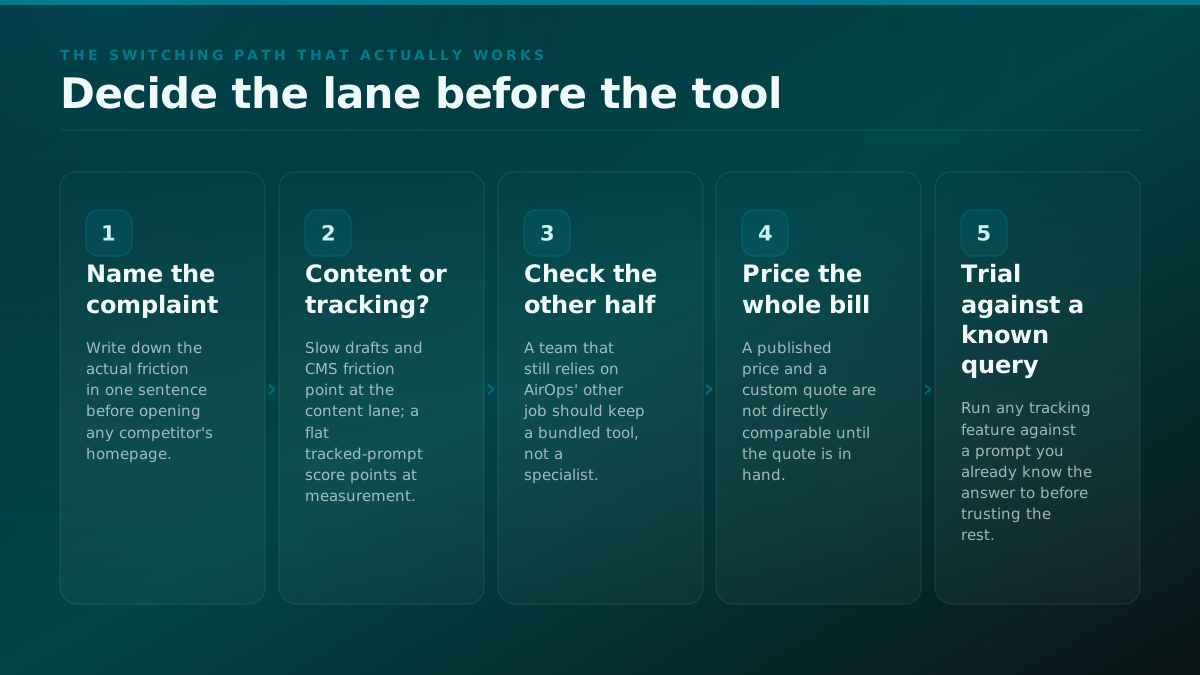
STEPS
How to figure out which lane your AirOps complaint is actually in
Write down the actual complaint in one sentence, before opening a single alternative's homepage
Step 1
Too slow to publish and the tracked-prompt number never moves are different complaints pointing at different halves of the product. Most teams skip this and end up comparing tools against a vague, blended complaint that no single tool actually answers.
Check whether the complaint is about output or about a number
Step 2
If the complaint is about drafts, templates, refresh speed, or CMS friction, the fix lives in the content-production lane. If it is about a tracked-prompt count, competitor visibility, or reporting depth, the fix lives in the measurement lane, whether that is a bundled feature or a dedicated tool.
Decide whether you actually use the half you are not complaining about
Step 3
A team unhappy with AirOps' content workflow but genuinely relying on its tracked-prompt view should look at Writesonic or Orchly, which keep both jobs bundled, rather than a content-only tool like ContentPen that would quietly drop the tracking half.
Price the replacement against the whole bill, not the headline number
Step 4
A 79 USD Writesonic Starter plan and a custom-quoted ContentPen plan are not directly comparable from the pricing page alone. Get an actual quote before assuming the unpublished option is cheaper or more expensive than the published one.
Run the new tool against a query you already know the answer to
Step 5
If the replacement includes any tracked-prompt feature, test it the same way you would test a dedicated measurement tool, against a query where you already know, from direct experience, whether your brand gets cited. A mismatch there is the first real signal about how much to trust the rest of the dashboard.
The five-step sequence above is deliberately front-loaded on the decision rather than the tool search, because the actual mistake most switching threads describe is not picking the wrong tool inside the right lane, it is skipping the lane decision entirely and picking whichever alternative showed up first in a Google search. Both Reddit threads cited throughout this post describe a version of that near-miss, one buyer who almost repeated the mistake by picking AirOps itself for the wrong job, and a second who avoided it only by reading reviews carefully before signing anything.
Where a tracker, bundled or dedicated, runs out either way
The honest limitation of this entire comparison is the same one that runs through every AI-visibility or AI-citation tool comparison on this site: naming which tool tracks a number better than another tool does not answer whether the number means anything about your own work. A team that picks the objectively best tracker in this comparison, by prompt count, platform coverage, or price, still cannot tell from that tool's dashboard alone whether a rising number reflects real progress, ordinary model-to-model variance, or the underlying model changing its own behavior for reasons unrelated to anyone's content. That question sits outside every product named in this post, AirOps and its alternatives alike, and answering it needs a held-out control run alongside whichever content or tracking tool a team keeps using.
The Reddit evidence behind this comparison is thin in volume and specific in kind, two real, dated, first-hand accounts rather than a large sample, which is stated here rather than papered over. What makes the topic worth a straight answer anyway is that both threads independently arrive at the same underlying insight this comparison makes explicit: AirOps is not one product being compared against a pile of interchangeable competitors, it is two products wearing one label, and the alternative that fits depends entirely on which one a buyer actually needed. A vendor listicle optimized to rank for the broadest possible version of this search has no reason to make that split explicit, since naming two separate buyer needs is worse for conversion than presenting one confident ranked list. An independent comparison has no such incentive, which is the entire reason this post is structured the way it is.
None of that changes with a bigger sample size, either. Even a comparison built from a hundred switching stories instead of two would still split along the same content-versus-tracking line, because the split is structural to what AirOps sells, not an artifact of a small evidence base. What a larger sample would add is confidence in the relative frequency of each complaint, not a different underlying answer, and this comparison is explicit that it has not measured that frequency, only that both failure modes are real and both are documented here with a named source rather than assumed from category logic alone.
The practical takeaway is short enough to fit in the time it takes to write down one sentence: name the actual complaint before opening a single competitor's pricing page, check whether that complaint sits in the content lane or the measurement lane, and only then start comparing tools inside that lane. Every other step in this comparison, the pricing table, the two-lane split, the tool-by-tool profiles, exists to make that one sentence easier to write correctly the first time, rather than after a trial period and a migration that turns out to have solved the wrong half of the problem.
For the broader argument on why a tracked-prompt score cannot prove causation on its own, see why a single AI-visibility score is noise. For a fuller comparison of dedicated measurement tools rather than content-bundled tracking features, see best AI visibility tools. For the checklist we use when a buyer sends us a pitch from a tool in this category, see our checklist for vetting an AI SEO agency. For the broader service this comparison points toward, see answer engine optimization, and for what a developer-tool or API buyer's own AI-citation questions tend to look like, see the questions developer tool buyers ask AI. Current pricing for a measurement engagement is scoped per engagement, for the same reason a control design cannot be sized without first seeing the query set it will run against.
Sources
Every number above, and where it came from. A figure without a row here is one we should not have printed.
- r/seogrowth, "Airops alternatives?" (u/uri3001)
- 3 upvotes, 20 comments, posted 2026-01-09, reverified live via a direct Reddit API pull 2026-08-20. A 50-employee startup evaluating AirOps for automated SEO and content, who ultimately picked trywonda.com in a self-edit to the post, "fully managed white glove service with customized workflows for content generation, refresh and monitoring." A separate top-level reply in the same thread names N8N as the alternative that worked for them after AirOps' setup friction and gated support pushed them off it.
- r/GrowthHacking, "Had an awful experience with an AEO tracking platform, what's a good alternative?" (u/Academic_Way_293)
- 12 upvotes, 25 comments, posted 2026-02-18, reverified live via a direct Reddit API pull 2026-08-20. The poster names Profound explicitly as the tracking tool they are leaving on poor support, says "I wanted to go with Airops at first but I saw several bad reviews, so now I'm leaning towards something like Promptwatch," and explicitly asks for "bonus points if it has content generation too, not just tracking," direct evidence of the two-lane buying decision this post is built around.
- LinkedIn, "airops alternatives" site-restricted search
- Saturates the 30-result cap, but with only 3 distinct authors within a 90-day window (via linkedin_demand.py, firecrawl.dev, never a scrape of linkedin.com itself), 2026-08-19, the narrowest author breadth of any candidate scored in the same radar pass, stated honestly as a thinner signal rather than smoothed into an equal-looking number.
- AirOps, own pricing page
- Live pricing tiers pulled directly, 2026-08-20. Insights plan free at 1 user, Solo plan free with 100 tracked prompts and pages, Pro/Pages/Enterprise all custom-quoted.
- AirOps, own homepage
- Self-description as "the growth platform for AI Search, Google, Gemini, Perplexity, Claude, ChatGPT," 2026-08-20. 20-plus customer logos shown including Webflow, Ramp, Notion, HubSpot and Amplitude; no total customer count published.
- Writesonic, own pricing page
- Live pricing tiers pulled directly, 2026-08-20. Starter at 79 USD a month tracking 50 prompts and 50 answers daily across ChatGPT, Gemini and Google AI Overviews, scaling to Growth at 399 USD a month with sentiment analysis and an Action Center trial.
- Our own research on what a tracked-prompt score can and cannot prove
- A held-out control, a set of queries deliberately left unworked, is the only design that separates a tool's reported number from the underlying model changing its own answers. Published with the method and the raw numbers on this site.
Questions this answers
- What are the best AirOps alternatives?
- On the content-production side, Writesonic, ContentPen, ContentMonk, Orchly, SlateHQ, Moonlit, and Aiken House are the names that rank directly for this search. On the pure-measurement side, a real buyer named Promptwatch after ruling out both Profound and AirOps. A technical team willing to self-host has named N8N as a lower-cost DIY route out of AirOps entirely.
- Is AirOps a content tool or a measurement tool?
- Both. AirOps' own pricing page lists AI content production alongside tracked prompts and pages starting on its free Solo tier, scaling to multi-engine tracking across Google, Perplexity, OpenAI, and Google AI Studio on its Pro plan. Most alternatives specialize in one job or the other rather than bundling both.
- Why do some AirOps alternatives switch threads talk about writing and others talk about tracking?
- Because AirOps sells two different jobs in one product, and a buyer's complaint usually points at only one of them. A thread about a clunky content workflow and a thread about a shallow tracking view are both real AirOps complaints, they just describe different halves of the same tool.
- How much do AirOps alternatives cost?
- Writesonic starts at 79 USD a month on annual billing for its entry tier. AirOps itself has a free Insights plan and a free Solo plan before its paid Pro tier, which is custom-quoted. Most of the smaller content-focused alternatives, ContentPen, ContentMonk, Orchly, SlateHQ, and Moonlit, do not publish a starting price and sell through a demo instead.
- Can a content tool's tracked-prompt feature prove content changes caused a citation increase?
- No. Proving cause needs a held-out control, a set of queries deliberately left unworked over the same period so a model's own drift can be separated from real change. No content-production tool with a bundled tracking feature, AirOps or Writesonic included, ships that kind of control alongside its dashboard.
- Does switching away from AirOps mean losing the tracked-prompt view too?
- Only if the replacement is a pure content tool like ContentPen or ContentMonk. Writesonic keeps a similar bundled shape to AirOps. A team that wants to keep tracking specifically after leaving AirOps' content side usually adds a dedicated tracker like Profound or Peec AI rather than expecting a content-only replacement to cover it.
- Where does trywonda.com fit into this comparison?
- A real 50-employee startup on Reddit named trywonda.com as the fully managed white-glove service they picked over AirOps after running product demos. It is included here because it is a genuine, first-hand switching destination, not because it independently ranks among the most-discussed names in this category the way Writesonic or Profound do.
- Is a 90-searches-a-month keyword even worth answering with a dedicated post?
- On raw volume alone, usually not, this sits below the 100-a-month threshold this site treats as a confident demand signal, and that is disclosed here rather than hidden. What earns it a straight answer is the evidence behind the number, two real, dated Reddit switching accounts naming four real destination tools between them.
- Why do most of the top-ranking pages for "airops alternatives" look like advertisements?
- Because seven of the ten live results are AirOps' own direct competitors, each running a page built to capture exactly this switching-intent search, and one more is AirOps' own site. Only Reddit and G2 sit outside that self-interested set, which is why this comparison leans on real buyer threads rather than another vendor's own framing of its competitive set.
- What does switching from AirOps actually cost beyond the new subscription?
- Two costs that rarely show up on a pricing page. First, paying for capability on the half of AirOps a team never used, a content allowance on a tracking-only account or a tracking allowance on a content-only account. Second, the time spent evaluating a replacement carefully enough to avoid picking a tool built for the wrong job.
Keep reading
Measurement
Best AI Visibility Tools (and Where a Tool Alone Runs Out)
Seven AI-visibility tools compared on what they actually measure and what they cost, plus the one question none of them can answer on their own.
24 min read
Measurement
Profound Alternatives: What Teams Actually Switch To (and Why)
Five real alternatives to Profound compared on what they track and what they cost, built from the actual switching threads where teams explain why they left.
23 min read
Measurement
Prompt Tracking, How Many Prompts and How Many Repeats Before a Change Is Real
Every page ranking for prompt tracking says how to pick prompts. None says how many, or how many repeats, before a weekly change stops being noise.
44 min read