Best AI Visibility Tools (and Where a Tool Alone Runs Out)
Seven AI-visibility tools compared on what they actually measure and what they cost, plus the one question none of them can answer on their own.
Citon24 min read
Short answer
What are the best AI visibility tools?
The most-cited AI visibility tools right now are Profound, Peec AI, AthenaHQ, Otterly.AI, Ahrefs Brand Radar, Semrush AI Toolkit, and Scrunch AI, each tracking how often a brand gets named across ChatGPT, Perplexity, Gemini, and Google AI Overviews on a repeated set of prompts. Prices range from 29 USD a month for a self-serve tracker to 500 USD a month and up for a multi-brand monitoring platform. Every one of them reports a number, but none of them, on its own, can tell you whether a rising number was caused by anything you did or by the underlying model changing its own answers. That separation needs a held-out control, a set of queries deliberately left untouched, and no AI visibility tool on the market ships one.
Type "ai visibility tools" into Google today and four of the top ten results are horizontal SEO or automation-tool vendors ranking their own AI-visibility feature above everyone else's, two more are AI-visibility tools ranking their own comparison page against their direct rivals, and one is a marketing agency's own roundup written for the same reason every agency writes one, to rank for a term its prospects already search. None of the current top ten is written by a party that runs AEO execution work and has no product or service in the category to protect. That gap is not an accident of one search term, and the buyers showing up in r/SEO already feel it, naming Profound and Athena HQ by name in the same breath they ask what else is actually worth running, a question a self-interested listicle is structurally unable to answer honestly.
This post is a real comparison, not a hedge dressed as one. Seven tools, what each is actually built to measure, what each costs, and, more importantly, the one question none of them can answer on their own: whether a rising number was caused by anything a buyer did, or by the underlying model changing its own behavior for reasons that have nothing to do with anyone's work. We build measurement designs that answer that second question for a living, which is exactly why this post spends more time on the gap than on the leaderboard.
It is also worth being direct about what "best" can and cannot mean here. There is no independent, tool-agnostic benchmark that scores these seven products against each other on accuracy, because accuracy would require checking each tool's reported citation rate against a ground truth nobody outside the model providers themselves can see in full. What follows instead is a comparison of what each tool claims to do, what it costs, and where the claim runs out, built from what real buyers say about using them rather than from a vendor's own feature grid.
At a glance
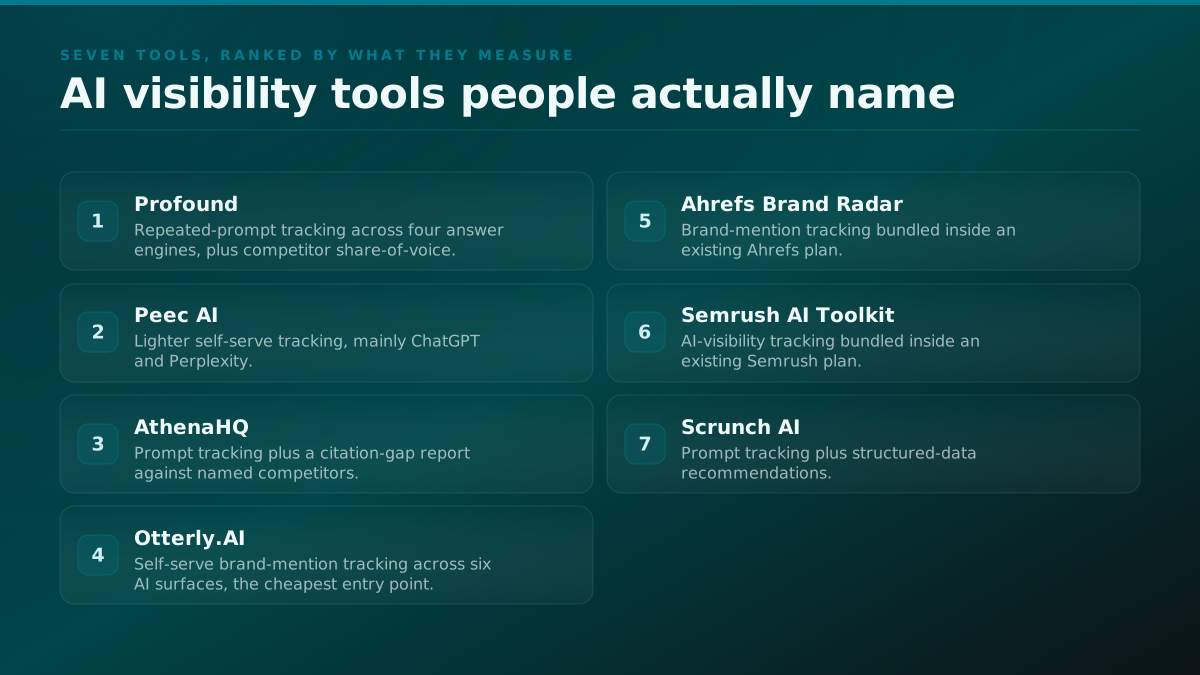
Seven tools people actually name, ranked by what they measure
| Tool | What it is built to do |
|---|---|
| Profound | Repeated-prompt citation tracking across ChatGPT, Perplexity, Gemini, and AI Overviews, with competitor share-of-voice. |
| Peec AI | Lighter-weight self-serve prompt tracking, mainly ChatGPT and Perplexity. |
| AthenaHQ | Prompt tracking plus a citation-gap report showing which competitors get cited on queries you do not. |
| Otterly.AI | Self-serve brand-mention tracking across six AI surfaces, the cheapest entry point in the category. |
| Ahrefs Brand Radar | Brand-mention tracking layered onto Ahrefs' existing keyword and backlink data. |
| Semrush AI Toolkit | Prompt tracking plus a content-gap view tied to Semrush's keyword database. |
| Scrunch AI | Prompt tracking plus structured-data recommendations aimed at machine-readability. |
The seven tools people actually name
Across the Reddit threads, the X comparison threads, and the LinkedIn discussion cited throughout this post, the same seven names keep showing up. This is not every AI-visibility tool that exists, and new entrants appear in this category most months. It is the set real practitioners are actually naming when they talk about what they run, which is a more useful filter than a vendor's own list of "competitors we beat."
Profound. The most-cited name in this category, and the one with the deepest feature set: repeated-prompt tracking across ChatGPT, Perplexity, Gemini, and Google AI Overviews, plus a competitor share-of-voice view that shows who else gets cited on the same query set. Its published pricing starts at 500 USD a month for a single-brand plan and scales past 5,000 USD a month for an enterprise dashboard covering multiple brands with unlimited prompt volume. That top-end figure is not published on a self-serve page; it is a realistic market estimate for the enterprise tier, consistent with the depth of the platform and the sales-call gate most vendors put in front of that tier. Buyers who get quoted a number well above 500 USD a month on a first call are usually being priced into the multi-brand or agency-seat tier rather than the single-brand entry plan the published figure describes, and it is worth asking directly which tier a quote actually reflects before comparing it to anything else on this list.
Peec AI. The lighter-weight, more self-serve entry point in the category, focused mainly on ChatGPT and Perplexity rather than the full four-surface spread Profound covers. A single-brand plan starts around 90 USD a month, a realistic estimate rather than a published figure, positioned between Otterly.AI's bare tracking and Profound's full platform. Teams choosing Peec AI over Profound are usually trading competitor-share depth for a lower monthly bill and a simpler setup, a reasonable trade for a single-brand team that has not yet built a case for the larger spend.
AthenaHQ. Prompt tracking with a specific second feature: a citation-gap report showing exactly which competitors get cited on the queries a brand is losing, rather than showing the brand's own score in isolation. Pricing starts around 300 USD a month for a single-brand plan, another realistic market estimate for a tier that is not published as a self-serve checkout price. The competitor-gap view is the reason AthenaHQ shows up in comparison threads next to Profound rather than next to the cheaper self-serve trackers; it answers a different, more actionable question than "are we mentioned."
Otterly.AI. The cheapest real entry point in the category, and the only one of the seven with a fully published, self-serve starting price, 29 USD a month for brand-mention tracking across ChatGPT, AI Overviews, AI Mode, Gemini, Perplexity and Copilot. It does one job, tracking, and does not claim to do more. For a founder or a solo marketer who wants a real number before committing to anything larger, it is the lowest-friction way to get one.
Ahrefs Brand Radar. Not a standalone AI-visibility product; a brand-mention tracking feature bundled inside Ahrefs' existing SEO platform, layered onto the same domain's keyword and backlink history a team already has if it already pays for Ahrefs. Its starting price is the price of the Ahrefs plan it ships inside, 129 USD a month for the entry Lite tier. The advantage is context a standalone tracker cannot offer on its own, a brand mention sitting next to the same domain's organic-ranking history in one dashboard rather than two.
Semrush AI Toolkit. The same bundling pattern as Ahrefs, from Semrush: AI-visibility tracking added to an existing Semrush plan, tied to the same keyword database a team already has if it already pays for Semrush. Its starting price is the entry Semrush plan, 139.95 USD a month. Semrush's own AI Toolkit page is one of the four horizontal-vendor listicles ranking for this exact search term, which is worth knowing before treating its comparison table as neutral.
Scrunch AI. Prompt tracking paired with structured-data recommendations, the one tool in this set that ships a remediation checklist alongside the tracking score rather than stopping at the number. Pricing starts around 500 USD a month for a single-brand plan, scaling into the low thousands for multi-brand enterprise coverage, both realistic market estimates for a tier sold through a sales call. The schema-focused remediation angle makes Scrunch the closest thing on this list to a tool that tells a buyer what to do next, rather than only what the current score is.
Seven AI visibility tools compared
| Tool | Starting price | What it tracks | Best for |
|---|---|---|---|
| Otterly.AI | 29 USD a month | Brand-mention tracking across ChatGPT, AI Overviews, AI Mode, Gemini, Perplexity and Copilot. | A team that wants a real number before committing budget to anything larger. |
| Peec AI | 90 USD a month | Prompt-based tracking, mainly ChatGPT and Perplexity. | A single-brand team that does not need multi-market coverage yet. |
| AthenaHQ | 300 USD a month | Prompt tracking plus a citation-gap report against named competitors. | A team that wants to see who is winning the queries it is losing. |
| Semrush AI Toolkit | 139.95 USD a month | AI-visibility tracking bundled inside an existing Semrush plan, tied to its keyword database. | A team already paying for Semrush that wants one more report, not a new vendor. |
| Ahrefs Brand Radar | 129 USD a month | Brand-mention tracking bundled inside an existing Ahrefs plan, layered onto backlink and keyword history. | The same case as Semrush, for a team standardized on Ahrefs instead. |
| Profound | 500 USD a month | Repeated-prompt citation tracking across four major answer engines with competitor share-of-voice, scaling past 5,000 USD a month for multi-brand enterprise coverage. | A team with real budget that wants the most-cited tool in the category and the deepest competitor view. |
| Scrunch AI | 500 USD a month | Prompt tracking plus structured-data recommendations aimed at making a page more machine-readable, scaling into the low thousands for multi-brand plans. | A team that wants the tracking number paired with a remediation checklist rather than a bare dashboard. |
Reading the table straight through, a pattern shows up that the individual product pages do not surface on their own: the two cheapest options in the category, Ahrefs Brand Radar and Semrush AI Toolkit, are not dedicated AI-visibility products at all. They are a feature added to a platform a buyer likely already owns for an unrelated reason, which changes the actual decision for a lot of teams from "which AI-visibility tool should we buy" to "does the feature we already have access to answer the question."
The category also has not settled on a single name for itself, which shows up in the raw language of the Reddit threads cited throughout this post: the same buyers alternate between "AI visibility," "GEO," "AEO," and, in at least one thread, whether a tool is measuring visibility at all rather than bot-crawler traffic that happens to look similar in a dashboard. A vendor selling into a category that has not agreed on its own vocabulary has an easier time selling a vague promise, since a buyer who is unsure what the term even means is in a weaker position to ask a specific, checkable question about what a tool actually does. The comparison table above is built around what each tool does mechanically rather than around whichever label its own marketing page prefers, specifically to route around that confusion.
What actually ranks for "ai visibility tools" right now?
Mostly self-interested pages, not independent comparisons: horizontal SEO vendors, one of the AI-visibility tools itself, and an agency, each with a reason to describe the category in a way that favors its own position.
What actually ranks for "ai visibility tools" right now
| Result type | Count in top 10 | Independent of vendor self-interest |
|---|---|---|
| Horizontal SEO or automation-tool vendor's own listicle | 4 | No |
| AI-visibility tool's own comparison page | 2 | No |
| Marketing agency's own listicle | 1 | No |
| SEO or marketing education blog | 2 | Partially, no financial stake in this specific category |
| Independent execution-agency comparison | 0 | N/A |
Four of the top ten results are horizontal SEO or automation-tool vendors, Semrush, SE Ranking, Frase, and Zapier among them, ranking a page about their own AI-visibility feature or an AI-visibility-adjacent workflow. Zapier's entry approaches the category from the automation angle it already owns, a round-up aimed at readers who found the term through a workflow search rather than a citation-measurement one. Frase and SE Ranking both fold the topic into their existing AI-content and SEO-platform marketing, the same pattern Semrush's own AI Toolkit page follows.
Two more are AI-visibility tools themselves, one of them Profound, publishing a "best AI visibility tools" comparison that, unsurprisingly, ranks their own product first. One is a marketing agency's own listicle, the same move any agency makes to rank for a term its own prospects are typing, structurally no more neutral than a tool vendor's page even though it is not selling software directly. Two are marketing or SEO media outlets, closer in spirit to independent coverage since neither sells a product in this specific category, but still written from a research-and-report posture rather than from having actually run execution work against these tools' own reported numbers and watched what moved a real citation count and what did not. Zero of the ten is written by a party whose business is proving whether AEO work caused a change, rather than selling a way to watch the number.
Google's AI Overview also fires on this exact query, in four of five separate trials we ran against it, with a median of nine references shown when it does fire. Nine references is a wide answer box by the standard of this category, meaning a page that earns a citation here is sharing the spotlight with roughly eight other sources rather than standing alone, and the AI Overview itself is a second, separate audience from the ten organic results above it, with its own selection logic that a page has to satisfy independently of ranking well in blue-link search. A structured, extractable comparison, the kind G2 buyers already rely on for a second layer of unsponsored opinion, is a closer fit for that selection logic than another vendor listicle.
Why the price range itself is a signal
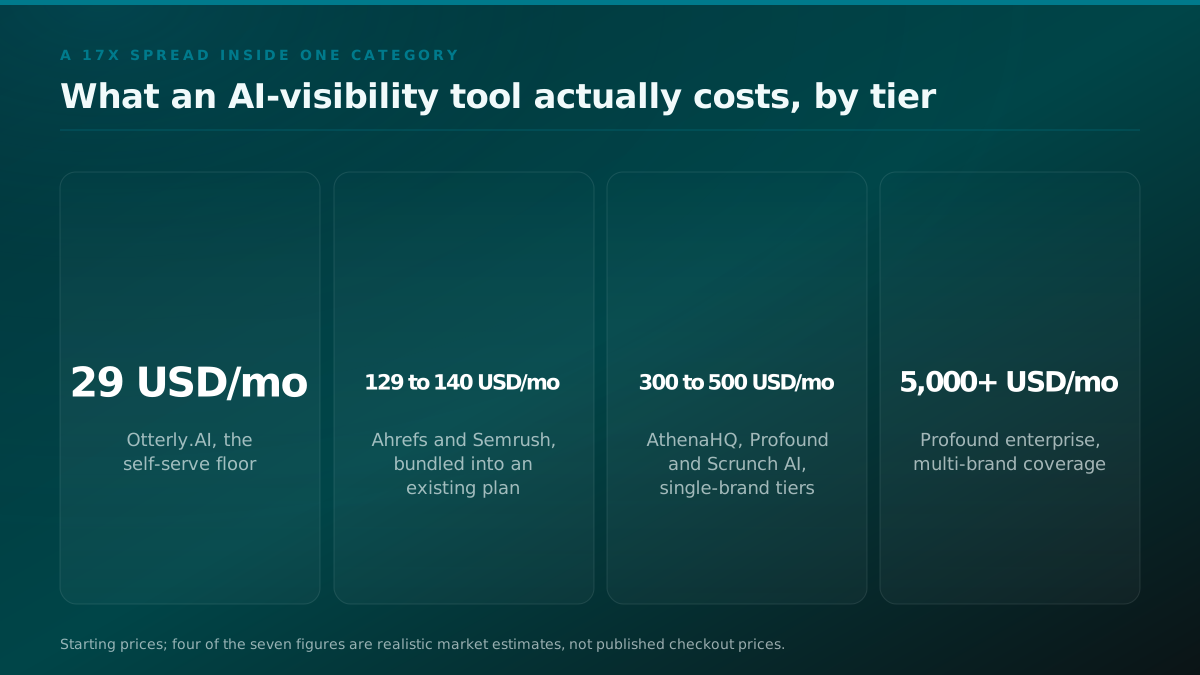
The gap between the cheapest and most expensive tool in this comparison is roughly 17x, from Otterly.AI's 29 USD a month to Profound's enterprise tier past 5,000 USD a month. That is not seven tiers of the same product. It is closer to two different products wearing the same category label, and a buyer who treats the whole spread as one continuous ladder is likely to either overpay for depth they do not need or underbuy the competitor view a real evaluation requires.
From the field
A 17x price range inside one product category is a sign the category has not settled what it is selling
Otterly.AI's published pricing starts at 29 USD a month. Profound's enterprise dashboard scales past 5,000 USD a month. Both products answer a version of the same question, how often does a prompt mention this brand, at different depths of competitor detail and multi-market coverage. A buyer comparing the cheapest and most expensive options in this category is not comparing two tiers of the same purchase; they are comparing a personal alert system against a monitoring platform built for a marketing team, and conflating the two is one of the more common ways a vendor's own comparison page inflates the perceived gap between the free-tier competitor and itself.
A 29-USD-a-month tracker gives one person, usually a founder or a solo marketer, a real number to check weekly. A 5,000-USD-a-month platform gives a marketing team a competitor view across multiple brands with unlimited prompt volume, the kind of feature set a buyer only needs once they already have a budget line and a team to act on what the number says. Reading a vendor's own comparison page, the cheaper tool in that page's table is usually there to make the vendor's own mid-tier plan look proportionate by contrast, not because the two products are actually solving the same problem at different price points. The honest version of that comparison is the one above, priced against what each tool is actually built to do rather than against a competitor a vendor chose to look better next to.
The vocabulary problem that comes before the tool problem
Before comparing tools, a buyer has to know whether a "visibility" number is measuring a real citation or something adjacent to it, because the two get sold under the same label.
Ahrefs' own CMO, publicly, on a platform where the company sells one of the seven tools in this comparison, has pointed out that most AI-visibility tools can be gamed by cherry-picking which prompts get tracked. That is a specific, checkable claim, and it is the single most important question to ask before comparing price at all: can you see the full, unfiltered list of prompts a tool is tracking, or only a curated sample the vendor chose to show?
The moment a dashboard lets you choose which prompts it tracks, it stops being a measurement and starts being a highlight reel.
A dashboard that lets a vendor pick favorable prompts is not lying, exactly. It is answering a narrower question than the one a buyer thinks they are asking. "How often are we cited" and "how often are we cited on the specific prompts this tool chose to track" are different claims, and only one of them is checkable by a buyer who cannot see the underlying prompt list. In practice this shows up as a demo that tracks five or six queries where a brand already performs well, presented as representative of the brand's overall AI visibility, when a fuller query set pulled from actual buyer research would tell a less flattering story. A buyer running the free-trial-against-a-known-query test later in this post is checking exactly this failure mode.
What can't these seven tools tell you?
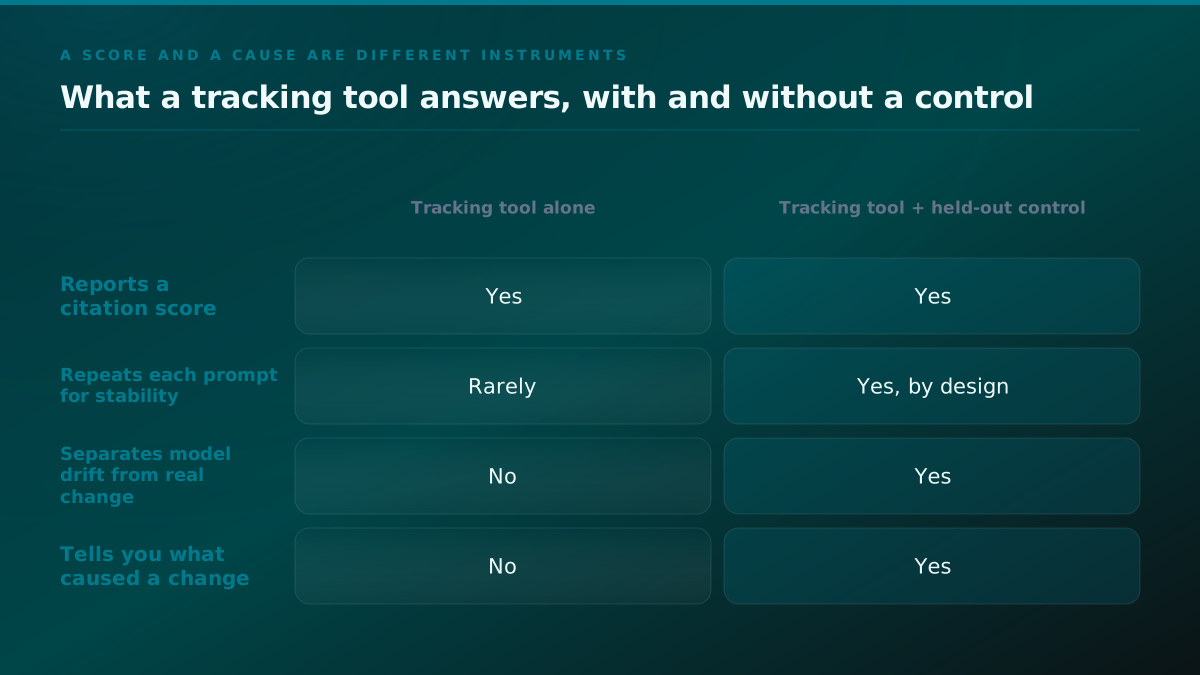
None of them, on their own, can tell a buyer whether a rising score was caused by anything the buyer did rather than by the underlying model changing on its own.
What a rising AI-visibility score cannot tell you on its own
| Question a buyer actually has | Can a tracking tool answer it alone? |
|---|---|
| Are we getting cited more often this month than last month? | Yes, this is the one thing every tool in this category does well. |
| Did our work cause that change, or did the model change its own behavior? | No. This needs a held-out control, queries deliberately left unworked over the same period. |
| Which competitor is winning the queries we are losing? | Partially. Profound, AthenaHQ and Scrunch report a competitor view; the cheaper self-serve tools mostly do not. |
| What should we actually change to move the number? | Rarely. Scrunch ships structured-data suggestions; most tools stop at the score. |
Every tool in this comparison does the same thing well: it reports a number.
From the field
A model can change its own answer with zero work from anyone
Our own step-zero measurement ran 12 money queries, five identical repeats each, against one model, on one day. 60 of 60 calls succeeded. 7 of the 12 queries flipped which brand got cited across repeats that were, by construction, identical inputs. A separate permutation test ran 20,000 random splits of that same query set with no intervention applied at all, and the null difference centered on zero, mean plus or minus 0.0016, standard deviation 0.215. No tool in this category discloses a comparable volatility check for its own reported score, which means a buyer reading a rising number from any of these dashboards has no way to know how much of that rise is signal and how much is the same noise floor we measured directly.
Citon, step-zero measurement, published with the raw numbers
A tool that shows you a rising number and a tool that shows you what caused it are not the same product, and every vendor in this category currently sells the first one.
The reason is structural, not a gap any of the seven vendors happened to miss. A repeated-prompt score, on its own, cannot distinguish three different causes for a change: real progress from work a team actually did, ordinary variance in how the underlying model answers the same prompt on different days, and the model provider changing its own behavior for reasons that have nothing to do with any single brand. Separating those three requires a comparison group, a held-out set of queries deliberately left unworked over the same period, so whatever the model did on its own can be subtracted from whatever the tracked queries show. None of the seven tools above ships one, and none of the vendor pages ranking for this search term mentions the concept at all.
How these tools actually decide what counts as a citation
The mechanics matter more than the marketing pages let on. A prompt gets sent to a model, the response gets scanned for a brand name or a link, and a hit or a miss gets logged. Do that once per prompt and the resulting number is closer to a coin flip on a noisy day than a measurement, which is exactly what our own step-zero run demonstrated: the same twelve queries, run five times each with nothing else changed, flipped outcome on seven of them. A tool that runs each tracked prompt only once per reporting period is reporting one sample from a distribution that has real spread, and presenting it as a stable score.
The tools that repeat prompts multiple times per cycle, which several of the seven above do at least partially, are closer to a defensible measurement, but repeating a prompt still only tells a buyer about variance within that tool's own tracking run. It does not tell a buyer whether the average across those repeats moved because of anything the buyer did, which is the same causal gap a single-pass tool has, just with a steadier number sitting on top of it. This is the distinction the Reddit thread above is actually asking about when it separates "AI visibility tracking" from "bot traffic analytics": one measures whether a crawler visited a page, the other is supposed to measure whether a model's generated answer named a brand, and a dashboard that blurs the two is measuring something closer to the first while marketing itself as the second.
Sample size compounds the problem in a direction most buyers do not think to check. Twelve queries repeated five times, the size of our own step-zero run, is already a small design by the standard of a real experiment, and it still produced a 51.1 percentage point minimum detectable lift, meaning a true effect smaller than that could sit invisibly inside the noise and never register as a change at all. A dashboard tracking fifty or a hundred prompts once each per week, the shape most of the seven tools above actually ship, has a different failure mode than under-sampling, it has no repeat structure to measure its own noise floor against in the first place. The number it reports is not wrong, exactly. It is a single draw from a distribution the tool never shows a buyer, presented as if it were the distribution's center.
What actually moves a citation, independent of which tool tracks it
A tracking tool answers whether a citation happened. It does not, on its own, explain why one page gets named and a near-identical competitor page does not, and every one of the seven vendors above is selling the tracking half of that question rather than the explanatory half. The factors that do correlate with getting cited are not exotic: a direct, extractable answer near the top of a page rather than buried under three sections of throat-clearing, structured data that tells a crawler what kind of content it is looking at, a publish or update date recent enough that a model weighting freshness has a reason to prefer the page, and language that states a claim plainly rather than hedging it into something a model has to interpret rather than quote. None of that shows up in any of the seven dashboards above, because none of them is built to audit a page, only to check whether a prompt result mentions a brand.
Scrunch AI is the closest of the seven to closing that gap, since its structured-data recommendations sit adjacent to the actual fix rather than only the symptom. Every other tool in this comparison stops at the score and leaves the "so now what" question to whoever reads the dashboard, which is a reasonable design choice for a tracking product and a real limitation for a buyer who assumed tracking and remediation were the same purchase.
There is also a cost side to the sampling question worth naming plainly. Repeating every tracked prompt five times instead of once is five times the API spend for whichever model the tool is querying, and a vendor pricing a plan around a fixed prompt-tracking volume has a direct financial incentive to keep the repeat count low. That incentive is not evidence any of the seven tools above is cutting corners deliberately, but it is a real structural pressure pointing away from the more defensible measurement design, and it is one more reason the question "how many times do you run each prompt, and is that visible to me" belongs in the first conversation with a vendor rather than discovered later from a support ticket.
Where does a tool alone run out?
A tracking dashboard runs out exactly at the boundary between reporting a score and explaining what caused it, and for a developer-tools or API buyer specifically, that boundary shows up sooner than the vendor pages let on.
A "best AI visibility tools" ranking written by one of the tools in it is not a comparison. It is a sales page wearing a listicle's clothes.
This is the honest answer to why this post is not simply "here is our own product, ranked first." A tool that tracks a number and a measurement design that can explain the number are two different things, and most of this category still only sells the first one. For a developer-tools or API company specifically, the gap is sharper than it looks from the outside: the buyers researching a product like that are reading documentation, package registries, and technical comparison threads other developers wrote, a different citation surface than the review-heavy, local-business-shaped queries most of these seven tools were originally built to track. A rising score on a general "AI visibility" dashboard does not automatically mean the queries that matter to a developer-tools buyer are the ones moving.
The practical version of this gap shows up in the default prompt sets most of these tools ship with. A trial account on any of the seven above tends to arrive pre-populated with consumer or local-business-shaped example prompts, "best CRM software," "top accounting tool for small business," the kind of query a general SEO team recognizes immediately. A developer-tools buyer has to replace that default set almost entirely with the queries their own users actually type into an AI assistant, comparison prompts phrased the way a developer phrases them, "does X have a rate limit on the free tier," "is X SOC 2 compliant," "X vs Y for a Node backend." A dashboard reporting a healthy score against the wrong default set is not lying, it is answering a question nobody researching a developer tool actually asked, and a buyer who does not replace the prompt list before trusting the score is comparing against the wrong baseline from the first day of the trial.
The same substitution matters on the citation-surface side, not only the prompt side. A model answering a consumer question about a local service business often leans on review sites and directory listings, the surface most of these tools were originally tuned against. A model answering a developer's question is more likely pulling from documentation, a GitHub README, a package registry description, or a technical comparison thread another developer wrote, none of which look anything like a review-site listing. A tool built and tested against the first surface does not automatically transfer its accuracy to the second one, and a buyer evaluating any of the seven products above for a developer-tools use case should ask directly whether the vendor has tuned or validated the tool against documentation-shaped citations specifically, rather than assuming general AI-visibility competence covers it.
STEPS
How to evaluate an AI-visibility tool in a week, not a quarter
Ask what prompts it tracks, and whether you can see the full list
Day 1
A tool that lets a vendor cherry-pick which prompts get tracked can manufacture a flattering number. Ask for the full, unfiltered prompt list before signing, not a curated sample.
Run the free trial against a query you already know the answer to
Days 2 to 3
Pick a query where you already know, from direct experience, whether your brand gets cited. If the tool's number disagrees with what you actually see when you run the prompt yourself, that is the first real signal about accuracy.
Ask whether it repeats the same prompt more than once
Day 4
A single pass per prompt cannot distinguish a real change from ordinary model-to-model variance. Ask whether the tool re-runs prompts and how many times, and whether that repeat count is visible to you or just baked into a single reported score.
Decide whether you need tracking or remediation
Days 5 to 7
A tracking tool tells you the score. A remediation tool, or an agency, tells you what to change. Most buyers in the Reddit threads cited throughout this post were frustrated by paying agency prices for what turned out to be tracking-tool functionality.
The evaluation sequence above is deliberately short, a week rather than a quarter, because most of what separates a real measurement instrument from a flattering dashboard shows up in the first few days of actually using one, not in a longer trial that mostly just confirms the first impression. A vendor whose demo already answers all four questions cleanly, a visible full prompt list, a trial that lets you run a known query, a disclosed repeat count, and a real answer to what happens when the number stalls, is worth taking seriously regardless of which tier it sits in. A vendor whose sales team redirects the conversation the moment any one of those four questions comes up is telling you something about the product before you have spent a dollar on it.
A very small team, one or two people with no dedicated marketing function, can reasonably skip this evaluation sequence entirely and start with whichever self-serve tracker is cheapest, since the cost of being wrong about tool choice at that scale is a few dollars a month rather than a mis-scoped budget line. The sequence earns its keep once a team is choosing between two or more paid tiers, or between a tool subscription and an agency retainer that costs meaningfully more, which is exactly the decision most of the Reddit threads cited throughout this post describe buyers making badly.
Three ways to buy into this category, ranked
The category resolves into three real tiers, priced roughly at 29 USD a month, 100 to 500 USD a month, and a measurement engagement priced per query set, each answering a different version of "is this working."
01 / A self-serve tracker
- Stands out
- Cheap, immediate, and gives you a real number to check weekly, from around 29 USD a month.
- Best for
- A team that wants to know whether it is cited at all, with no budget or intent to run active work yet.
- Falls short
- Reports a score with no comparison point and, in most cases, no visible list of what prompts produced it.
02 / A mid-market monitoring platform
- Stands out
- Adds a competitor view and, in some cases, remediation suggestions, at 100 to 500 USD a month.
- Best for
- A marketing team that already knows it wants ongoing visibility and needs to report a number upward.
- Falls short
- Still reports a score, not a cause. None of the platforms in this tier ship a held-out control.
03 / A measurement partner that runs a held-out control
- Stands out
- The only option here where a rising or flat number is actually interpretable, because a real comparison group exists.
- Best for
- A team spending enough, on tooling or on execution work, that "did this work" needs a defensible answer.
- Falls short
- Costs more than a self-serve tool and takes longer to produce a result, since a real control design has to run before it produces a number worth trusting.
None of the three tiers above is wrong for every buyer. A solo founder checking whether their product gets mentioned at all is well served by a 29-USD-a-month tracker, and paying more than that for a competitor-share dashboard they will not act on is money spent on a feature they cannot use yet. A marketing team that already knows it needs a competitor view and a reporting number for a monthly update is well served by a mid-tier platform, and the extra cost buys real functionality, not just a bigger logo on the invoice. The gap only shows up for the team spending real budget, on tooling, on execution work, or on both, that needs an answer to whether any of it actually worked, and a subscription to a tracking dashboard, at any of the seven price points above, was never built to give that answer.
Moving between tiers is also not a one-way ratchet. A team that starts on a self-serve tracker and later signs an AEO retainer or brings on a measurement partner does not need to abandon the original tool, since the tracking subscription and the held-out control answer different questions and both numbers are more useful read together than either is alone. The mistake worth avoiding is treating a jump from tier one to tier three as an upgrade of the same product, when it is closer to adding a second, structurally different instrument next to the first one.
Budget conversations inside a marketing team also tend to compare the wrong two numbers when this category comes up. A 500-USD-a-month monitoring platform gets weighed against a 4,000-USD-a-month agency retainer as though they compete for the same line item, when the monitoring subscription reports a score and the retainer is supposed to move it, two different jobs that only look interchangeable if nobody has asked either vendor what specifically it delivers. Separating "what does this cost" from "what does this actually produce" before comparing two options across tiers avoids the more common version of this mistake, paying agency prices for tracking-tool functionality, or paying tracking-tool prices and expecting agency-level remediation.
The same confusion appears in reverse when a team already running a paid execution engagement asks whether it still needs a tracking subscription on top of it. Usually yes, and for a reason that has nothing to do with distrust of the agency doing the work: a party running the execution has a structural incentive to read its own results generously, and an independently sourced tracking number, even a cheap one, gives a second, less interested read on the same question. The two purchases are not redundant with each other; they check each other.
Four independent channels corroborate that this comparison is describing the category most practitioners actually see, not a narrow slice of it: the Reddit threads asking which tools people run day to day, the vendor comparison video naming the same seven tools by name, an Ahrefs executive publicly discussing the category's own measurement weaknesses, and a LinkedIn search on the exact phrase saturating its result cap across 23 distinct authors inside 90 days rather than one vendor's own repeated posting. That kind of agreement across four differently biased sources is closer to a real signal than any single one of them would be alone, which is the same logic a held-out control applies to a citation score, checking a claim against more than one instrument before trusting it, and it is why this comparison leans on real buyer language throughout rather than on any single vendor's own framing of the category.
The buyers in the Reddit threads cited throughout this post are not confused about whether these tools work. They are confused about what "working" actually measures, and a comparison table that only lists price and feature checkboxes does not answer that question. A held-out control does, which is the entire reason a rising number and a caused number are worth telling apart before anyone signs a contract based on either one.
For the fuller argument on why a tool's own reported score cannot prove causation on its own, see why a single AI-visibility score is noise. For the checklist we use when a buyer sends us a pitch from one of these seven vendors, see our checklist for vetting an AI SEO agency. For the broader service this comparison points toward, see answer engine optimization, and for what a developer-tool or API buyer's own AI-citation questions tend to look like, see the questions developer tool buyers ask AI. Current pricing for a measurement engagement is scoped per engagement, for the same reason a control design cannot be sized without first seeing the query set it will run against.
Sources
Every number above, and where it came from. A figure without a row here is one we should not have printed.
- r/SEO, "AI Tools you're actually using for SEO"
- 86 upvotes, 118 comments, 2026-08-19 (topic-radar pull). Names Profound and Athena HQ as the AI-visibility tools the poster already knows, then asks what else practitioners are actually running day to day.
- r/SEO, "AI visibility tracking VS. bot traffic analytics"
- 2026-08-19 (topic-radar pull). Names Peec AI and Profound by name and asks a methodology question that most buyers cannot answer on their own, whether a "visibility" number is measuring citations or just crawler traffic.
- r/SEO, "Do geo tools actually [move] visibility in ai answers?"
- 2026-08-19 (topic-radar pull). Names Profound and asks whether GEO platforms measure the thing they claim to move, or simply display a score without proving it.
- @timsoulo (Ahrefs CMO, 52.9k followers) on X
- 90 favorites, 2026-08-19 (topic-radar pull). A substantive thread on why most AI visibility tools can be gamed by cherry-picking which prompts get tracked, directly relevant to comparing tools rather than trusting any single dashboard number.
- @ReachLLM on X, head-to-head tool comparison
- 2026-08-19 (topic-radar pull). Names Profound, Peec AI, Otterly.AI, Semrush, Ahrefs, and Athena HQ by name in a direct comparison video, evidence the category has consolidated around this specific tool set.
- @gaganghotra_ on X, "AI Visibility Tool Red Flags in 2026"
- 2026-08-19 (topic-radar pull). Nine named warning signs for a buyer evaluating an AI-visibility dashboard before paying for one.
- LinkedIn, "ai visibility tools" site-restricted search
- Saturates the 30-result cap with 23 distinct authors within a 90-day window (via linkedin_demand.py, firecrawl.dev, never a scrape of linkedin.com itself), 2026-08-19. Real breadth across practitioners, not one vendor's own repeated posting.
- Otterly.AI, self-serve AI-visibility monitoring pricing
- Published pricing starting at 29 USD a month for a self-serve tool that tracks brand mentions and citations across ChatGPT, AI Overviews, AI Mode, Gemini, Perplexity and Copilot.
- Our own research on what an AI-visibility score can and cannot prove
- A held-out control, a set of queries deliberately left unworked, is the only design that separates a tool's reported number from the underlying model changing its own answers. Published with the method and the raw numbers on this site.
Questions this answers
- What is an AI visibility tool?
- A product that repeatedly sends a set of prompts to AI answer engines, ChatGPT, Perplexity, Gemini, and Google AI Overviews among them, and reports how often a given brand gets named or cited in the responses. It is a tracking instrument, not a tool that changes the outcome on its own.
- What are the best AI visibility tools?
- The tools named most consistently by real buyers, across Reddit threads and vendor comparisons, are Profound, Peec AI, AthenaHQ, Otterly.AI, Ahrefs Brand Radar, and Semrush AI Toolkit. Each does the same core job, repeated-prompt tracking, at different depth and price.
- How much do AI visibility tools cost?
- From 29 USD a month for a self-serve single-brand tracker (Otterly.AI) up to 500 USD a month and beyond for a multi-brand monitoring platform (Profound, Scrunch AI). Tools bundled inside an existing SEO suite, Ahrefs and Semrush among them, add AI-visibility tracking to a plan already starting around 130 to 140 USD a month.
- Can an AI visibility tool prove its work caused a citation increase?
- No tool in this category ships a held-out control, a set of queries deliberately left unworked over the same period so the model's own drift can be separated from real change. Without that comparison, a rising number could reflect improved tracking, the model changing on its own, or genuine progress, with no way to tell which from the score alone.
- Is Ahrefs or Semrush an AI visibility tool?
- Both have added AI-visibility or brand-mention tracking features to their existing SEO platforms rather than launching as dedicated AI-visibility products. For a team already paying for either suite, the bundled feature is a reasonable starting point; a team with no existing subscription usually gets more AI-visibility-specific depth from a dedicated tool like Profound or Peec AI.
- Do I still need an agency if I already use an AI visibility tool?
- A tracking tool answers "are we cited," not "what should we change" or "did our work cause this." A team running active AEO work, content changes, schema updates, or citation-focused publishing, still needs a way to separate that work's effect from ordinary model variance, which is a measurement design question a dashboard subscription does not answer on its own.
- Why do most "best AI visibility tools" articles look like advertisements?
- Because most current top-ranking results for that search are a horizontal SEO or automation-tool vendor's own listicle, an AI-visibility tool's own comparison page, or a marketing agency's roundup. 4 of the top 10 fall into the first category and 2 more into the second, with zero written by an execution-agency with no product to favor.
Keep reading
Measurement
Profound Alternatives: What Teams Actually Switch To (and Why)
Five real alternatives to Profound compared on what they track and what they cost, built from the actual switching threads where teams explain why they left.
23 min read
Measurement
AirOps Alternatives: Content-AEO vs Pure Measurement
Nine real AirOps alternatives, split into content production and pure measurement, plus the buyer split most vendor comparison pages miss entirely.
25 min read
Measurement
Profound Pricing: What an AI Visibility Tool Costs
Profound publishes two tiers and hides the third. What Starter and Growth gate, and what Enterprise costs per brand per country, per one practitioner's report.
23 min read