Profound Alternatives: What Teams Actually Switch To (and Why)
Five real alternatives to Profound compared on what they track and what they cost, built from the actual switching threads where teams explain why they left.
Citon23 min read
Short answer
What are the best alternatives to Profound?
Teams leaving Profound switch to one of three shapes of replacement: a cheaper self-serve tracker (Otterly.AI, from 29 USD a month), a mid-tier platform with a different feature emphasis (AirOps, from around 200 USD a month; Peec AI or AthenaHQ, both under 350 USD a month), or they keep a tracking tool of some kind and add a measurement partner that runs a held-out control alongside it. The real switching threads on Reddit name support responsiveness and an unanswered question about how Profound sources its "real conversation" data as the two most common reasons teams start looking, not price. None of the five alternatives compared here, including the cheaper ones, close that second gap on their own, because it is not a pricing problem. It is a measurement-design problem every tool in this category shares.
Type "profound alternatives" into Google today and five of the top ten results are AI-visibility or AEO tools ranking their own comparison page against Profound, each one, unsurprisingly, putting itself first. Two more are SEO-education blogs folding the search into a broader roundup, one is a review aggregator ranking by submitted star ratings rather than editorial judgment, and one is a personal blog carrying an affiliate link. None of the current top ten is written by a party that runs AEO execution work and has no tool in the category to sell against Profound's.
The buyers actually searching this term are not shopping in the abstract. In r/GrowthHacking, a real buyer describes finally leaving Profound after "an awful experience" with the platform's support team, and is weighing AirOps and a newer entrant, Promptwatch, as replacements in the same thread. Two more threads in r/SEO raise a different, more specific concern: whether anyone outside Profound's own sales team can explain how the platform actually sources what it calls "real conversation" data before a citation gets counted. Neither concern is answered by a vendor comparison page ranking itself first.
This post is built from those threads rather than from a feature grid. Five real alternatives, what each one is actually built to track, what each one costs, and, more directly than most comparisons in this category will say, whether switching tools actually fixes the reason most people are looking in the first place.
It is also worth being direct about what a comparison built this way can and cannot claim. There is no independent, tool-agnostic benchmark that scores Profound against these five alternatives on citation accuracy, because accuracy would require checking each tool's reported citation rate against a ground truth nobody outside the underlying model providers can fully see. What follows instead is a comparison of what each alternative claims to do, what it costs, where its own pricing structure creates a trap for a cost-motivated switch, and where the gap that made someone start looking in the first place actually sits, built from what real buyers say about switching rather than from a vendor's own feature table.
At a glance
Five real alternatives, and what each one changes
| Tool | What actually changes if you switch |
|---|---|
| AirOps | Trades a pure tracker for a content-and-workflow platform with citation tracking built in, at a real published entry price. |
| Peec AI | Same core job as Profound, ChatGPT- and Perplexity-heavy, at roughly a fifth of the entry price. |
| AthenaHQ | Keeps the competitor-gap report Profound is known for, drops the four-engine breadth. |
| Otterly.AI | The cheapest real switch, six surfaces tracked, without a competitor-comparison view. |
| A measurement partner alongside any tracker | The only option that answers the provenance question the Reddit threads keep raising. |
Why teams say they're actually leaving Profound
Price shows up in the switching threads, but it is not the most common complaint, and treating it as the main reason misdiagnoses what a good alternative actually needs to fix.
Finally had enough with my first AEO tracking tool. Their support team was really unhelpful, and I never got a straight answer to a basic question.
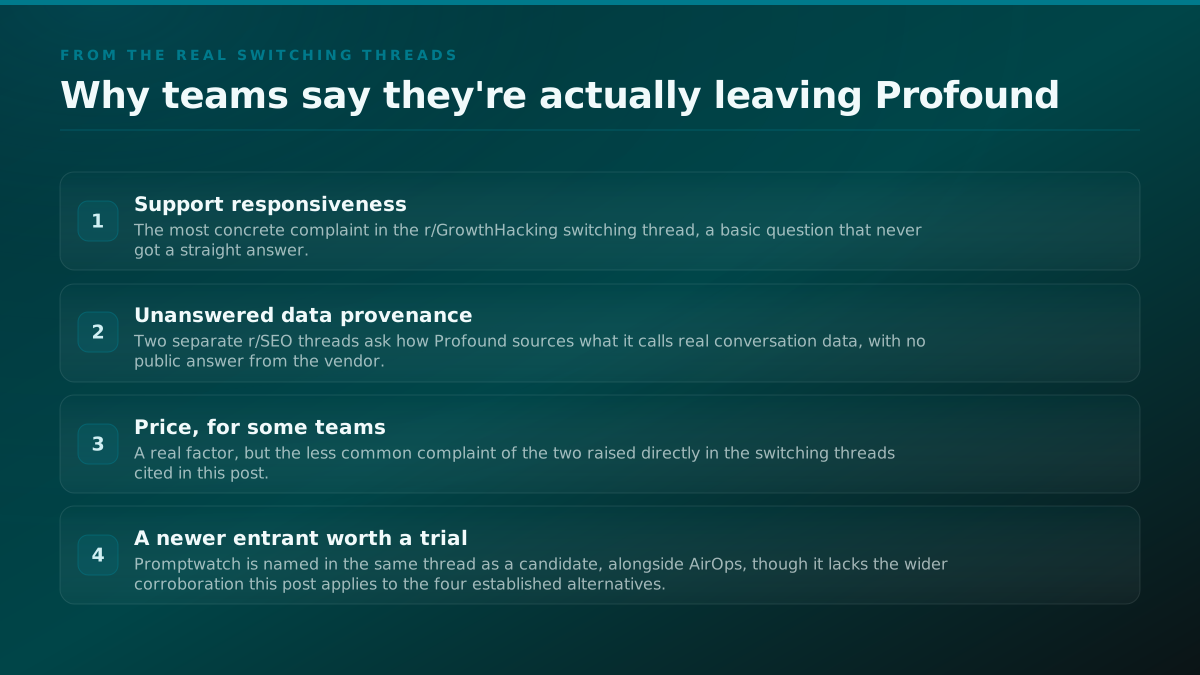
Support responsiveness is the concrete, specific complaint in the thread above, an unanswered basic question with no straight response from Profound's team. The two r/SEO threads cited throughout this post raise a second, structurally different concern: not a service failure but an unanswered technical question, how the platform sources what it counts as a real citation. That distinction matters for anyone shopping for an alternative right now, because a support complaint is fixed by picking a different vendor with better support. A provenance concern is not automatically fixed the same way, since a cheaper alternative that also does not publish its sourcing method has the identical gap at a lower monthly bill.
Nobody who has actually signed will say exactly how the platform sources what it calls real conversation data, and that is the question I actually need answered before I pay for a year.
Reading the two threads together, roughly the same shape shows up twice: a buyer who has not yet signed asking whether anyone who has can vouch for the tool's own methodology, and getting back either silence or a general product description rather than a specific answer. That is the more useful signal for this comparison than the star rating on any review aggregator, because it is a checkable, specific claim rather than a satisfaction score.
Five real alternatives, compared on what they actually do differently
Every alternative named across the switching threads and comparison videos cited in this post does the same core job, repeated-prompt tracking against AI answer engines, and differs mainly in what gets bundled alongside it and what it costs. None of the five was selected for this comparison from a category list or a competitor database; each one was named unprompted, either in the live Reddit switching thread quoted above, in the vendor comparison video naming the same tool set by name, or in the pricing pages this post cites directly, which is a narrower and more useful filter than "every AI-visibility tool that currently exists."
Five Profound alternatives compared
| Tool | Starting price | What it tracks | What's different from Profound |
|---|---|---|---|
| AirOps | Around 200 USD a month (Solo), around 2,000 USD a month (Pro) | Citation and share-of-voice tracking (Insights) bundled with a content-workflow engine (Workflows, Grids, an autonomous drafting agent). | Adds content production on top of tracking; a hard price jump between Solo and Pro with nothing published in between. |
| Peec AI | Around 90 USD a month | Prompt-based tracking, mainly ChatGPT and Perplexity. | Narrower engine coverage than Profound's four-surface tracking, at roughly a fifth of the entry price. |
| AthenaHQ | Around 300 USD a month | Prompt tracking plus a citation-gap report against named competitors. | Keeps the competitor-gap view Profound is known for; narrower engine coverage, lower price. |
| Otterly.AI | 29 USD a month | Brand-mention tracking across six AI surfaces, ChatGPT, AI Overviews, AI Mode, Gemini, Perplexity and Copilot. | The cheapest real switch and the widest surface count of the four; skips the competitor-share view. |
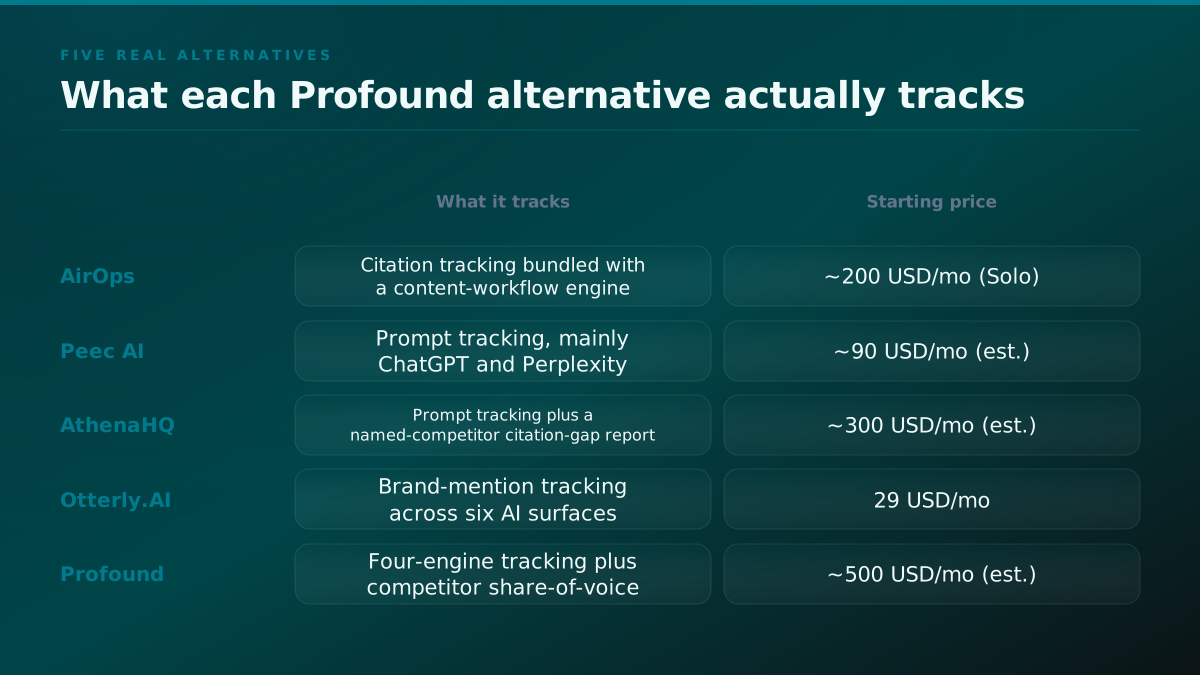
AirOps. The alternative named directly in the r/GrowthHacking switching thread above, and the most structurally different of the five: AirOps is a content-and-workflow platform first, with citation and share-of-voice tracking, its Insights feature, bundled in rather than sold as the whole product. A team switching to AirOps is not making a like-for-like swap; it is trading a pure tracker for a platform that also drafts and refreshes content through a separate workflow engine. Its published pricing runs from a free Insights-only tier to a Solo plan around 200 USD a month, then jumps to a Pro plan around 2,000 USD a month, roughly a tenfold increase with nothing published in between and the upgrade gated behind a sales conversation. A team choosing AirOps specifically to save money against Profound's roughly 500-USD-a-month entry tier should confirm which side of that gap its real prompt volume and seat count land on before treating the Solo price as the number it will actually pay.
Peec AI. The closest thing to a direct, lighter-weight swap for Profound's core tracking job, focused mainly on ChatGPT and Perplexity rather than the fuller four-surface spread Profound covers. Peec AI does not publish a self-serve starting price; a realistic single-brand estimate is around 90 USD a month, roughly a fifth of Profound's entry tier for a narrower slice of engine coverage. A team leaving Profound purely over cost, with no support or provenance complaint of its own, is the clearest fit for this swap.
AthenaHQ. The alternative that keeps the feature Profound is most known for among the five compared here, a citation-gap report showing exactly which named competitors are winning the queries a brand is losing, rather than reporting the brand's own score in isolation. Pricing is not published; a realistic single-brand estimate sits around 300 USD a month, below Profound's entry tier while keeping the competitor-view depth a straight downgrade to a bare tracker would give up.
Otterly.AI. The cheapest real switch among the five, and the only one with a fully published, self-serve starting price, 29 USD a month for brand-mention tracking across six AI surfaces, ChatGPT, AI Overviews, AI Mode, Gemini, Perplexity and Copilot. It skips the competitor-share view, the one feature Profound and AthenaHQ both offer, which is the direct trade a team makes choosing the lowest price point in this comparison.
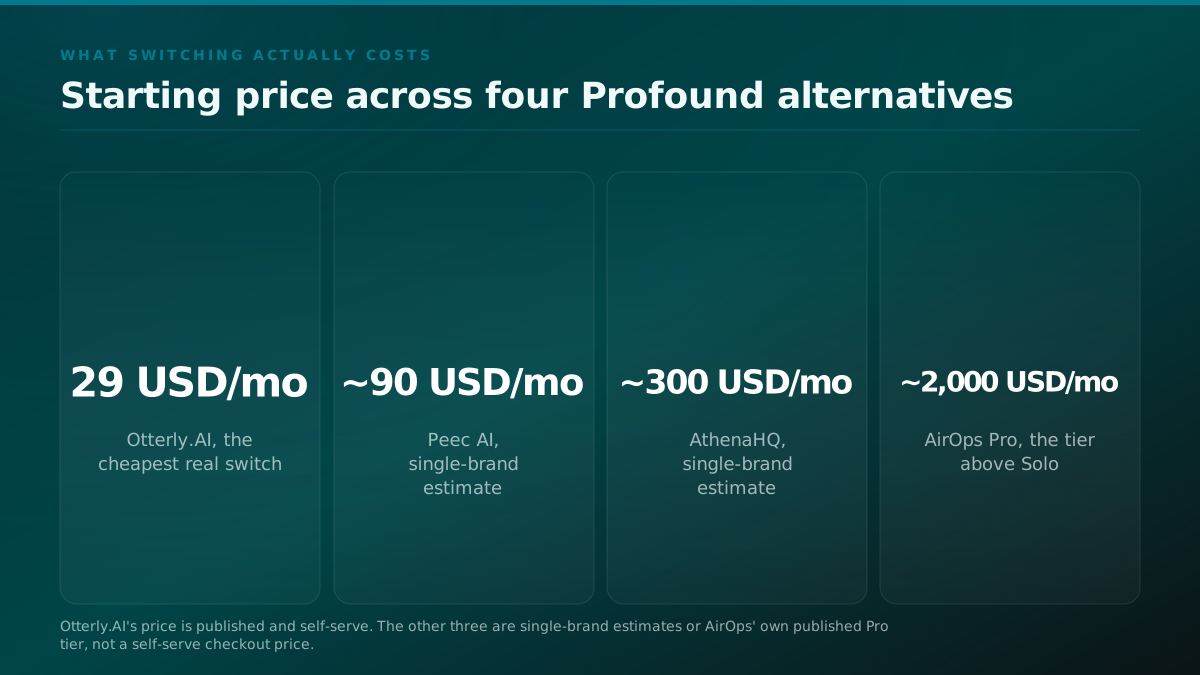
Reading the four side by side, the roughly 70x spread between Otterly.AI's entry price and AirOps' Pro tier is not four tiers of one product. It is closer to two different questions wearing the same "alternative to Profound" label: "I want the same tracking job for less money" and "I want tracking plus a second capability Profound does not bundle in." A team that has not decided which question it is actually asking before comparing prices is likely to either overpay for a workflow engine it will not use or underbuy the competitor view it will need within a quarter.
The newer entrant nobody's compared yet
The r/GrowthHacking thread names one more candidate worth addressing directly, since a comparison that only covers the four established alternatives would be quietly incomplete against its own primary evidence.
Promptwatch comes up in the same switching thread as AirOps, named by the same buyer weighing replacements for Profound. It is new enough to the category that it does not yet appear in the broader comparison videos or LinkedIn discussion cited throughout this post the way AirOps, Peec AI, AthenaHQ, and Otterly.AI do, and it does not publish a self-serve pricing page the way Otterly.AI does. That absence of a wider paper trail is itself the honest finding here: a tool can be a real, live candidate in an actual buyer's evaluation, as Promptwatch clearly is in the thread above, without yet having the breadth of independent corroboration this comparison requires before naming a specific price or feature claim as settled. The buyer in the thread was still deciding between it and AirOps at the time of the post, which is a more accurate description of where Promptwatch sits in this market than either a confident recommendation or a dismissal would be.
The practical takeaway for anyone reading this comparison because they saw the same thread: treat a newer entrant like Promptwatch as worth a trial alongside one of the four established alternatives above, not as a replacement for evaluating them, until it has enough independent switching threads and comparison coverage of its own to corroborate a vendor's own claims the way this post corroborates AirOps' published pricing against Otterly.AI's.
What actually ranks for "profound alternatives" right now?
Almost entirely self-interested comparison pages, each written by one of the tools being compared.
What actually ranks for "profound alternatives" right now
| Result type | Count in top 10 | Independent of vendor self-interest |
|---|---|---|
| AI-visibility or AEO tool's own comparison page | 5 | No |
| Marketing-education or SEO-tool blog | 2 | Partially, no financial stake in this specific category |
| Review aggregator (G2) | 1 | Partially, ranks by submitted reviews rather than editorial judgment |
| Personal blog with an affiliate angle | 1 | No |
| Independent execution-agency comparison | 0 | N/A |
Five of the current top ten results are AI-visibility or AEO tools publishing their own "Profound alternatives" comparison, naturally ranking themselves first in a table they wrote. Two more are SEO-education or marketing-tool blogs folding the search into a broader category roundup, closer to independent coverage than a vendor's own page but still written from a research-and-report posture rather than from having run a switch and watched what a provenance concern actually costs a team downstream. One is a review aggregator, useful for a star rating but structurally unable to answer a specific, checkable question like a data-sourcing method. One is a personal blog carrying an affiliate link to at least one of the tools it recommends, a real conflict of interest even at a smaller scale than a vendor's own page.
Zero of the ten is written by a party whose business is proving whether a switch actually closed the gap a team was switching to fix, rather than selling the next tool in the rotation.
Google's AI Overview fires on this exact query in five of five separate trials, with the thinnest answer box measured across this tenant's recent research into this category, a median of three references shown when it fires. Three references is a narrow answer box by the standard of this category, which means a page earning a citation here is sharing the spotlight with only two other sources rather than roughly nine, the median for the broader "ai visibility tools" search. A structured, extractable comparison built around real switching evidence is a closer fit for that narrower selection window than another vendor's self-ranked table.
The question a cheaper tool does not answer
The provenance concern raised in the two r/SEO threads is not specific to Profound, and it is worth being direct about that rather than letting a comparison post imply that switching brands fixes it.
From the field
The most-upvoted due-diligence question about Profound has no public answer
A separate r/SEO thread, cited above, raises a specific and checkable concern, how Profound sources what its own marketing calls "real conversation" data when it reports a citation. Neither Profound's homepage nor its published documentation states the sourcing method for that claim in a way that answers the thread directly. This matters more than it looks, because a buyer switching tools over this concern and landing on a cheaper alternative that also does not disclose its sourcing method has not actually closed the gap that made them start looking. It has just moved the same unanswered question to a lower monthly bill.
None of the four alternatives compared above publishes a sourcing methodology more transparent than Profound's. AirOps, Peec AI, AthenaHQ, and Otterly.AI each describe what they track, ChatGPT, Perplexity, Gemini, and the rest, and none of the four publishes the specific method by which a mention gets classified as a genuine citation rather than an incidental brand-name appearance in a longer answer. A team that switches from Profound to any of these four over the provenance concern in the Reddit thread above has changed which vendor it is trusting on faith, not whether it is trusting a vendor on faith at all.
A cheaper tracker that cannot answer the provenance question has the same gap as the expensive one. It is just a cheaper version of the same gap.
This is the same structural gap this tenant's own research into the broader AI-visibility category has documented directly: a repeated-prompt score, run once per reporting period by any tool in this category, cannot distinguish real progress from ordinary model-to-model variance without a held-out control, a set of queries deliberately left untouched over the same period so whatever the model did on its own can be subtracted from whatever the tracked queries show. Switching from one single-pass tracker to a cheaper single-pass tracker does not add that control. It just changes the invoice.
The practical version of this shows up in a specific, recognizable sequence across the switching threads cited throughout this post. A team signs with Profound, the score rises over a quarter, the team credits its own AEO work, then the score dips the following quarter with no corresponding change in the team's own activity, and the team starts asking in public forums whether the tool itself is unreliable. Read against the sourcing and repeat-count questions above, a dip like that is at least as likely to be ordinary model variance surfacing through a single-pass measurement as it is to be a real regression in citation performance, and no dashboard in this comparison, including the four newly compared alternatives, distinguishes between the two causes for the reader. Switching to a different single-pass tracker after a dip like this changes which vendor's dashboard displays the same ambiguous number; it does not resolve the ambiguity.
A related pattern worth naming directly: a team that switches tools specifically because a score stopped rising sometimes finds the new tool's score starts higher than the old one's ended, and reads that as confirmation the switch worked. A more careful read is that different tools use different default prompt sets and different citation-detection thresholds, so a like-for-like comparison between two tools' raw scores is rarely apples to apples even when both are tracking the same brand. The honest baseline for judging whether a switch helped is not "did the new tool's number look better than the old tool's number," it is "did the new tool's own number improve over its own baseline, measured against a held-out control run over the same period," which is a different and more demanding bar than most switching decisions in the threads cited above actually apply.
How these four alternatives actually decide what counts as a citation
The mechanics matter more than any of the four alternatives' marketing pages let on, and understanding them is what separates a real fix for the provenance concern from a switch that only feels like one.
A prompt gets sent to a model, the response gets scanned for a brand name or a link, and a hit or a miss gets logged. Do that once per prompt per reporting cycle, which is the default cadence for a self-serve tier on any of the four alternatives compared here, and the resulting number is closer to a single draw from a noisy distribution than a stable measurement. This tenant's own step-zero research, cited above, ran the same twelve queries five times each against one model on one day and found seven of twelve flipped which brand got cited across repeats that were, by construction, identical inputs. A tool reporting one pass per prompt per week is reporting one such draw and presenting it as if it were the center of the distribution rather than a single, possibly unrepresentative sample from it.
None of the four alternatives compared above discloses how many times it repeats a tracked prompt within a reporting cycle on its entry tier, the same disclosure gap the Reddit provenance thread raises about Profound specifically. AirOps' Insights feature and AthenaHQ's citation-gap report both imply a more thorough sampling process than a single pass, given the additional competitor-comparison layer each product builds on top of the base tracking number, but neither publishes the repeat count that would let a buyer verify the claim rather than infer it from the feature list. Peec AI and Otterly.AI, positioned as lighter, cheaper entry points, are the more likely of the four to run a single pass per prompt per cycle given their price point, though this is an inference from pricing structure rather than a disclosed fact, and it is worth asking any of the four directly rather than assuming it either way.
This is also where the developer-tools angle matters specifically, since it is the audience this comparison is built for. A model answering a consumer question about a local business or a review-heavy product category tends to lean on review sites and directory listings, the surface most tools in this category were originally tuned against. A model answering a developer's question about an API or a CLI is more likely pulling from documentation, a GitHub README, a package registry description, or a technical comparison thread another developer wrote, none of which resembles a review-site listing. A tool built and validated against the first kind of surface does not automatically carry the same accuracy to the second, and none of the four alternatives compared here states directly whether its citation-detection method has been validated against documentation-shaped citations specifically rather than the review-and-directory surface the category more broadly targets. That is a fair, specific question to ask any of the four vendors before signing, and it is a more useful question than "is this cheaper than Profound," since price differences of a few hundred dollars a month matter less to most of the teams in the switching threads cited above than whether the tool is actually measuring the surface their buyers use.
What AirOps' own pricing reveals about switching to save money
The Reddit switching thread names AirOps specifically as a candidate, which makes its own published pricing worth reading closely before treating it as the cheaper option it might look like at a glance.
From the field
AirOps' own pricing has a gap nobody in the switching threads mentions
AirOps publishes two tiers with nothing between them, a Solo plan around 200 USD a month and a Pro plan around ten times that, roughly 2,000 USD a month, with the jump gated behind a sales call rather than a self-serve upgrade path. A team switching from Profound specifically to save money can find itself quoted the Pro tier if its prompt volume or seat count crosses the Solo plan's limits, which erases most or all of the savings the switch was meant to produce. This is a real, published structural fact about AirOps' pricing, not a hypothetical, and it belongs in the decision before anyone signs.
A team evaluating AirOps as a cost-motivated switch away from Profound's roughly 500-USD-a-month entry tier is comparing against the Solo plan, around 200 USD a month, a real saving on paper. But AirOps' own published structure has no tier between Solo and Pro, and the Pro tier, around 2,000 USD a month, is quadruple Profound's own published entry price rather than a saving. Whether a given team lands in Solo or gets quoted Pro depends on prompt volume and seat count in a way that is not fully visible from the pricing page alone, which means the honest version of "is AirOps cheaper than Profound" is "it depends which tier your actual usage falls into," not the flat yes a switching thread might imply.
How to test an alternative before committing a year of budget
The evaluation sequence below is built directly around the two failure modes the Reddit threads describe, an unresponsive support team and an unanswered sourcing question, rather than a generic vendor checklist.
STEPS
How to test a Profound alternative before committing a year of budget to it
Ask the sourcing question directly, in writing
Day 1
Ask the vendor exactly how it sources what it reports as a real citation, and ask for the answer in writing rather than on a call. A vendor that answers this specifically and in detail has already cleared the bar the Reddit provenance thread describes; a vendor that redirects to a general product description has not.
Run the free trial against a query where you already know the true answer
Days 2 to 4
Pick a prompt where you already know, from direct experience, whether your brand gets cited today. If the tool's reported number disagrees with what you see running the prompt yourself, that disagreement is the first real signal about the tool's own accuracy, independent of price.
Test the support response you're actually switching over
Days 4 to 5
If support responsiveness is the reason you are evaluating alternatives, as it was for the buyer in the r/GrowthHacking thread above, send a real support question during the trial and time the reply. A trial-period response time is close to the best a vendor will ever perform.
Check where the price actually lands at your real volume
Days 6 to 7
AirOps' own published tiers show why this step matters, a Solo-tier quote can jump to the Pro tier once prompt volume or seat count crosses a threshold that is not obvious from the pricing page alone. Ask directly what triggers a tier change before treating any published starting price as the number you will actually pay.
The order matters more than it looks. Most teams price-shop first and only discover a support or provenance problem after they have already signed a year of budget to a vendor, which is exactly the sequence the r/GrowthHacking buyer above describes going through with Profound. Asking the sourcing question in writing on day one, before running a single trial query, filters out any vendor unwilling to answer it before it costs anything to find out later. A vendor whose sales team redirects the conversation the moment the sourcing question comes up, rather than answering it directly, is telling a buyer something about the product before a single dollar has changed hands, and that signal is worth weighing more heavily than any feature comparison in the pricing deck that follows.
A team with no support or provenance complaint of its own, switching purely to save money, can reasonably compress this sequence into the second and fourth steps alone, run the trial against a known query and confirm the real price at actual usage volume, and skip the support test entirely. The full sequence earns its keep for a team switching specifically because of one of the two complaints in this post's Reddit evidence, where skipping the step that tests for the exact problem being switched away from is how a team ends up repeating it with a different logo on the invoice.
A very small team, one or two people with no dedicated marketing function, can reasonably skip most of this sequence and start with whichever self-serve tracker is cheapest, since the cost of guessing wrong at that scale is a few dollars a month rather than a mis-scoped annual contract. The sequence earns its keep once a team is choosing between two or more paid tiers, or between a tool subscription and an active AEO engagement that costs meaningfully more, which is exactly the decision most of the switching threads cited throughout this post describe buyers making without a structured test first.
Three shapes of "switching away from Profound," ranked
Every real alternative in the switching threads cited throughout this post resolves into one of three shapes, priced from 29 USD a month to a measurement engagement scoped per query set.
01 / Switch to a cheaper tracker
- Stands out
- Immediate savings, same core job, from 29 USD a month at the low end.
- Best for
- A team leaving mainly over price, with no unresolved provenance or support complaint.
- Falls short
- Inherits the same unanswered sourcing question this post's Reddit evidence raises about the category as a whole, just at a lower monthly bill.
02 / Switch to a platform with a different second feature
- Stands out
- AirOps adds content workflows, AthenaHQ keeps a competitor-gap view Profound is known for, at a comparable or lower price.
- Best for
- A team that wants the tracking plus one specific extra capability the current tool is not delivering.
- Falls short
- Still a switch between tools that report a score, not a switch that answers what caused the score to move.
03 / Keep a tracker of some kind, add a measurement partner
- Stands out
- The only option here that closes the provenance gap directly, because a held-out control does not depend on trusting any single vendor's sourcing claim.
- Best for
- A team spending enough, on tooling or on active AEO work, that "is this number real" needs a defensible answer rather than a switch that trades one unanswered question for a cheaper one.
- Falls short
- Costs more than a straight tool swap and takes longer to produce a result, since a real control design has to run before it produces a number worth trusting.
None of the three is the wrong move for every team. A buyer leaving Profound purely over its roughly 500-USD-a-month entry price, with no unresolved provenance or support complaint, is well served by Otterly.AI or Peec AI, and paying for AirOps' workflow engine or AthenaHQ's competitor-gap depth would be money spent on a feature that specific buyer does not need yet. A team that wants the competitor-gap view Profound is known for, without Profound's own price or support experience, is well served by AthenaHQ specifically, the one alternative in this comparison built to keep that exact capability.
The gap only shows up for the team switching because of the provenance concern this post's Reddit evidence describes, or spending enough on tooling or active AEO work that "did this actually improve" needs a defensible answer rather than a new vendor's word for it. Every tool comparison in this post, including AirOps, Peec AI, AthenaHQ, and Otterly.AI alongside Profound itself, was built to report a score. None of the five was built to explain what caused it to move, and no amount of switching between them closes that specific gap on its own.
Moving between the three shapes above is also not a one-way decision. A team that switches from Profound to Otterly.AI purely to cut cost, and later signs an active AEO engagement, does not need to abandon the cheaper tracker; the tracking subscription and a held-out control answer different questions, and both readings are more useful side by side than either is alone. The mistake worth naming directly, because it shows up across all three switching threads cited in this post, is treating a tool switch as though it were the same category of decision as adding a measurement partner, when the first changes which vendor sends the invoice and the second changes whether the number on that invoice's dashboard can be trusted at all.
Budget conversations inside a marketing or growth team also tend to compare the wrong two numbers when a Profound switch comes up. AirOps' Pro tier, around 2,000 USD a month, gets weighed against a multi-thousand-dollar AEO retainer as though the two compete for the same line item, when the tool subscription reports a score and the retainer is supposed to move it, two different jobs that only look interchangeable if nobody has asked either vendor what specifically it delivers. Separating "what does this cost" from "what does this actually produce" before comparing two options across that gap avoids the more common version of this mistake, paying agency prices for tracking-tool functionality that AirOps' own Insights feature already covers at a fraction of the cost, or paying tracking-tool prices and expecting agency-level remediation from a product that was never built to provide it.
The same confusion appears in reverse for a team already running a paid execution engagement that asks whether it still needs a tracking subscription on top of it, one of the four alternatives compared here or Profound itself. Usually yes, and for a reason that has nothing to do with distrust of whoever is doing the execution work: a party running active AEO work has a structural incentive to read its own results generously, and an independently sourced tracking number, even a cheap one like Otterly.AI's 29-USD-a-month entry tier, gives a second, less interested read on the same question. The tracking subscription and the execution engagement are not redundant with each other. They check each other, which is the entire reason a team that has already switched tools once over the provenance concern in this post's Reddit evidence should not expect a second switch to be the last one it needs.
Three independent channels corroborate that this is describing the actual switching decision most practitioners are making, not a narrow slice of it: the Reddit thread where a real buyer names Profound and AirOps directly while actively mid-switch, a vendor comparison video naming the same tool set by name, and a LinkedIn search on the exact phrase saturating its result cap across 29 distinct authors inside 90 days rather than one vendor's own repeated posting. That agreement across three differently biased sources is closer to a real signal than any one of them alone, the same logic a held-out control applies to a citation score, checking a claim against more than one instrument before trusting it.
The buyers in the threads cited throughout this post are not confused about whether Profound, or any of its alternatives, technically works. They are confused about whether a rising or falling number from any of them is measuring something real, and a comparison built only around price and feature checkboxes does not answer that question. A held-out control does, which is the entire reason a switch that only changes the vendor and a switch that actually closes the gap are worth telling apart before anyone signs a new year of budget based on either one.
None of this is an argument against switching. A team leaving Profound over the support experience described in the r/GrowthHacking thread above has a concrete, fixable complaint, and any of the four alternatives compared here is a reasonable candidate to fix it, since the support experience of the vendor a team actually signs with is a real, independently checkable variable, not a category-wide gap the way the provenance and single-pass measurement questions are. The distinction that matters is not whether to switch, it is which problem the switch is actually solving, and being specific about that before signing a new contract is the difference between a switch that fixes the reason someone started looking and a switch that just moves the same open question to a different login.
For the fuller argument on why a single tool's reported score cannot prove causation on its own, see why a single AI-visibility score is noise. For how these five tools stack up against the wider category, including three more names not covered in depth here, see the best AI visibility tools comparison. For the checklist we use when a buyer sends us a pitch from an agency claiming to fix any of this, see our checklist for vetting an AI SEO agency. For the broader service this comparison points toward, see answer engine optimization and measuring answer engine optimization lift. Current pricing for a measurement engagement is scoped per engagement, for the same reason a control design cannot be sized without first seeing the query set it will run against.
Sources
Every number above, and where it came from. A figure without a row here is one we should not have printed.
- r/GrowthHacking, "Had an awful experience with an AEO tracking platform, what's a good alternative?"
- 13 upvotes, 25 comments, 2026-08-19 (topic-radar pull). Names Profound directly as the tool being abandoned over an unresponsive support team, and the poster is actively weighing AirOps and Promptwatch as replacements in the same thread.
- r/SEO, "Has anyone use profound"
- 39 comments, 2026-08-19 (topic-radar pull). A direct due-diligence request from a buyer who has not yet signed.
- r/SEO, "Anyone using Profound and done due diligence?"
- 28 comments, 2026-08-19 (topic-radar pull). Raises a specific, unanswered question about how Profound sources what it calls "real conversation" data, a provenance concern rather than a pricing one.
- @ReachLLM on X, head-to-head tool comparison
- 2026-08-19 (topic-radar pull). Names Profound, Peec AI, Otterly.AI, Semrush, Ahrefs, and AthenaHQ by name in a direct comparison, evidence the category has consolidated around this specific tool set.
- LinkedIn, "profound alternatives" site-restricted search
- Saturates the 30-result cap with 29 distinct authors within a 90-day window (via linkedin_demand.py, firecrawl.dev, never a scrape of linkedin.com itself), 2026-08-19. Real breadth across practitioners, not one vendor repeatedly posting.
- AirOps, published pricing tiers
- A free Insights tier, a Solo plan starting around 200 USD a month, and a Pro plan starting around 2,000 USD a month, with a hard jump between the two and nothing published in between.
- Otterly.AI, self-serve AI-visibility monitoring pricing
- Published pricing starting at 29 USD a month for a self-serve tool that tracks brand mentions and citations across ChatGPT, AI Overviews, AI Mode, Gemini, Perplexity and Copilot.
- Our own research on what an AI-visibility score can and cannot prove
- The held-out control design that separates a tool's reported number from the underlying model changing its own answers, published with the method and the raw numbers on this site.
Questions this answers
- What are the best alternatives to Profound?
- The alternatives named most consistently by real buyers in switching threads and vendor comparisons are AirOps, Peec AI, AthenaHQ, and Otterly.AI. Each does the same core job, repeated-prompt citation tracking, at a different price and with a different second feature layered on top.
- Why do teams actually leave Profound?
- The real switching threads cite support responsiveness and an unanswered question about how Profound sources what it calls real conversation data more often than price. A cheaper alternative that does not answer the same sourcing question has not actually closed the gap that made the team start looking.
- Is AirOps a good Profound alternative?
- AirOps tracks citations through its Insights feature, bundled with a content-workflow engine Profound does not offer. Its published pricing has a hard jump from around 200 USD a month (Solo) to around 2,000 USD a month (Pro), with nothing published in between, which is worth checking against your actual prompt volume before switching to save money.
- What is the cheapest real alternative to Profound?
- Otterly.AI, at 29 USD a month for brand-mention tracking across six AI surfaces, ChatGPT, AI Overviews, AI Mode, Gemini, Perplexity and Copilot. It skips the competitor-share view that Profound, AthenaHQ, and AirOps' Pro tier all include, so the savings trade away one specific feature rather than costing nothing.
- Does switching tools fix the data-provenance concern raised about Profound?
- Not on its own. None of the four alternatives compared here publish a sourcing method for how they classify a citation that is more transparent than Profound's. The concern the Reddit due-diligence thread raises is a category-wide measurement-design gap, not a Profound-specific defect a competitor has already solved.
- Can a tracking tool alternative prove a switch actually improved anything?
- No tool in this category, including the four compared here, ships a held-out control, a set of queries deliberately left untouched over the same period so a real change can be separated from ordinary model variance. Without that comparison, a rising number after switching tools could reflect the new tool's different counting method as easily as a real improvement.
- Should I switch tools or add a measurement partner instead?
- If the reason for leaving is price alone, a cheaper tracker like Otterly.AI or Peec AI is a reasonable direct swap. If the reason is the provenance or support complaints in this post's Reddit evidence, switching tools alone trades one unanswered question for a cheaper one; a control alongside whichever tracker you keep is the more direct fix.
Keep reading
Measurement
Best AI Visibility Tools (and Where a Tool Alone Runs Out)
Seven AI-visibility tools compared on what they actually measure and what they cost, plus the one question none of them can answer on their own.
24 min read
Measurement
AirOps Alternatives: Content-AEO vs Pure Measurement
Nine real AirOps alternatives, split into content production and pure measurement, plus the buyer split most vendor comparison pages miss entirely.
25 min read
Measurement
Prompt Tracking, How Many Prompts and How Many Repeats Before a Change Is Real
Every page ranking for prompt tracking says how to pick prompts. None says how many, or how many repeats, before a weekly change stops being noise.
44 min read